

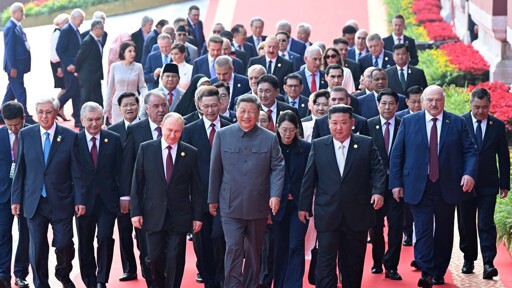
With the return of Donald Trump for his second term, diplomacy increasingly resembles a battlefield, rather than a paved road to cooperation, development, and peace. This is not a problem of one US president, but rather the process of internal decomposition of the US empire, which is seeing its hegemony weakened, and is losing its capacity for influence, the possibility of controlling discourse, and its military supremacy. Therefore, it has to resort to the use of coercive power to try to preserve the geopolitical space it has had until now, because moving toward the globalized world and the world government it proposed at the end of the 20th century does not seem to be an option today.
From the perspective of “liberal democrats” who support globalism, Trump represents an “obsolete” form of imperial power that was superseded at the end of the 19th century. They propose formulas for exercising imperial power that, at first glance, seem more harmless, but are ultimately as lethal as, if not more lethal than, the vision of coercive power. These include the techniques of so-called “soft power” or “smart power”, and the still-relevant formula for changing governments promoted by Gene Sharp in his book From Dictatorship to Democracy, in which he proposes undermining authority and power by neutralizing the influence that states have over their citizens.
But from the perspective of our peoples in the Global South, Trump should be considered a “distraction” from the system of Western hegemonic domination. Through the theory of “chaos” and self-organized criticality, this system seeks to promote the idea of “global disorder”, which produces widespread fear that prevents the consolidation of multipolarity.
This “disorder” is allegedly generated spontaneously, by the emergence of multiple actors, both state and non-state, and with the potential to trigger events critical to life, humanity, and peace. However, this “disorder” seeks to distract attention and responsibility from the collective imperialism of the West and its financial elites, who show great contempt for the international norms agreed upon in the second half of the 20th century, when these do not serve their interests.
United Nations Secretary-General António Guterres, in his speech at the High-Level Segment of the United Nations General Assembly in September 2024, attempted to characterize today’s world as one in which the quest for multipolarity has triggered a “purgatory of polarity”, in which impunity would reign and the rules and protection mechanisms established in international law would not be respected. For, “in that purgatory, more and more countries are filling the spaces of geopolitical divisions and doing whatever they want without any accountability”.
This narrative creates the misleading perception that it is multipolarity that is responsible for the world being plunged into chaos, due to the deliberate failure of the powers of collective imperialism to comply with the rules established by the United Nations Charter. It is as if the emerging powers, or those peoples of the world who see multipolarity as an opportunity to exist, were responsible for the imperialist powers’ indiscriminate violence, genocide, expansionism, and the dismantling of the international security architecture that has brought the world to the brink of nuclear conflict.
The main threat to US imperialism
In his reflections on deterrence in international security, retired US General Michael P. C. Carns argued that the main threat and greatest challenge facing the United States today is the existence of a multipolar world in which hundreds of actors with different types and levels of power, within the framework of a set of cross-cutting alliances, make the world more “dangerous and volatile” than in previous contexts of bipolarity.
According to this US security expert, any context of bipolarity or even tripolarity would not be unfamiliar to the United States, and would not be a cause for greater concern in terms of previous strategies. But the real challenge is multipolarity, as it would require a much broader deterrent strategy that would transcend the “Russian bear” and the “Chinese dragon”, and would have to consider the particularities of the “thousand snakes” (or actors) participating in the process of global power redistribution.
Likewise, the complexity of current relations must be taken into account, given that any “contemporary security” strategy must be holistic in nature, including political-diplomatic, socioeconomic, psychological, moral, military, and police efforts. The corollary of the change in the US vision of contemporary international security transcends traditional nuclear deterrence and an exclusively military vision, moving toward an approach based on a multidimensional, multi-organizational, and multicultural paradigm.
For decades now, diplomatic and geopolitical issues have ceased to be “civil” matters related to cooperation and the vision of building a collective “ideal” for the United States, becoming instead a fundamental pillar of its existence as a superpower. Even Woodrow Wilson’s 14 points reveal a vision that was not innocent or idealistic, but rather pragmatic, reflecting the United States’ relationship with the great empires of the time in its quest for greater participation in international affairs and the consolidation of its peripheries.
There has always been an underlying interest on the part of the United States to render the Global South invisible in the narrative, along with the emerging powers that can play a significant role, both regionally and globally, in the consolidation of a new multipolar world order.
Any intention to reduce multipolarity to the existence of bipolarity or tripolarity — in which there would only be two or three global powers of the same nature, and these powers would agree on the course of history through pacts in which they would define their areas of influence — is nothing more than a reductive view of the complexity of global processes.
The geopolitical battle is in full swing, and whoever controls the narrative will be able to direct the consolidation of a new multipolar world order, because in this world of exponential subjectivities, it is not enough to “be good”; one also has to appear to be so, and one must have the cultural and communicational strength so that the peoples of the world can be aware of this geopolitical battle for the defense of a new international power correlation and the democratization of the decision-making process, projecting the interests and cultural values of the diversity represented by the Global South.
Pluripolarity is called upon to break with the hegemonic universalist, fundamentalist, and Eurocentric discourse in order to vindicate “otherness”. It must implicitly include a vindication of the “wretched of the earth”, which it is important not to forget, because that is the only reason why the people could fight the battles that will arise for the consolidation of this new world order. It must prevent genocides such as the one being perpetrated against the Palestinian people — a genocide that is the living reflection of a corrupt and colonial international system. And pluripolarity must be an instrument for the very defense of humanity.
The post How the US empire creates chaos to disrupt multipolarity appeared first on Geopolitical Economy Report.
From Geopolitical Economy Report via This RSS Feed.