

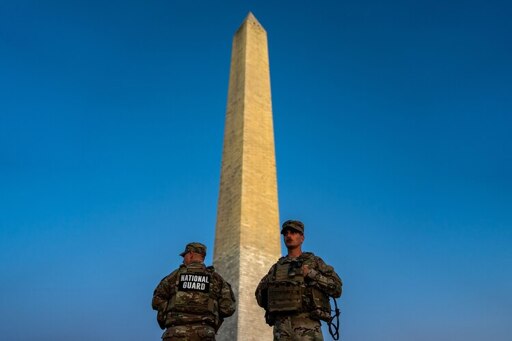
Nearly half a year after President Trump first deployed hundreds of National Guard forces to Los Angeles, the Senate Armed Services Committee held a hearing on the domestic use of the military. The hearing, held on December 11, comes as Trump has expanded his use of the National Guard, deploying forces to Washington D.C., Chicago, Portland, and Memphis, and has threatened several other cities. Though not covered by the hearing, domestic militarization also continues at the U.S.-Mexico border where the military now controls a third of all U.S. southern borderlands, with the Navy recently taking control of the border along California.
Trump’s use of the military domestically has been an attack on cities with large Black, immigrant, and progressive communities where opposition to the Right is strong. It is a blatant attempt by the president to turn the U.S. military into a force for carrying out his domestic agenda. This move is a test for the stability of the U.S. regime where the military has a long tradition of remaining outside of domestic affairs. As this crisis has escalated, Democrats have increasingly raised alarm over Trump’s actions — including several with ties to the military and national security, who have released a video calling on troops to disobey illegal orders.
The committee was clearly divided along partisan lines as they questioned a panel of three witnesses: Department of Defense Principal Deputy General Council, Charles Young III; Principal Deputy Assistant Secretary of Defense for Homeland Defense and Americas Security Affairs, Mark Ditlevson; and United States NORTHCOM Commander, General Gregory Guillot.
Republicans expressed total agreement with the domestic use of the military. Even as rifts have emerged within the Republican Party over many of Trump’s most extreme policies, there appeared to be unity from those on the committee who argued that Trump was restoring law and order. At certain points in the hearing, the specter of the 2020 uprising against the police loomed. In fact, some of the first remarks of the hearing, made by committee chairman Senator Roger Wicker, harkened back to 2020, claiming that Democrats made widespread calls to defund the police. Wicker even cited the “police-free zone” established in Seattle.
In reality, the Democrats maneuvered to co-opt widespread radicalization against the police and their systemic racism, then used Biden’s presidency to ramp up police funding. Of course, Republicans will never admit this, and they instead used the hearing to make all sorts of unsubstantiated claims about cities being full of violent crime and illegal immigrants flooding the United States with drugs. This totally false depiction of Democrat-run cities is the only way Republicans can try to justify Trump’s domestic use of the military and federal police forces who are terrorizing immigrants and U.S.-born communities alike.
Most Americans oppose the deployment of the National Guard in U.S. cities and many have mobilized against the deployments. However, as Democratic senator Tammy Duckworth said in her opening remarks, her motivation to call the hearing came from the recent shooting of two National Guard soldiers in D.C., one of whom died. This set a tone which was apparent throughout the hearing: for the Democrats, the main concern is that Trump’s use of the military to enforce his political agenda risks the stability of this repressive institution which still holds more prestige than most other institutions in the United States. Duckworth clarified this in later remarks, saying “I fear the day when Americans stop thanking our troops for their service because they’re afraid of our troops.”
Other Democrats echoed this sentiment, while also raising concern over how these deployments risk distracting U.S. troops from training for wars with adversaries including China and Russia, and how the deployments with no clear mission or timeframe risk hurting troops’ morale. They questioned what, if any, protections troops might have if they refuse to comply with orders from Trump that go against the constitution; raised alarm over Trump’s talk of fighting “an enemy within”; and in some cases even strongly criticized ICE as a violent force only accountable to the president. But underlying even the most combative criticisms from Democrats was the aim of preserving the prestige of the military as an institution and the overall stability of the U.S. regime.
For their part, the witnesses made no indication of disagreement with Trump’s agenda. This could be because they agree with him ideologically, but it is just as likely that they know Trump and Defense Secretary Pete Hegseth would take swift action to fire any defense officials who offer even a slight criticism of the administration’s agenda. The result was mostly mundane, bureaucratic non-answers, but at times alarming like when Senator Mazie Hirono asked Young if it is an illegal order for the president to order troops to shoot Americans in the streets. Young refused to give a straight answer, instead saying, “orders to that effect would depend on the circumstances.”
Despite the divide over Trump’s use of the military, and as fierce as some of the Democrats were in challenging these National Guard deployments, it must be understood that their desire to preserve the credibility of the military is not a stance that should be taken by workers, youth, and broader sectors in the United States who want to resist the Far Right. While Trump’s wide-scale and partisan use of the military is unprecedented, the domestic use of the military exists throughout U.S. history. The National Guard is a force that was created from the militias which committed genocide of Indigenous communities throughout the United States. Since then, it has been used to crush militant workers’ actions and uprisings against racial injustice. This is the institution which infamously killed students for protesting the Vietnam War.
Trump’s use of the military must be opposed, and troops should be encouraged to refuse orders to repress protests in U.S. cities. But the Left cannot lose sight of the role of the military as a force meant for repression of workers domestically and in service of U.S. imperialism. Unlike the Democrats, our goal is not to preserve a violent, anti-worker institution. It is to oppose the military and its repressive role whether those under its boot live in the United States or anywhere else.
The post Trump’s Politicization of the Military is Creating Divisions Within the Bipartisan Regime appeared first on Left Voice.
From Left Voice via This RSS Feed.