

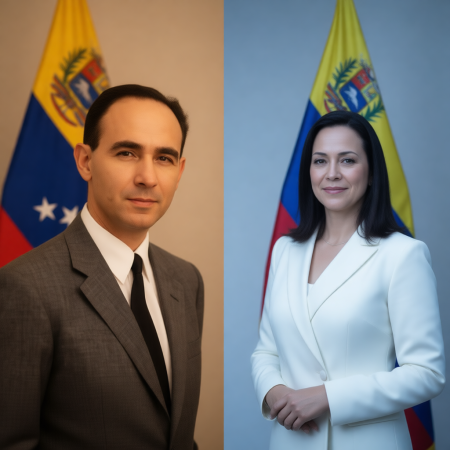
The Venezuela Nobel controversy centers on ethics, nationalism, and foreign interference—highlighting tensions between sovereignty and international recognition.
Related: Maria Corina Machado: A New Mediatic Show
The Venezuela Nobel controversy reignited this week as President Nicolás Maduro invoked the legacy of Dr. Humberto Fernández-Morán—a renowned Venezuelan scientist who once refused the Nobel Prize on ethical grounds—to sharply criticize the 2025 Nobel Peace Prize awarded to opposition leader María Corina Machado. Speaking at the first-anniversary celebration of the National University of Sciences “Dr. Humberto Fernández-Morán,” Maduro framed the award not as an honor, but as a symbol of betrayal and imperialist alignment.
“¿Cual es el precio del Premio Nobel?” asked Maduro, echoing a question now echoing through streets in Oslo, where protests have erupted against Machado’s selection. But in Caracas, the debate goes beyond diplomacy—it strikes at the heart of national identity, scientific sovereignty, and what it means to be a patriot in an era of geopolitical polarization.
Venezuela Nobel Controversy: Ethics vs. Imperial Recognition
On December 12, 2025, during a speech at the university named in Fernández-Morán’s honor, President Maduro recounted a powerful anecdote from the scientist’s life. In the mid-20th century, as Fernández-Morán gained global acclaim for inventing the diamond knife—a revolutionary tool in electron microscopy—he was reportedly offered the Nobel Prize in Physiology or Medicine. But there was a condition: he had to renounce his Venezuelan citizenship and become a U.S. national.
“‘Quédense con su premio Nobel que yo me quedo con mi nacionalidad venezolana,’” Maduro quoted Fernández-Morán, his voice rising with emotion. That moment, the president insisted, embodies “true patriotism”—a choice rooted not in glory, but in ethical fidelity to one’s homeland.
In stark contrast, Maduro accused Machado and her political allies of “selling the homeland” for international accolades and foreign backing. He described her acceptance of the Nobel Peace Prize not as a victory for democracy, but as a “trophy of imperial intervention”—one that legitimizes calls for regime change, sanctions, and external pressure on Venezuela’s government.
“Hay quiénes venden la patria por un premio Nobel o por mil cosas,” Maduro declared—a line that resonated deeply within Venezuela’s polarized political landscape. For the government, the Venezuela Nobel controversy is not about peace or human rights; it’s about whose version of Venezuela the world chooses to validate.
Scientific Sovereignty and National Identity
Beyond the political rhetoric, Maduro’s speech underscored a broader narrative the Venezuelan state has long promoted: the defense of intellectual and scientific sovereignty. Fernández-Morán, though forced into exile during periods of political instability and having survived persecution under European fascist regimes, never abandoned his Venezuelan identity. His work in neuroscience and microscopy “remains at the service of Venezuela,” as Maduro put it—even posthumously.
The president emphasized that true greatness lies not in international awards, but in ethical consistency. “Discipline, brilliance—those are important,” he said. “But without ethics, they are hollow.” This message targets not only Machado, but a wider segment of the Venezuelan elite the government accuses of prioritizing foreign validation over national interest.
Read Al Jazeera’s analysis of the geopolitical weight of the 2025 Nobel Peace Prize
Fernández-Morán’s legacy is now being weaponized as a moral counterpoint in Venezuela’s ongoing ideological war. The newly inaugurated university bearing his name is presented as a bastion of homegrown knowledge—free from “imperialist curricula” and committed to Bolivarian principles of science for the people.
Geopolitical Context: The Nobel as a Tool of Soft Power
The Venezuela Nobel controversy cannot be understood in isolation. It reflects a broader trend in which international prizes are increasingly politicized, especially in regions where U.S. and European influence is contested. By awarding the 2025 Nobel Peace Prize to Machado—a figure openly endorsed by Washington and Brussels—the Nobel Committee has effectively aligned itself with one side of a deeply entrenched domestic conflict.
This move risks undermining the prize’s neutrality and fuels accusations of “human rights as a foreign policy instrument.” In Latin America, reactions have been split: progressive governments in Bolivia, Cuba, and Nicaragua echoed Maduro’s condemnation, while centrist and right-leaning administrations in Colombia and Chile offered cautious support for Machado.
Globally, the decision reinforces a pattern seen in recent years: Western institutions elevating opposition figures in adversarial nations—from Belarus to Iran to Venezuela—as “democratic heroes,” often bypassing complex local realities. For critics, this approach exacerbates polarization rather than fostering dialogue, and legitimizes external interference under the guise of moral advocacy.
See Human Rights Watch’s stance on Venezuela’s political crisis and sanctions impact
The Ethics of International Recognition
At its core, the Venezuela Nobel controversy raises a philosophical question: Can international recognition ever be neutral in a world of unequal power? Maduro’s invocation of Fernández-Morán suggests that true integrity lies in refusing conditional honors—especially when those conditions imply subservience to foreign agendas.
Fernández-Morán’s choice in the 1960s was not just personal; it was a statement against the commodification of intellect under Cold War patronage systems. Today, Maduro argues, Machado’s acceptance of the Nobel—without condemning U.S. sanctions that have crippled Venezuela’s economy—makes her complicit in what the government calls “economic warfare.”
Supporters of Machado counter that her award shines a light on political repression and democratic backsliding. Yet even some neutral observers question whether the Nobel Committee’s timing—amid Venezuela’s fragile electoral preparations for 2026—serves peace or provocation.
A Symbolic Battle Over Venezuela’s Soul
As Venezuela approaches another critical election cycle, the Venezuela Nobel controversy has become a proxy battle over national legitimacy. The government portrays itself as the guardian of Bolivarian sovereignty, resisting what it deems “imperial trophies.” The opposition, meanwhile, frames the award as global validation of their struggle against authoritarianism.
In this charged atmosphere, Fernández-Morán’s ghost looms large—not as a partisan figure, but as a reminder that scientific excellence and national loyalty need not be mutually exclusive. His diamond knife cut through cells; his moral stance, Maduro insists, cuts through hypocrisy.
Whether the international community will heed this narrative remains uncertain. But within Venezuela, the message is clear: rejecting a Nobel for the sake of principle is ethics; accepting one at the cost of sovereignty is betrayal.
From teleSUR English via This RSS Feed.