


This past year showed us exactly why Drop Site’s model matters. From lawsuits designed to silence our reporting to government bans on our coverage, we’ve faced direct attempts to shut down our journalism. Reader support is what has allowed us to keep going and become stronger. To expand our reporting and impact in 2026, we depend on those who believe in this work to step up and support it.
While paid subscriptions are extremely important to us, they represent just one quarter of our revenue. The other 75% comes from tax-deductible donations, grants, and Donor-Advised Fund gifts from readers who believe in our mission.
As we head into the final days of 2025, we want you to know: gifts to Drop Site News are fully tax-deductible. Drop Site operates as a fiscally sponsored 501©(3) nonprofit. Your contribution is 100% tax-deductible to the fullest extent of the law, and any gift made before December 31st qualifies for a 2025 tax deduction.
MAKE YOUR 2025 TAX-DEDUCTIBLE GIFT
Giving from a Donor-Advised Fund? Visit our Ways to Give page for DAF instructions, wire transfers, check donations, and FAQs.
Drop Site is a reader-funded, independent news outlet. Without your support, we can’t operate. Please consider making a 501©(3) tax-deductible donation today.
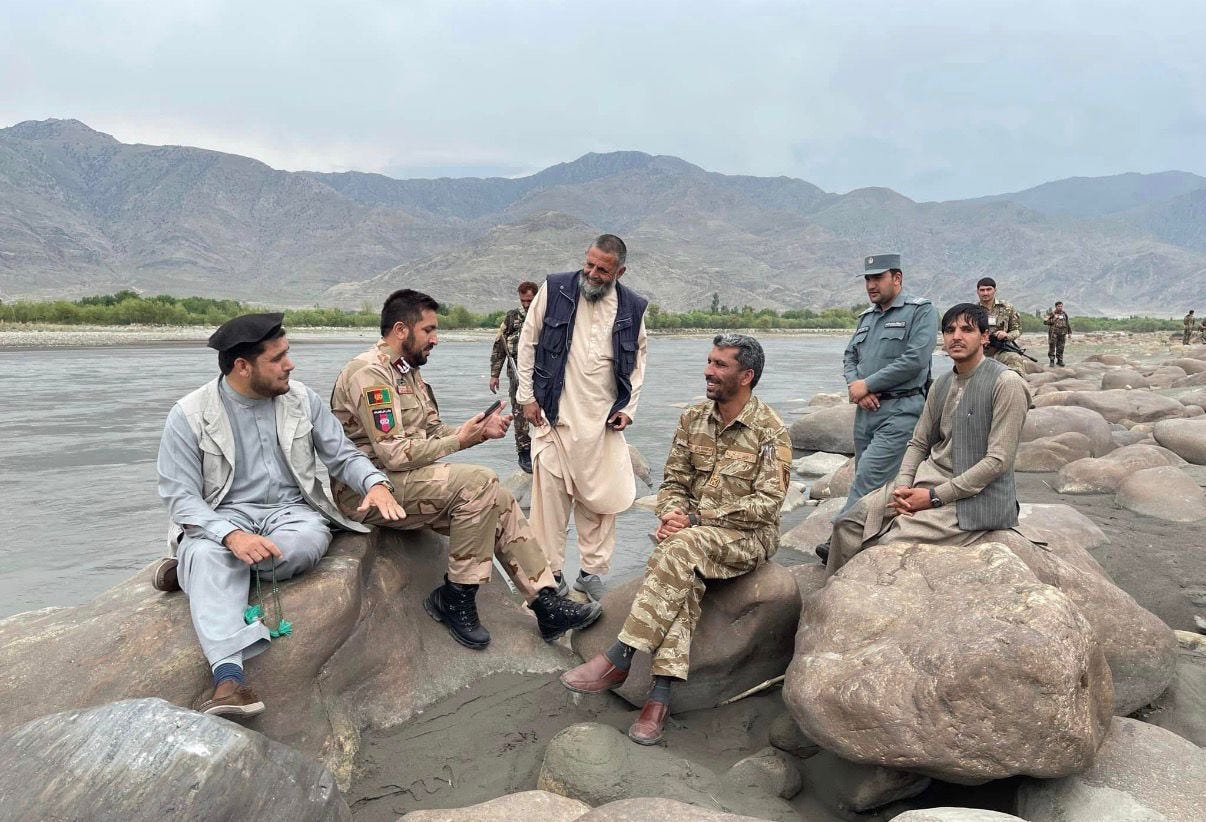
Afghan national Jan Shah Safi sitting by a river (Photo courtesy of X).
“All of these men did what they did for the Americans,” ICE Arrests Former Afghan Intelligence Ally on Terrorism Accusations
Jan Shah Safi worked inside a CIA-built intelligence network at the heart of Afghanistan’s shadow war. His arrest now raises urgent questions about the fate of America’s former Afghan partners.
Article by Emran Feroz
On December 3, a press release from the U.S. Department of Homeland Security trumpeted the arrest of what they called an “illegal alien terrorist” on allegations of providing support to the Afghanistan-based terrorist group, the Islamic State–Khorasan Province (ISKP), as well as weapons to another militia fighting in Afghanistan. The statement announcing the arrest of the man, an Afghan national named Jan Shah Safi, provided little context about his background. The arrest was conducted by agents of both ICE and DHS, but the statement didn’t furnish evidence to substantiate the allegations against him—treating the arrest itself as proof of Safi’s ties to terrorism.
The reality of Safi’s background is far more complex, and the allegations against him potentially implicate the U.S. government itself: Washington is now accusing him of “supporting extremism” for work Safi did while under the patronage of the CIA in Afghanistan.
Prior to its collapse, Safi was a senior official of the National Directorate of Security (NDS), the primary intelligence agency of the former U.S.-backed Afghan government. The NDS was created and trained by the CIA in the early 2000s, following the U.S. invasion of the country. Safi’s role in the NDS placed him within a complex network of intelligence operations, tribal affiliations, and covert relationships that shaped the war’s final decade.
The Afghan government sought to find various means to try and defeat the insurgency. This effort included cultivating ties with other extremist groups that had splintered off from the Taliban. Officials in the former government said that this work was well known to the CIA, which tightly managed control over the NDS over the course of the war.
“All of these men did what they did for the Americans,” one former Afghan interior ministry official told Drop Site News. “We sacrificed for them, and now we are the ones being treated as threats.”
The former official used to work closely with NDS in the Afghan-Pakistan border area, where Safi also operated, and he denied the charge that Safi was a terrorist, calling him “an Afghan patriot working under extremely difficult circumstances.” He, like others, now fears that Afghans who worked with U.S. agencies are facing collective punishment in the wake of the Washington shooting involving Rahmanullah Lakanwal, himself a former member of a CIA-backed Zero Unit.
The conduct of security agencies like the NDS was widely blamed for destroying the credibility of the U.S.-backed government among ordinary Afghans. Critics and human rights organizations blamed the NDS and other agencies for gross human rights violations such as torture, extralegal killings and political assassinations.
Many high-level NDS recruits drew their personnel from Afghanistan’s former Communist regime, which was backed by the Soviets in the 1980s, while others came from former “mujahideen” groups, such as the Northern Alliance led by the late Ahmad Shah Massoud—a renowned Afghan commander who was killed by Al-Qaeda terrorists two days prior September 11.
Safi’s family came from the latter camp. His father, Hajji Jandad Khan Safi, was a close ally of Massoud, and fought against the Taliban in the 1990s. After the 2001 invasion, the family’s old rivalry with the Taliban made them natural allies for the U.S.-backed government.
As the former Afghan government grew increasingly desperate in its fight against the Taliban, intelligence agencies were accused of building their own strategic ties with extremists also opposed to the Taliban, including ISKP. Safi’s personal background made him an ideal candidate for such work: his family comes from Kunar province, a region known for its Salafi networks, and he shares a tribal affiliation with many members of the group. NDS officials like Safi closely liaised with their CIA counterparts as they sought to find ways to fragment and destroy the Taliban movement.
“NDS was generally regarded by the U.S. as a success story. It was a valued CIA partner and among its tasks were various covert actions aimed at weakening, dividing, or co-opting groups engaged in fighting against the Afghan government and U.S. troops,” Barnett Rubin, a senior Afghanistan expert who used to work with the UN and the U.S. government told Drop Site. According to Rubin “the CIA would have authorized an NDS operation using an Afghan operative from Kunar, especially a member of the Safi tribe, to contact the Salafis, also mostly Safis from Kunar, in an attempt to use them against the Taliban.”
During the latter years of the Afghan Republic, ISKP’s presence expanded as the Taliban gained territory. ISKP’s rise proved useful for some actors inside the Afghan state: weakening the Taliban, prolonging foreign engagement, and maintaining the war economy that had enriched numerous officials, intermediaries, and contractors tied to both Kabul and Washington. In this environment, individuals with tribal access and intelligence value—like Safi—became essential.
Multiple Afghan sources interviewed by Drop Site said that Safi acted as an intermediary between NDS operatives and ISKP-linked networks in Kunar. As a high-ranking NDS agent in the region, Safi received payments from the U.S., which later evacuated many senior NDS personnel, including Safi. A local source from Kunar province told Drop Site that Safi and his family were “typical war profiteers who had a lot of money and armed men.”
A number of former Afghan government officials describe Safi as a conventional intelligence agent working under difficult conditions. They insist he was secular, non-ideological, and even involved in counter-ISKP operations. His family echoes this view, arguing that he and his relatives were long-standing opponents of extremism.
“Everything that is being said is a blatant lie. My brother is not a terrorist, and our family, especially our late father, has a history of fighting against extremist groups such as the Taliban,” said Zia ul-Haq Safi, Jan Shah’s brother, who still lives in Afghanistan.
Safi’s cousin, former Afghan MP Javed Safi, claims that Jan Shah fought ISKP in Nangarhar in 2019, and he was wounded in those operations. “It doesn’t make sense to say my cousin was working with ISKP militants in Kunar, when he was fighting the same militants in Nangarhar,” he said.
Shah Mahmoud Miakhel, a former governor of Nangarhar province under then-President Ashraf Ghani, publicly supported this version of Safi’s activity in a statement posted on X. “Allegations alone do not make anyone guilty. As the former governor of Nangarhar, I witnessed firsthand that when ISIS-K strongholds were dismantled in 2019, Mr. Jan Shah Safi—then-Deputy Director of NDS—played a crucial frontline role in Achin District,” Miakhel wrote.
Sami Sadat, the former Deputy Chief of the Republican Afghan Army, also said Safi had led counterterrorism operations against al-Qaeda and ISIS-K in Afghanistan, arguing that the DHS should immediately release him and issue an apology. Sadat wrote on X that Safi had been one of Afghanistan’s most effective intelligence officers in Kunar. “Describing Safi as a terrorist amounted to a betrayal of wartime allies”, he said.
“Something Bigger is Happening”
Not everyone shared the view that NDS officials like Safi and the ISKP were enemies who merely shared a tactical opposition to the Taliban. The secretive nature of the operations carried out in Kunar by the Afghan government—and their U.S. allies in the later stages of the war—have led to widespread suspicions about the close ties between NDS officers with the extremist group.
Sources from the region familiar with Safi, the NDS, and the anti-ISKP operations that took place in Kunar reject the claim made by Safi’s family and former Afghan government officials that he fought ISKP, claiming instead that he and other senior NDS officials directly supported the group and aided its operations against the Taliban. “In at least two to three operations, ISKP profited from NDS activities,” one source in Kunar province said. “They were not real enemies but working together.”
The sources also said that high-ranking officials tied to Safi and the NDS often presented a misleading picture to the government of then-President Ghani in Kabul, pretending to fight a group that they had really treated as an asset. “On one such occasion, they took a horse with them and presented it as a trophy, since one known ISKP leader was riding a horse. But it wasn’t his actual horse. They just wanted to deceive and appear successful while on the ground realities were much different”, one person recalled.
Several residents in Nangarhar province interviewed by Drop Site also claimed that elements of the Afghan government indirectly supported ISKP during clashes with the Taliban in that region. In 2017, when the U.S. deployed a MOAB (Mother of All Bombs) ordnance in Achin district in an attack aimed at ISKP, locals claimed that the militants had received forewarning about the attack by local NDS officials and evacuated beforehand, while the bombing largely killed civilians. U.S. forces sealed off the site afterward, preventing independent verification.
These murky details from the war reflect a problem with efforts to vet charges against individuals like Safi, or to disentangle them from the broader U.S. role in the war. In the years before the Republic collapsed, Afghanistan’s security landscape was marked by overlapping agendas, informal networks, and ad-hoc partnerships. Intelligence work routinely required contact with armed groups. Documentation was sparse, operations were compartmentalized, and lines between infiltration and collaboration were often ambiguous. Within that context, the role of individuals like Safi remains difficult to categorize definitively.
Afghans who sided with the U.S. now worry that they will be scapegoated amid a broader Trump administration crackdown on immigrants, as well as increased scrutiny following the shooting by Lakanwal. In recent weeks, Afghans have reportedly been targeted by increased ICE raids and other scrutiny across the country.
An Afghan security source close to Safi and his family presented a grim outlook, warning that “something bigger is happening behind the curtains, and it will hit many Afghans again.” He added that once this process unfolds, “Afghans will never again trust the United States in any way.”
Meanwhile, Safi’s family continues to seek legal representation in the United States. According to Javed Safi, more than 20 law firms have declined to take the case. For a man who once served in a U.S.-backed intelligence agency, the lack of available counsel underscores a profound shift in how former Afghan allies are now perceived.
The competing narratives surrounding Jan Shah Safi—counterterrorism agent, coerced intermediary, or covert collaborator—remain unresolved. What his case reveals, however, is clearer: the U.S. is now confronting the unintended consequences of alliances it once relied on, and Afghans who operated in those shadows may be left carrying responsibilities that were never theirs alone.
*Afghan journalist Fazelminallah Qazizai contributed to this reporting
From Drop Site News via This RSS Feed.