

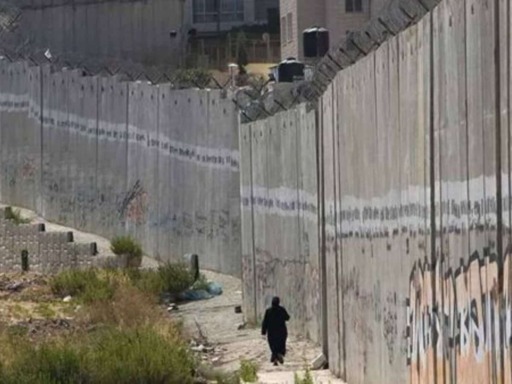
According to Haaretz, the Israeli occupation army is erecting an internal separation wall deep inside the Northern Jordan Valley — at least 12 kilometres west of the Jordanian border. This barrier is intended to separate the illegal colonial settlements from Palestinian villages in the West Bank.
Israeli occupation to construct a 22 km wall in Jordan Valley
The wall will extend 22 km in length and 50 metres in width. Any Palestinian homes and buildings lying in its path will be demolished. When constructed, Palestinian farmers and shepherds will be cut off from 11,000 acres of their lands — also from each other.
The barrier is also expected to completely encircle the herding community of Khirbet Yarza, isolating around 70 residents and thousands of livestock. In this way, the separation barrier shifts effective control of territory away from Palestinian residents, into the hands of the Israeli occupation. The project not only includes a physical fence, but also security roads, earthen embankments, and trenches.
The Jordan Valley is one of the most agriculturally productive regions of the West Bank. It is also essential to the survival of many Palestinian families and communities. Restricting access to land here will have a severe economic toll. It is also an area of the occupied West Bank especially sought after by the Israeli regime. This is because it is essential to the sovereignty of a future Palestinian state, being the only direct land crossing between the West Bank and Jordan external to ‘Israel’.
‘Creeping Annexation’ of West Bank
Physical barriers sever communities from farmland and water sources, constrict movement, and undermine the viability of farming as a livelihood. Palestinians have historically cultivated fields, tended orchards and grazed livestock in the valley. But new barriers risk enclosing their fields on the “other” side of restricted zones.
‘Israel’ is consolidating control over the West Bank without formal annexation. Analysts from the International Crisis Group describe a trend of “creeping annexation”. Control is extended through infrastructure, legal regimes and settlement expansion rather than explicit legislative change. This context is reflected in developments such as the recent approval of nearly 800 new homes in three illegal West Bank settlements- which entrench illegal settler presence and shift demographics.
For Palestinian farmers and shepherds in the Jordan Valley, the barrier will mean repeated loss of access to fields, orchards and grazing lands. These losses ripple into food insecurity, declining household incomes and deepening rural poverty. Beyond economics, the barrier will also reshape social life. It will restrict mobility between villages and isolate residents. It will also make education and healthcare access more burdensome.
Main purpose of ‘security barrier’ is land theft and ethnic cleansing
What ‘Israel’ describes as a security barrier will be part of a broader pattern of control and land grabbing. Just like the illegal 700km West Bank separation barrier, it will deepen Palestinian isolation. It will also disrupt livelihoods rooted in agriculture and pastoralism. And it will reinforce a system in which the Israeli occupation’s civilian and security priorities override fundamental Palestinian rights. Rights to land, movement and community.
The human costs — economic, social, psychological — will continue to grow as construction progresses and access to land and resources becomes more diminished.
Overlaying all this is the broader plan approved by the Israeli occupation’s Security Cabinet in May 2025. This is the construction of a $1.7Bn 425 km “security barrier” along the Jordan border. When completed it will extendfrom Syria’s southern occupied Golan Heights to north of Eilat in southern ‘Israel’.
The occupation’s Defense Ministry claims this project is necessary for national defence. But its main purpose is to entrench occupation, undermine Palestinian rights, and ultimately extend control over Palestinian land. It has also led to widespread condemnation from Jordan.
Multilayered fences, advanced surveillance systems, mobile military units, and advanced information systems will all be used to supposedly help “strengthen settlementalong the border” and “reduce smuggling and security threats”.
On the ground, these barriers recalibrate power, redraw lived geographies and erode Palestinian presence in regions of the West Bank. Each new fence, trench or military road tightens a system of control. Palestinian families are left with fewer options, fewer rights and fewer ways to remain on their land. For many communities, the question is no longer whether they can farm, build or move freely. It is whether they can stay at all.
Featured image via the author
By Charlie Jaay
From Canary via This RSS Feed.