

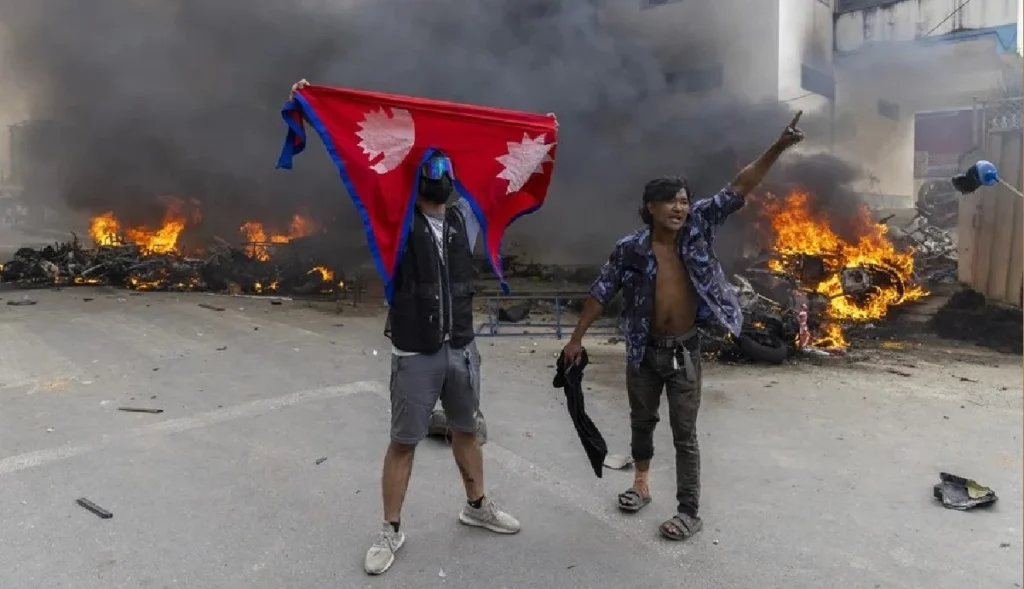
The U.S. is accused to finance, train, and coordinate youth networks in Nepal to drive the violent Gen Z protests that ultimately led to the overthrow of Prime Minister K. P. Sharma Oli in September 2025, as conmfirmed by leaked files reviewed by The Grayzone.
The objective was explicit: to align the local agenda with U.S. priorities under the narrative of democratic reform.
RELATED: Nepal’s Youth Movement Denounces Government’s Deepening Ties With Israel
The operation, carried out by the National Endowment for Democracy (NED) and its Republican-affiliated arm, the International Republican Institute (IRI), aimed to install leadership aligned with Washington’s strategic interests in the geopolitically sensitive Himalayan region.
It was run through the program “Yuva Netritwa: Paradarshi Niti” (Youth Leadership: Transparent Policy), which was funded with an initial budget of $350,000 between 2021 and 2022.
The documents reveal that the IRI allocated the money to train dozens of young people in mobilization tactics, protest organization, social media management, political pressure techniques, and methods for running street-level campaigns.
Through workshops, training sessions, and digital platforms, the IRI selected between 60 and 70 young people described as “emerging leaders” and equipped them with tools to design protests, coordinate groups, escalate demands, and exert pressure on political decision-makers.
Internal manuals were also produced outlining methods to influence national, local, and provincial politics through street actions.
The operation included a broad sociopolitical study carried out with the Nepalese consultancy Solutions Consultant, aimed at identifying youth sectors vulnerable to political radicalization and mapping local grievances.
US regime change front funded Nepalese youth revolutionaries, leaks reveal
Nepal’s ‘Gen Z’ shadow army mobilized as the US sought to neutralize Chinese and Indian influence over Kathmandu
By @KitKlarenberghttps://t.co/se4YDReL2J
— The Grayzone (@TheGrayzoneNews) December 11, 2025
Social networks as excuse
In September 2025, after the Nepalese government blocked platforms such as Facebook, YouTube, and X for failing to comply with local regulations, the so-called “Gen Z” protests erupted. Within hours, the demonstrations escalated into armed unrest, leaving at least 76 people dead, including civilians and police officers.
Videos circulating online showed protesters carrying semi-automatic rifles and organized groups attacking public buildings, government offices, and the homes of officials.
The protests resulted in Prime Minister Oli’s resignation and the installation of an interim leader chosen through an anonymous vote on a Discord server with fewer than 10,000 participants—an unprecedented mechanism in Nepal’s political history.
A well-known strategy
While Western media portrayed the uprising as a spontaneous democratic revolt, the leaked documents suggest that Washington had been laying the groundwork for at least four years. Nepal was viewed by the IRI as a pivotal country for U.S. interests in the Indo-Pacific, due to its position between China and India, its potential to host U.S. military facilities, and its role in the region’s geopolitical containment of Beijing.
The model mirrors strategies used by the NED and IRI in Sri Lanka, Indonesia, and especially Bangladesh, where a nearly identical operation contributed to the 2024 coup.
From teleSUR English via This RSS Feed.