

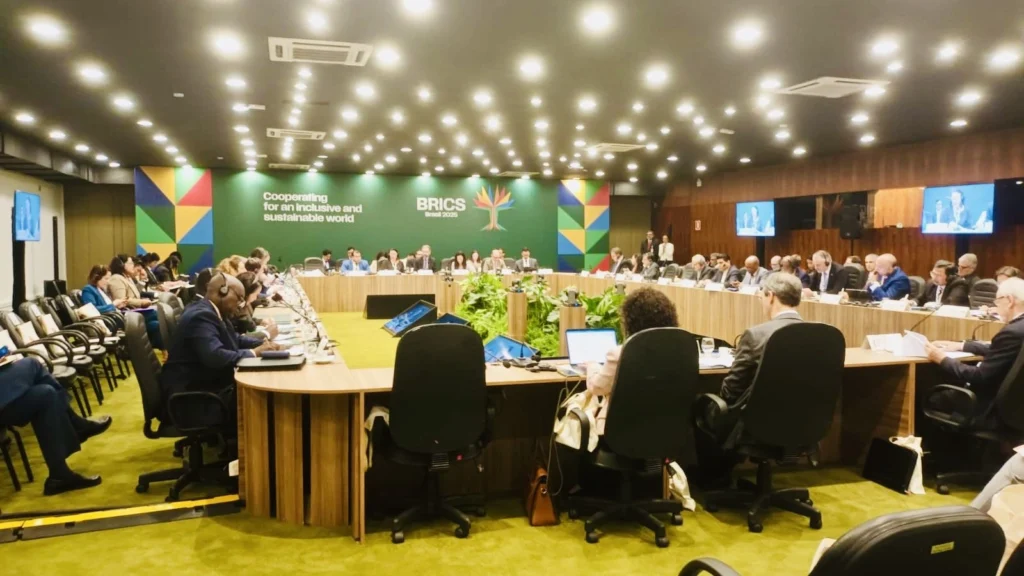
Brazil closed out its rotating presidential term of BRICS on Friday, December 12, with a meeting in Brasilia chaired by Foreign Minister Mauro Vieira. Speaking at the event, Vieira underscored that collaboration within the 11-member group has outgrown its original scope, now reaching well beyond its earlier focus on political coordination and financial cooperation.
Addressing the road ahead, the minister stressed that the group must prioritize delivering visible, real-world outcomes for ordinary citizens. He noted that BRICS should strive to be recognized not merely as a space for dialogue among states, but as an actor capable of producing meaningful change.
RELATED: Brazil’s Supreme Court Deliberates on Temporary Framework for Indigenous Lands
He reiterated that the bloc “should not be understood solely as an intergovernmental discussion forum, but as a mechanism that delivers concrete gains for our societies”, signaling a shift toward policies more closely tied to daily life and social progress within member nations.
The fourth BRICS Sherpas meeting, the final meeting under the Brazilian presidency of the 11-nation grouping, kicks off in Brasilia.
On Friday, Brazil will hand over the BRICS presidency to India, which is being represented by Secretary (ER) Sudhakar Dalela, India’s BRICS Sherpa pic.twitter.com/T9VCufzl5V
— Dhairya Maheshwari (@dhairyam14) December 11, 2025
Last Round of Meetings
Meanwhile, Thursday, December 11, saw the beginning of the final round of meetings led by Ambassador Mauricio Lyrio, Brazil’s sherpa in the BRICS. He described Brazil’s tenure positively, emphasizing the country’s strong defense of multilateral cooperation amid an increasingly fragmented and uncertain global environment. He further pointed out that widespread international mistrust has complicated collective efforts within the group.
Lyrio also highlighted the importance of the leaders’ declaration adopted at the July summit in Rio de Janeiro. The document denounced armed conflicts, called for fairer and more inclusive global governance structures, and reaffirmed the urgency of reforming the United Nations Security Council.
Over the course of Brazil’s presidency, BRICS convened extensively, holding 220 videoconferences, 62 technical-level meetings, 21 ministerial sessions, four sherpa meetings, an in-person leaders’ summit in Rio, and an additional virtual summit.
From teleSUR English via This RSS Feed.