

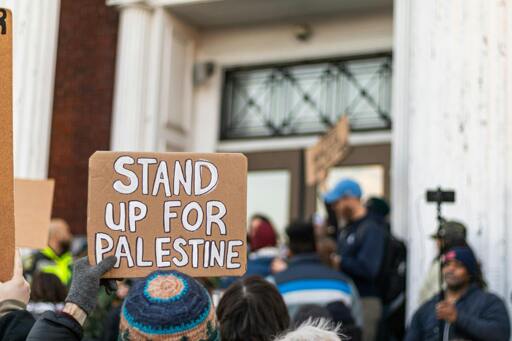
The movement for Palestine made significant headway in Somerville, Massachusetts this winter when the city became the first in the country to vote to divest from businesses involved in Israel’s brutal and oppressive apartheid regime. While the vote itself was nonbinding, over 11,000 people supported it in a city of 80,000, securing far more votes than either of the candidates for mayor in the same election cycle. Less than a month later, the City Council voted 9-2 to approve the divestment measure and implement it as policy.
It took serious mobilization from the pro-Palestine movement not only to achieve this victory but also to apply firm pressure on local politicians who were too concerned with heir political reputations to publicly support and adopt divestment as a policy proposal. This win did not occur in a vacuum, however, and it provides crucial lessons for the Left and an opportunity for debate in order to expand the strategy to the greater Boston area and beyond.
Growth of the Movement for Palestine
While Somerville for Palestine (S4P) had been organizing for years as part of the boycott, divestment, and sanctions (BDS) movement, the group’s first major victory came in early 2024, when Somerville became the first city in Massachusetts to pass a resolution calling for a ceasefire in Gaza. Passed just a few months after October 7, in the context of growing repression around Palestine and a pro-Zionist consensus among Democrats and Republicans, this reflected a significant victory for the local movement for Palestine.
More importantly, the success of the ceasefire resolution motivated activists in the Palestine movement to pursue not just symbolic action but a more strategic fight to consciously divest from businesses that enable and facilitate Israel’s genocidal campaign in Gaza. Using the Freedom of Information Act (FOIA), S4P obtained information on how the city of Somerville spends its funds, identifying several areas where meaningful investments and ties were made with targets of the BDS campaign.
This included a $1.7 million contract with Hewlett-Packard, which maintains a biometric surveillance system at checkpoints in the West Bank. City pensions are invested in Lockheed Martin, a weapons manufacturer producing fighter jets and Hellfire missiles, which Israel uses to slaughter Gazans and raze their cities, totaling $500,000. Somerville also contracts much of its construction work to Caterpillar, whose bulldozers are used to demolish Palestinian homes and build new settlements for Israeli colonizers. These numbers formed the basis for the campaign’s next step: to fully divest all city funds from these companies and any others involved in the business of genocide.
Political Cowardice and Working-Class Coalitions
Initially, S4P made efforts to meet with individual city councillors, urging them to introduce and support a divestment resolution. Most of these politicians privately “sympathized” with the movement, but they consistently refused to take a public stance on the issue. Despite the nonpartisan nature of city government positions, they were unwilling to risk their political capital even after S4P developed a public petition with BDS language.
Just three days after filing for the divestment question to be put up to the City Council, Tufts student Rümeysa Öztürk was kidnapped off the street by masked ICE agents. In the aftermath, hundreds of Somerville residents and community supporters gathered outside the City Council meeting, and activists flooded the chamber in support of Öztürk and the divestment initiative.
When it came time for the council to decide whether to consider a vote on divestment or to file the petition as a nonbinding electoral referendum, only two councillors voted in favor of a City Council vote, leaving S4P with a 5,000-signature gathering requirement to put the question on the November ballot.
Organizers in the Palestine movement immediately got to work, not just to meet that target but to learn lessons from other cities where the movement fought for divestment. They contacted members of the Democratic Socialists of America (DSA) in Pittsburgh, who had tried to get their city to divest in August 2024 after gathering 15,000 signatures. Bureaucratic legal measures and technicalities blocked that measure from appearing on the 2024 ballot and again in 2025 after DSA secured 20,000 signatures. Upon learning how this struggle was impeded by the bourgeois system and the pro-Israel lobby, S4P set an ambitious and strategic goal: “10,000 signatures, 10,000 conversations about Palestine.”
They also made significant inroads in the labor movement and with community groups around Somerville. Members of S4P who are also organized with the 700-strong Somerville Educators Union (SEU), an affiliate of the Massachusetts Teachers Association (MTA), urged the union to back the initiative in a membership vote and organized the rank-and-file to campaign for the issue. Workers and youth across Somerville, including members of the Jewish and South Asian caucus in S4P, developed a sprawling volunteer base and launched outreach initiatives that could surpass their goal. The result was a multiracial, multigenerational movement that collected 11,000 signatures, thanks to nearly 300 volunteers who by September had knocked on over 10,000 doors.
Legal Challenges and Opposition
The Palestine movement in Somerville did not lack opposition, however. By the time S4P filed to put divestment on the ballot, the pro-Zionist lobby had mobilized to spread propaganda in Somerville and launch a financial campaign to defeat the measure. At the aforementioned council meeting, the New England regional director of the notoriously pro-Zionist, pro-police Anti-Defamation League (ADL) spoke out against the ballot question. In the United States, the ADL functions as a faux-progressive mouthpiece of the Zionist lobby, providing surveillance and propaganda cover for the U.S. and Israeli regimes.
Soon enough, representatives of the ADL and the Israel lobby created an astroturf group called Somerville United against Discrimination (SUAD). To fight the initiative, this group spent over $200,000 in donor money, 80 percent of which came from outside Somerville, with an average of $1,000 per donor. This was far more money than any mayoral candidate had spent during that election cycle, and it dwarfed the $50,000 that S4P was forced to fundraise to combat this new opposition. Most of this money went toward baseless legal challenges, TV ads, and provocative mailers that made several absurd claims, including that divesting from companies enabling the genocide in Gaza would “violate anti-discrimination laws.”
These claims, aside from being objectively false and implying that HP or Lockheed Martin are Jewish companies, are part of the same old conflation of anti-Zionism with antisemitism and serve only to weaken and demobilize the movement for Palestine, regardless of local political preferences. SUAD claimed that the ballot question “distracts from pressing local issues” like rising living costs and cuts to school and healthcare funding. It is true that Somerville residents are facing rising living costs, thanks to landlords, corporate-friendly politicians, and wealthy donors — the same people funding SUAD and supporting the Zionist regime!
Another challenge for S4P was that the only legal pathway to put divestment on the ballot was to make the question nonbinding and thus incapable of affecting the newly adopted city charter. Under capitalist “democracy,” ordinary workers and residents don’t get to choose their own laws and are prevented by the structures of local government from compelling their politicians to adopt policies widely supported by the working class. In the year 2000, the U.S. Supreme Court prevented a state law from barring agencies from doing business with Myanmar’s repressive military regime. This established a precedent to limit state law so that the most city governments can do is seek the divestment of government funds.
In other words, any legal challenge to U.S. foreign policy at the local level is constrained by the national government’s policy, which maintains an existential relationship with Israel and supports it to promote its interests in the Middle East. Local divestment is a significant step in the right direction, but our horizons must extend beyond it toward a broader strategy of challenging the ruling class on national and international levels. Palestinian liberation — and working-class control over society — cannot be achieved without a global movement to overthrow capitalism, colonialism, and imperialism.
You might be interested in: Palestinian Liberation and Permanent Revolution
Overcoming Challenges and Winning Concessions
Still, S4P was relentless in mobilizing the broader working class to fight for Palestine at the local level. They consistently organized large rallies outside City Hall, created a sprawling network of volunteers and community organizations, and continued to combat the Zionist lobby’s propaganda right up until Election Day. Their efforts marked a huge victory for the Palestine liberation movement: 11,489 votes for divestment from Israel, or 56 percent of the electorate, with only 36 percent opposed. More people voted in favor of this issue than the number who voted for the mayor-elect.
After the victory of the ballot question movement, it remained to be seen whether the city government would follow through on the mandate. On November 25, city councillor and DSA member Willie Burnley Jr., who lost his mayoral bid despite being the only candidate to promise to enact the ballot question as policy, brought a divestment resolution to the City Council to do just that. The winner of the mayoral race, current city councillor Jake Wilson, had opposed the ballot question before the election on the grounds that it was “illegal under state law” and “unenforceable.” These were shaky arguments considering that the referenced Massachusetts procurement law, Chapter 30B, only requires city contracts to be based on “highest quality at the lowest cost.”
Nonetheless, the pro-Palestine movement came out in full force, with over a hundred supporters gathering for hours outside ahead of the council meeting and activists live-streaming the event on Instagram. Pressure from this movement successfully forced the City Council to pass the measure 9-2; Wilson switched his stance and voted in favor. Far from reflecting a genuine change of conscience, Wilson and the rest of the City Council were forced to adopt the measure in the face of overwhelming support from organized residents.
Expanding the Struggle
This was a major blow for the Zionist establishment in the Boston metropolitan area and marked the first time in the country that residents had voted to end their city’s business ties with Israel, compared to other cities where resolutions were simply passed by their respective city governments. But other major cities in the Boston metropolitan area have even greater ties to Israel, including partnerships with Lockheed Martin and Northrop Grumman, police department partnerships with IDF training programs, and universities like Harvard and MIT, which develop technology for the Israeli military. For the BDS movement, escalating the struggle will require even greater mobilization of workers, youth, and the oppressed to challenge these institutions and strategically target their economic foundations.
In particular, more unions need to participate in the movement to cut ties with Israel’s genocidal regime. While the rank-and-file of SEU mobilized in support of the initiative, there was a notable lack of support from the leaders of the Somerville Municipal Employees Union (SMEU), whose work benefits were used to fund weapons manufacturers, and the leaders of Laborers Local 381, which handles construction in the city. While BDS can put economic pressure on local governments, it’s the labor movement that has the power to bring the economy to a standstill and to force a real reckoning with Boston’s ties to Israel.
In addition, a mass socialist party, independent of the Democrats and Republicans and controlled by the working class and the oppressed, would be a crucial vehicle for uniting these movements while moving beyond legal and electoral strategies into street actions and strikes. S4P has demonstrated that the limits of local politics and city councils cannot contain the growing radicalization of workers and young people around the question of Palestinian freedom, and it will require a mass strategy that extends beyond these confines to achieve real gains for other parts of the Boston metro area. From Palestine to Boston, it remains fundamental for us to fight the capitalists and their interests as one united movement.
The post Somerville Residents Say No to Genocide, Force City to Divest from Israel appeared first on Left Voice.
From Left Voice via This RSS Feed.