

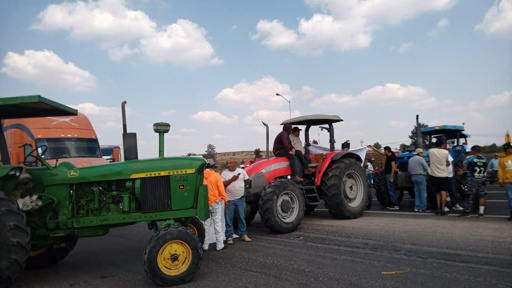
This article by Vanessa Rivas originally appeared in the December 11, 2025 edition of El Heraldo de Chihuahua.
The National Front for the Rescue of the Mexican Countryside announced that starting Tuesday they will begin demonstrations on highways and customs offices across the country, awaiting a favorable response from the Federal Government to their proposal to create a reserve of basic grains to stabilize prices.
The initiative, which proposes a joint investment of 100 billion pesos between the Federal Government and private enterprise, seeks to stabilize prices, strengthen food sovereignty and provide certainty to thousands of producers affected by the crisis in the countryside.
Eraclio Yako Rodríguez Gómez, leader of the National Front for the Rescue of the Mexican Countryside [and a former Morena Deputy elected in 2018 – editor], explained that this reserve would allow the country to be protected from international price crises, strengthen food sovereignty, and provide certainty to millions of farming families.

Eraclio Yako Rodríguez Gómez is a former Morena deputy & was previously President of the Commission for Rural Development and Conservation, Agriculture and Food Self-Sufficiency of the Chamber of Deputies
Yako Rodríguez Gómez reported that starting next Tuesday, mobilizations will begin on highways and toll booths throughout the country, as part of the pressure to get the Federal Government to give a positive response to the proposal.
He warned that if they do not reach agreements again, the farmers will once again take to the streets, international bridges, and, in Mexico City, the areas surrounding various embassies.
Starting Tuesday, farmers from various states will set up along the sides of major highways—without blocking them—as a form of protest. In Chihuahua, the demonstrations will be concentrated at the Sacramento tollbooth and in the municipality of Jiménez.
Yako Rodríguez explained that the mobilizations are part of a national day of action whose objective is to highlight the deterioration of conditions in the Mexican countryside and demand actions that guarantee fair prices for basic grains.
The meeting with the Federal Government, originally scheduled for Tuesday, has been rescheduled for Wednesday morning. Participants will include Julio Berdegué Sacristán, head of the Ministry of Agriculture and Rural Development (SADER); María Luisa Albores González, Director General of Food for Well-being; Leonel Cota Montaño, Undersecretary of Agriculture; as well as Undersecretaries of Finance, Economy, and the Interior.
The leader indicated that a technical commission from the Front would work on Monday and Tuesday to refine the points of the proposal for the creation of this food reserve. “ I foresee that we can reach an agreement,” Rodríguez Gómez stated.
The Front presented a technically and financially structured project, with an approximate cost of 100 billion pesos, which would allow Mexico to have a stabilization instrument in the face of market crises and climatic phenomena.
The proposal suggests that the State and private enterprise share the investment, in order to achieve guaranteed prices that will allow producers to emerge from the current crisis.
According to Yako Rodríguez, the strategic reserve would consist of 300,000 tons of beans, acquired by the Food for Well-being program at 20 pesos per kilo; 10 million tons of white and yellow corn, paid at 7,200 pesos per ton; 1 million tons of wheat and an equivalent volume of sorghum, both at 6,500 pesos per ton.

The plan also includes the creation of a 6 billion peso fund to finance oilseeds and other operational mechanisms to regulate the market and prevent speculation.
The leader argued that this reserve would function as a “food bank” , drawing on experiences once led by ASERCA (Agency for Marketing Services and Agricultural Market Development), a decentralized Mexican agency of the then SAGARPA, but now with a greater capacity to react to price cycles, droughts and logistical disruptions.
Yako Rodríguez insisted that the measure would allow Mexico to regain room to maneuver in the face of external pressures. “A country with a strategic reserve has decision-making power. Without it, we depend on what other markets dictate,” he stated.
Finally, he pointed out that situations like the corn crisis in Chihuahua—where currently “no one wants to buy it”—exemplify the urgent need for a price stabilization mechanism. “If they manage to pay six pesos, that’s already a win; we propose that it should be paid at seven ,” he emphasized.
-

Mexican Farmers Protest Again Next Week
December 12, 2025
Campesino organizations are proposing the government creating a Strategic Food Reserve to stabilize prices, strengthen food sovereignty & help thousands of farmers facing ruin from the agricultural crisis.
-

Ejido Members “completely shut down” Canadian Mine in Guerrero
December 12, 2025December 12, 2025
Carrizalillo community members don’t understand why the Mexican government allows the Canadian corporation to continue committing environmental offenses for which Los Filos mine was previously shut down.
-

The Presidential Mandate & The Battle to Transform CIDE
December 12, 2025December 12, 2025
Despite entrenched, hostile forces, President AMLO’s push to transform the public institution CIDE from a bastion of neoliberalism to one which can consider national development from a sovereign perspective carries on.
The post Mexican Farmers Protest Again Next Week appeared first on Mexico Solidarity Media.
From Mexico Solidarity Media via This RSS Feed.