

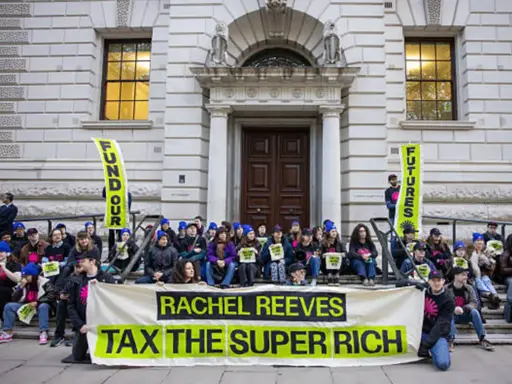
The richest 0.001% own three times more wealth than 50% of humanity, according to the World Inequality Report 2026. The shocking finding builds on work from over 200 scholars from around the world. The report stated that its statistics underscore the need for “top-end tax justice” globally.
Access to education
The landmark research found high inequality in education spending. When considering how much resources and expertise money can buy in each country (purchasing power parity), Sub Saharan Africa spent just £175 per child. By contrast, European countries spent around £6,500 per child and in North America and in Oceania the figure stood at around £7,900 per child. This is a gap of more than 1 to 40 in investment in a child’s life compared to the vast majority of African countries. The disparity is also three times as much as the gap in per capita GDP.
The report notes such under investment in children in Africa entrenches:
a geography of opportunity that exacerbates and perpetuates global wealth hierarchies
A study released in November by the outgoing South African G20 presidency also demonstrates issues with systemic inequality in education. That report noted that the competition-at-all-costs approach of capitalism creates a false scarcity of knowledge and information. Instead of sharing breakthroughs, the system seeks to profit from them, spiralling inequality further.
Richer nations also extract money from Africa. The World Inequality Report 2026 found that richer nations extract three times (1% of global GDP) as much from less well off nations than is returned in development aid.
Climate crisis
The report further noted that capital ownership plays a crucial role in the climate emissions a person is producing. Globally, the wealthiest 10% of individuals account for 77% of emissions associated with private capital ownership. Meanwhile, the wealthiest 1% account for 41% of those emissions.
That the rich contribute way more to the climate crisis is an established fact. A report from Oxfam found that an average hour and a half in the lives of 50 of the world’s richest billionaires emits more carbon pollution than a normal income person does in their entire life time. That’s through not only private jets and yachts, but investment in fossil fuels.
Inequality: sharper focus
Even as the report scoped out from the 0.001%, inequality remained stark. Throughout the world, the wealthiest top 10% hold 75% of assets and capital, compared to 50% of humans, who own just 2%.
When it comes to income, the top 10% of earners receive more than 90% of the globe, while amongst the least well off 50% get less than 10% of the total global income.
Back to the richest 0.001% – around just 60,000 multi-millionaires: their share of the entire world’s wealth has increased from 4% in 1995 to over 6% today, showing that inequality is getting worse not better. Indeed, the report also noted that the wealth of billionaires and those with more than a hundred million has increased by around 8% every year.
It’s worth noting that when essentials like housing, energy, travel, internet, and the likes are privatised, that provides a risk-free investment for those with large capital to make, meaning they can always increase wealth extraction from such necessary industries.
Solutions
The World Inequality Report 2026 argued that redistributive policies through instruments like progressive taxation have been successful in tackling expertise and resource inequality. It found that in Europe, North America and Oceania, tax and transfer systems have reduced income disparity by over 30%.
Besides, when technology can increasingly automate production, this level of inequality is essentially sustained for the sake of it. As well as progressive taxation, we need to consider a system re-think.
Featured image via the Canary
By James Wright
From Canary via This RSS Feed.