

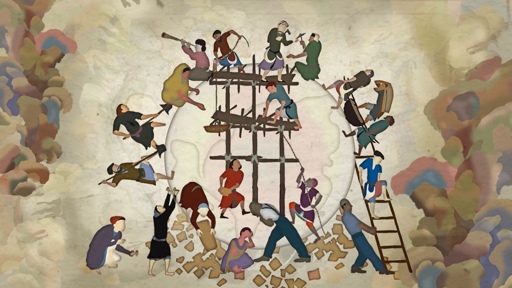
Is Asia possible? This provocation comes from a recent intervention by Tricontinental Asia, the latest in a series of conjunctural analyses on the Asian continent.
There is increasing acknowledgement that the world economy’s center of gravity is shifting to Asia. Home to 60% of the world’s population, the continent contributes to 70% of world economic growth, 40% of world merchandise trade, and 57% of world manufacturing value added.
A range of Asian organizations, such as the Association of Southeast Asian Nations (ASEAN), Shanghai Cooperation Organization (SCO), and Asia-Pacific Economic Cooperation (APEC), signal a tendency towards regionalism. The Asia-centric Regional Comprehensive Economic Partnership is the world’s largest free trade bloc.
In fact, an argument could be made that Asia’s dynamism animates the new mood in the Global South. Five of the 10 BRICS member states are on the continent of Asia (six if we include Russia, which straddles both Europe and Asia). Approximately 83% of the population and 82% of the gross domestic product of the BRICS member states derive from Asia.
“Cooperation between states cannot be sustained unless they are deeply bound together in terms of production modes, production chains, and economic interests,” says Yang Ping, founder and editor of the Chinese journal Wenhua Zongheng(Beijing Cultural Review).
Speaking at the launch of the Tricontinental Asia intervention in Shanghai, on the sidelines of the 2025 Global South Academic Forum, Yang Ping pointed out that the longest-lasting regional economic unions have thus far been in Europe (the socialist COMECON bloc and the capitalist European Union) due to deep integration of industrial chains. Integration in Asia, however, remains mixed because of uneven development and strong regional disparities.
The division of labor in Asia
In 1972, Egyptian Marxist Samir Amin classified the African continent into four zones based on their allotted economic functions in the international division of labor: the colonial trade economies of West and Central Africa, the mining concessions of the Congo River basin, the labor reserves of Eastern and Southern Africa, and outliers like feudalistic Ethiopia. Borrowing from Amin, a similar methodology may be used to begin to understand Asia.
East Asia is the industrial core. This region includes Japan, the first non-European country to industrialize, as well as China, which accounts for over 30% of global manufacturing value added and is the only country in the world to produce goods from every category of the United Nations Industrial Classification. China also leads in 37 out of 44 critical technologies.
Southeast Asia consists of the colonial trade economies that have transitioned into export platform economies. Despite increasing manufacturing capabilities, countries like Malaysia and Thailand lack indigenous technology and globally competitive firms. In many of these economies, land reforms remain incomplete and inequality is high, thereby suppressing the potential of the home market.
South Asia is the labor reserve that supplies the Global North and the Gulf states. In fact, its role has changed little since colonial times, when the subcontinent provided coolies, sepoys, and administrators for the colonial state. Economies like Bangladesh, Nepal, and Sri Lanka remain dependent on remittances. Attempts at auto-centric industrialization (India) and a transition to export platform economies (Sri Lanka and Bangladesh) have yielded limited results.
Central Asia most closely resembles a mining concession due to its heavy dependence on natural resource rents. This understudied region is strategically important due to its reserves of potential energy, including oil, gas, uranium, and hydropower. It is also rich in commodities and critical minerals that are crucial in the race for green and digital technologies.
Finally, there is West Asia, which is dominated by the petrodollar rentiers of the Gulf Cooperation Council. These states constitute 28% of global oil sales and recycle that surplus in the US military-industrial-financial complex. Attempts at auto-centric development have been crushed through hybrid war, invasion, sanctions, or the capitulation of local elites (in Egypt, Syria, Iraq, Yemen, and Iran). The military-petroleum-finance nexus in this region is crucial for the maintenance of imperialism in Asia and the rest of the Global South.
Financial dependence and military encirclement
But the unevenness of Asia’s development is also a strength. The continent has within it all the basic factors required for a regional auto-centric development: labor, natural resources, technology, and capital. However, Asia remains disarticulated for various reasons.
In addition to the five zones outlined above are the “forward bases” of imperialism in Asia. These include settler colonies (Israel, Australia, and New Zealand) and militarily occupied or compliant states (Japan, Chinese Taipei, South Korea, and NATO-member Turkey). Situated on Asia’s eastern and western flanks, these states act as signal disruptors that destabilize and disarticulate the region in the interests of Western capital. They are supplemented by hundreds of US military bases dotting Asian continent.
Paired with this military encirclement is financial subordination. The “Asian Economic Integration Report 2025”, published by the Asian Development Bank (ADB), notes that Asia is the second most integrated region in the world after the European Union and the United Kingdom. In the ADB’s Regional Integration Index, Asia performs well in trade, movement of people, and foreign direct investment. However, Asia’s integration is weakest in the sphere of finance.
The integration between West Asian hydrocarbons and the US dollar, as well as the industrial orientation of East and Southeast Asia towards the markets of the Global North, ensures the perpetuation of dollar hegemony. This leaves the region vulnerable to the actions of the US Federal Reserve System, which controls the world reserve currency. In financial terms, Asia still pays tribute to Washington and Wall Street.
Restoring history to invent the future
The first soldier to raise the Soviet flag over the Reichstag was an Asian: Raqymjan Qoshqarbaev from the Kirghiz Autonomous Socialist Soviet Republic, present-day Kazakhstan. There are no photographs of this event, which occurred at night. The iconic image, “Raising a Flag over the Reichstag” by Yevgeny Khaldei, was only an artistic recreation of this moment. Qoshqarbaev himself could not be in the photograph.
The latest study by the Tricontinental: Institute of Social Research is a “restorationist” history of World War II, or the World Anti-Fascist War. Asia’s role in this war has been erased by the Global North and forgotten even in parts of Asia. Approximately 35% of deaths in the World Anti-Fascist War occurred in China, the Dutch East Indies, French Indochina, and the Philippines. Adding the Soviet Union to this mix raises the share to 66.5%.
The study asserts that the true beginning of the Second World War was in 1931, with the Marco Polo Bridge incident, which signaled the advance of Japanese militarism in China. Restoring the history of Asia as a site of anti-colonial and anti-imperialist resistance allows us to begin to theorize a possible Asia.
Yang Ping notes that, despite capitalism’s constant drive toward globalizing production and breaking down national borders, the system remains reliant on nation-states and territorial boundaries to function. He argues that capitalist globalization is fundamentally fragile due to the inequalities between center and periphery, upstream and downstream positions in global value chains, and in how profits are distributed.
Read More: Despite US tariffs, China’s trade surplus exceeds 1 trillion dollars
“Today we see a wave of de-globalization, with capitalism entering an anti-globalization phase. From this perspective, capitalism’s ability to sustain cross-national integration is facing growing constraints,” said Yang Ping.
“Without discovering a mode of production and social organization superior to capitalism, or finding deeper mechanisms of economic and political integration, it is extremely difficult to transcend capitalist structures and realize continental-level unions.”
Shiran Illanperuma is a Sri Lankan journalist and political economist. He is a researcher at Tricontinental: Institute for Social Research and a co-editor of Wenhua Zongheng: A Journal of Contemporary Chinese Thought.
The post Towards a political economy of Asia appeared first on Peoples Dispatch.
From Peoples Dispatch via This RSS Feed.