


This editorial by Pedro Miguel originally appeared in the December 13, 2025 edition of La Jornada. The views expressed in this article are the author’s own and do not necessarily reflect those of Mexico Solidarity Media*, or the* Mexico Solidarity Project*.*
A peaceful and democratic revolution has the immeasurable virtue of avoiding loss of life and material destruction, but it also carries the challenge of developing and progressing within a legal and bureaucratic framework created by the regime it overthrew: a suffocating set of rules and institutions designed to preserve the old order and staffed by personnel trained in its mindset. No political project comes to power with enough personnel to govern a country or with the capacity to maintain even minimal stability if it dispenses with the inherited administrative teams.
In this situation, there is a real danger that the state apparatus will ultimately neutralize the transformative attempt, assimilating it and reducing it to a mere collection of harmless good intentions. Conversely, the eagerness to force the renewal of public administration and governance practices can lead to a rupture and disarray that results in paralysis, a clash of powers, and an institutional crisis that sooner rather than later will become economic and social.
As President, Andrés Manuel López Obrador acted with a profound understanding of this dilemma and implemented all the fundamental changes he could, recognizing that a deep transformation of the judicial and law enforcement agencies was not feasible, and that the legislative majorities aligned with the Fourth Transformation were insufficient—because they lacked the two-thirds majority required—to undertake constitutional reforms. They had to limit themselves to amending laws, with the risk that these reforms would end up being overturned, as happened many times, by a Supreme Court beholden to oligarchic interests, or even by simply corrupt judges. Furthermore, there was an electoral body compromised by the mafia-like designs of the old political class and a swarm of autonomous agencies endowed with constitutional powers to obstruct and sabotage decisions of the federal executive branch. All this, without taking into account that the vast majority of governorships were in the hands of the opposition, that the de facto powers of business corporations were reluctant to change, and that the media conglomerates used all their virulence, sensationalism, and ability to poison public opinion to try to induce a majority animosity from society towards the government.
This explains the initial need to choose the lesser of two evils; for example, abandoning the idea of prosecuting former presidents (an impractical undertaking without the cooperation of the judiciary and a willing public prosecutor’s office) and adopting a policy of alliances that would break the unity of the reactionary forces, along with a strategy of negotiation and dialogue with traditional economic and labor powers that would allow for decisive steps in social and labor policy, such as social programs and wage strengthening policies. During the previous six-year term, these choices proved to be democratic virtues in a governmental practice guided by the logic of persuasion rather than coercion, and they allowed for the maintenance of a stable economy (despite the pandemic) oriented toward redistribution rather than the dogma of growth.

Pedro Haces with President Claudia Sheinbaum.
In the June 2024 election, the Fourth Transformation put forward two fundamental proposals: to continue implementing its national project from the federal government, with Claudia Sheinbaum as its standard-bearer, and to achieve full power to enact constitutional reforms through a qualified legislative majority, with a primary focus on judicial reform. Society gave broad support to these proposals, resulting in the formation of much stronger and more robust Executive and Legislative branches than those of the first transformative period. The alliances, so criticized by some impatient and purist elements of the movement, have made possible the complete democratic transformation of the Supreme Court and other judicial bodies, the elimination of autonomous agencies that were bastions of neoliberalism, and, through the Senate, the beginning of a renewal and modernization of the Attorney General’s Office.
Out of frustration and bitterness, a supposed subordination of legislative and judicial bodies to Morena is invented and spread, which is false; it is, instead, an alignment of public powers in a national project and in the social pact under construction, something perfectly valid and legitimate.
Today, President Sheinbaum has a much wider margin of action than her predecessor and better conditions to, among other things, combat corruption, confront criminal violence, and cleanse public offices of entrenched vices. It appears that the transformation will accelerate in the coming years.
-

Strengthening the Foundations of Morena & The Fourth Transformation
November 14, 2025
Eight urgent demands from militants and founders loyal to the original and principles of the Fourth Transformation.
-

“Morena’s main enemy is within Morena”
September 8, 2025September 8, 2025
Morena founder Eduardo Cervantes Díaz spoke at a press conference advocating for grassroots committees for Morena militants and against corruption, and then was removed from his position.
-
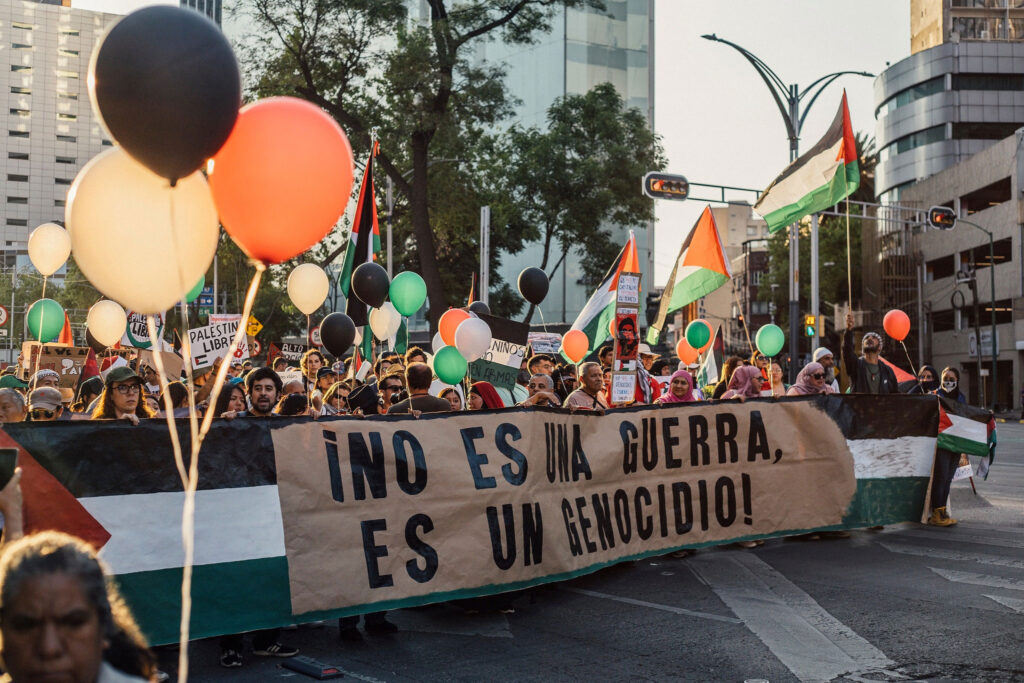
For The Good Of All, Sever Relations with israel
September 4, 2025October 9, 2025
What does “Mexican Humanism” mean when our country’s representatives cling to something they insist on euphemistically calling a “peaceful solution” to mediate between “conflicting parties”?
The post The 4T Speeds Up appeared first on Mexico Solidarity Media.
From Mexico Solidarity Media via This RSS Feed.