

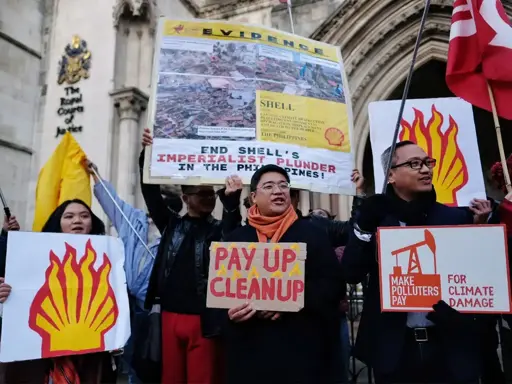
A group of over 100 Filipinos is seeking financial compensation from Shell. This is after the super typhoon Odette devastated their communities. The landmark case against the UK’s biggest oil company argues that it contributed to climate change. And they say this made typhoon Odette more likely and more severe.
The case could have a major impact on the fossil fuel industry.
The Philippine Movement for Climate Justice, Greenpeace Philippines and Fossil Free London staged a demonstration outside the Royal Courts of Justice on 11 December, to mark the filing of the case.
Super typhoon Odette
On 16 December 2021, Odette killed or severely injured over 1,800 people and destroyed over 2 million homes. It affected eight million people overall. At the time, marked as an off-the-scale event, it was the second costliest typhoon on record in the Philippines. It caused nearly $1bn worth of direct damage.
The survivors argue that Shell’s actions contributed to climate change, which made Odette significantly more likely and more severe. It is the first case to link death, injury and property destruction in the Global South directly to a fossil fuel giant in the Global North.
Odette destroyed Batasan fish vendor Trixy Elle’s home. She said:
Odette took everything from me and my family. We were forced to sell our precious belongings just so we could afford to rebuild our home.
We’ve done nothing to cause the climate crisis, but because companies like Shell chose profit over people, our lives have been turned upside down.
Tessa Khan, International Climate Change Lawyer and Executive Director at Uplift, added:
This kind of devastating weather event was anything but natural. It was a disaster born out of decades of extraction and profiteering.
The bravery demonstrated by the survivors makes clear that fossil fuel companies can no longer act with impunity.
This case strengthens the growing push by communities to hold fossil fuel giants to account for the harm they have caused.
Shell’s role in the climate crisis
The case draws on emerging science which can now directly attribute individual extreme weather events to climate change, and emissions to specific fossil fuel companies. In June, scientists found that the likelihood of a disaster like Odette in the Philippines has roughly doubled due to global warming.
Shell is one of the world’s largest emitters, accounting for 2.04% of historical global emissions. By contrast the Philippines, the country with the highest risk of climate hazards, has contributed just 0.2%.
The case also argues that Shell has known since 1965 that fossil fuels were the primary cause of climate change. Furthermore, that the company had been warned that failing to curb emissions would lead to major economic consequences by 2038, yet chose not to change course.
The claimants are seeking financial compensation in line with the ‘polluter pays’ principle, as well as remedial measures consistent with their right to a healthy environment.
The claimants are seeking damages for severe losses including serious property damage, personal injury, bereavement, psychological trauma and loss of earnings.
They’re also seeking further relief in relation to the violation of their constitutional right to a balanced ecology.
The claim alleges that Shell’s actions materially contributed to anthropogenic climate change. And this significantly intensified the typhoon’s impact and likelihood, thereby increasing the damage suffered by the clients.
More climate impact cases
They join a growing list of communities using the courts to send a message that the era of consequence-free polluting is over.
As of September 2024 86 cases had been filed globally, with 33 relating to companies’ responsibilities for climate impacts. There are growing signs that the legal tides are turning.
In May, a German court delivered a precedent-setting verdict in the high-profile Saul vs RWE case. It ruled that major emitters can be held liable for climate-related damages abroad.
In July, the International Court of Justice advised that governments have a binding duty to protect people and the planet from the climate crisis.
So the potential liabilities for fossil fuel companies are substantial. Climate Analytics estimates that the climate damages attributable to the 25 largest oil and gas companies exceed $20tn.
Jefferson Chua, Greenpeace Philippines Climate Campaigner, said:
Carbon majors like Shell can no longer hide behind their corporate veil, far away from those who bear the heaviest costs because of the decisions they make in their board rooms. It’s not right for them to continue to profit at the expense of the death and hardship of communities. Survivors of Odette have had enough of the climate crisis and are bringing the fight to Shell’s doorstep.
And Aaron Pedrosa, legal team head of the Philippine Movement for Climate Justice (PMCJ), summed up:
Our communities have suffered unimaginable losses. Their case shows that no corporation operates in a vacuum. When their actions materially worsen the impacts of climate disasters, the courts have a role in ensuring those responsible are held accountable. They cannot continue to contribute to climate harm with impunity.
Featured image via Fossil Free London
By The Canary
From Canary via This RSS Feed.