

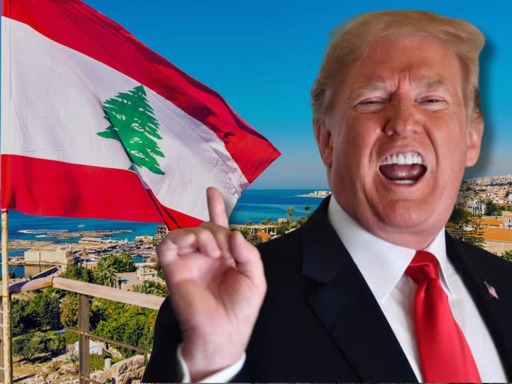
It must be a day ending in ‘Y’ because theUS and Israel are up to something nefarious in the Middle East. This time it’s in Lebanon. A barely reported so-called ‘side-letter’ details the US commitment — or the lack of — to peace in Lebanon. And Trump’s new year threat to restart hostilities if Hezbollah doesn’t disarm risks destroying the US-brokered ‘ceasefire’.
Meanwhile, the US has been extending its influence and infrastructure in the country. The Americans are building a gigantic fortress embassy. And with a US-trained president leading Lebanon, it’s worth taking a deeper look.
On 3 December 2025, around a year into a ‘ceasefire’ between Israel and Lebanon, it was reported that diplomats from the two countries would meet. Israel’s 2024 assault in southern Lebanon was the sixth in the last 50 years. It ran from October 2023 until November 2024 — against the backdrop of ongoing genocide in Gaza.
But this is a very distinct kind of ceasefire: one with Israeli characteristics. Case in point: by 4 December Israel was hitting targets inside Lebanon again. In fact, since the November 2024 ‘truce’, the UN has said: “Israel continues to strike Lebanese territory almost daily.” While the Christian Science Monitor termed the arrangement “the ceasefire that isn’t”.
Israeli exceptionalism
Naturally, Israel claims that it is hitting Hezbollah targets legitimately. Hezbollah is Israel’s old adversary in the south of Lebanon. It is a Shia political party with a paramilitary wing that was conceived in the heart of Israeli-occupied southern Lebanon in 1982. But implicit in the continued attacks is an acute Israeli exceptionalism — an outgrowth of the US’s global exceptionalism. We decided to take a deeper look at the terms of the ceasefire. In particular, an underreported so-called ‘side-letter‘ from US president Donald Trump to Israel.
The document pledges full US political, material and technical military support to Israel in a return to war. Taken with Trump’s threat to attack Lebanon if it hasn’t disarmed Hezbollah by the New Year’s Eve, it deserves scrutiny if we are to understand what is at stake.
The ‘side letter’ Lebanon knew nothing about
The Times of Israel published the full terms of the ceasefire. It contains twenty ‘points’ with various lettered subsections. Point 4 gives the deal an appearance of equality between the two countries:
These commitments do not preclude either Israel or Lebanon from exercising their inherent right of self-defense, consistent with international law.
The US is broker and guarantor of the peace deal. Yet the Trump administration also made clear it is willing to destroy it. According to a second piece in the Times of Israeldated 27 November 2024, the ‘side-letter” commits the US:
to providing Israel with intelligence information pertaining to violations of the terms of the ceasefire deal, and in particular, regarding any indication that Hezbollah is attempting to infiltrate the ranks of the Lebanese Armed Forces, which will be deployed to southern Lebanon.
The agreement also mentions Iran. It reiterates
the US’s commitment to cooperating with Israel to prevent Iran from continuing its destabilizing operations in Lebanon, including the smuggling of Iranian weapons to Hezbollah.
The letter goes on to state that if Israel feels it needs to strike inside Lebanon, regardless of where, it has to notify the United States wherever possible.
It even had a bit of satire in it stating that:
Israel [has the] right to conduct reconnaissance flights over Lebanon, for intelligence purposes, so long as they do not break the sound barrier.
Big words from the best guarantor of a ceasefire agreement that has ever existed. Thank you Mr. Trump.
US influence in Lebanon
Lebanon is not formally a US ally, yet relations have deepened since early 2025. Pro-US president Joseph Aoun took power in January. Aoun is a career military officer. The US even trained him in counter-terrorism tactics:
He steadily rose through the ranks, undergoing various training in Lebanon and abroad, including with the US counterterrorism programme. He also was awarded Lebanon’s Medal of War three times, along with several other medals and honours.
For some, Aoun’s leadership signals a move away from Iran, whose influence in Lebanon has long been powerful.
Widely seen as the preferred pick of army backer the United States, as well as regional heavyweight Saudi Arabia, he is perceived as being best placed to maintain a fragile ceasefire and pull the country out of financial collapse.
An American fortress embassy
American influence is also wielded through its Beirut ‘mega-embassy’. CNN reported in 2023 that the
massive new US embassy complex in Lebanon is causing controversy for its sheer size and opulence in a country where nearly 80% of the population is under the poverty line.
Located some 13 kilometers (about 8 miles) from the center of Beirut and built on the site of the current embassy, the US’ new compound in Lebanon looks like a city of its own.
Researchers from Middle East Research and Information Project (MERIP) described this imperial project in 2024 as:
[a] 19-structure ziggurat that dwarfs any government facility in Lebanon, is the second largest in the world after Baghdad’s.
The sheer size of the project raised questions. Especially given that Lebanon is a small nation:
Its billion-dollar estimated budget rivals the cost of the US embassy in London, and it is about four times its size, despite Britain having ten times Lebanon’s population and 130 times its GDP.
Yet “no specific reason has been offered for building such a massive compound”. The US says its embassies are helping US citizens in the region. Naturally, MERIP says the answer is less innocent:
Rather, the new embassy, like that of Baghdad, speaks to longstanding US military interests and activity in Lebanon and the wider region.
US influence
The recent MAGA-influenced National Security Strategy (NSS) has recalibrated US foreign policy. There is a strong sense of withdrawal from Europe. China, Russia and Iran have all been deprioritised. But the Middle East has not been abandoned. The new mega-embassy suggests Lebanon will be a key node for US influence.
At the same time, its clear that the main US ally in the region remains Israel. And virtually unconditional support for the settler-state is assured — at virtually any cost. In this grand scheme, peace and stability in Lebanon is small change for the US and for the expansionist Zionist project it will continue to back to the hilt.
Featured image via the Canary
By Joe Glenton
From Canary via This RSS Feed.