

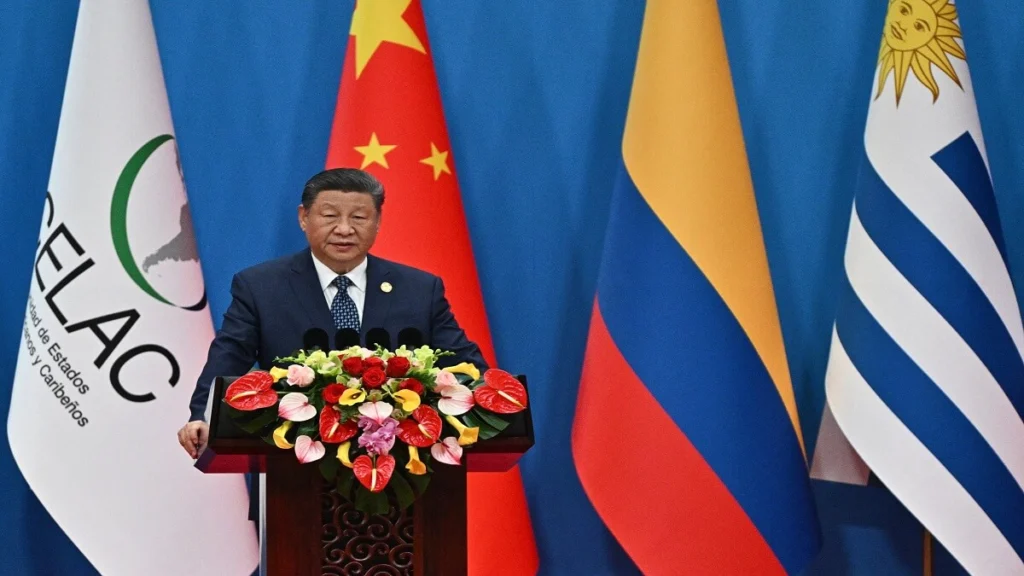
China’s new policy toward Latin America and the Caribbean confirms the Asian giant’s commitment to elevating the relationship to a “new level” through projects encompassing trade, clean energy, telecommunications, finance, health, agriculture, education, and active multilateralism, in stark contrast to the “Trump corollary” to the Monroe Doctrine, revealed over the weekend.
RELATED:
Putin Reaffirms Support for Venezuelan President Maduro in Phone Call
According to ECLAC, trade between China and Latin America reached US$495 billion in 2023, while cumulative direct investment exceeds US$160 billion over two decades, with more than 3,500 Chinese companies currently operating in the region.
China is currently the main trading partner of Brazil, Chile, Peru, and Uruguay, and the second largest in all of Latin America. The official document from Beijing reaffirms that this relationship will be deepened based on mutual respect, shared benefits, and the rejection of all forms of interference.
In areas such as telecommunications, energy, and public works, China’s presence is already decisive. Companies like Huawei and ZTE are involved in deploying communication networks in more than twenty countries, while Chinese energy investment in 2024 represented 57% of Beijing’s total overseas investment, primarily in solar and wind projects in Brazil, Argentina, Chile, Cuba, and the Caribbean.
Added to this is the consolidation of strategic infrastructure such as railways, transoceanic corridors, ports, and logistics projects that connect regional trade with Asia.
Beijing also maintains cooperation in science, health, and technology, with joint laboratories in Brazil and Chile, and has supplied more than 410 million doses of vaccines during the pandemic.
El presidente de #Cuba, Miguel Díaz-Canel dio una entrevista a la agencia china. En la conversación habló de algunos elementos de la Revolución China que pudieran servir de ejemplo e inspiración para Latinoamérica y el Caribe. pic.twitter.com/kdqXIDEXzA
— teleSUR TV (@teleSURtv) October 9, 2025
China emphasizes that its policy toward Latin America is guided by non-intervention, respect for sovereignty, the defense of multilateralism, and the rejection of unilateral sanctions, especially against Cuba, Venezuela, and Nicaragua.
It also highlights the promotion of political dialogue and the strengthening of Latin American and Caribbean organizations such as CELAC, which it recognizes as playing an increasingly important role in shaping a more balanced international order.
The verified progress of China’s anti-hegemonic plan in the region is palpable, especially in the commercial, financial, and diplomatic spheres.
Este año es el 10° aniversario del funcionamiento oficial del Foro China-CELAC. La cuarta reunión ministerial del foro será en Beijing el 13 de mayo y el presidente, Xi Jinping, asistirá a la ceremonia de apertura y pronunciará un discurso
Conoce más en: https://t.co/uzRJtNC9a7 pic.twitter.com/jfFYWvWmaX— teleSUR TV (@teleSURtv) May 15, 2025
In several countries, the weight of the Chinese market has reduced historical dependence on trade with the United States. Brazil, Peru, and Chile export more than a third of their national production to China, while Uruguay is making progress in negotiations for a free trade agreement.
At the same time, Chinese banks have granted more than US$137 billion in loans since 2005, without requiring structural reforms or adjustment programs.
Strategic infrastructure also reflects this momentum: China participates in more than 70 energy projects, manages or modernizes 26 ports in the region, and contributes to more than 40 railway projects, including Uruguay’s Central Railway and the metro systems of Chile and Mexico.
Cooperation also includes logistical, policing, and technology programs applied to civil security, as well as maritime exchange and surveillance agreements to strengthen national capacities.
#ENVIDEO | #Brasil 🇧🇷 rechazó la presencia militar de #EEUU 🇺🇸 en América Latina. #Irán 🇮🇷 pidió un frente contra sanciones. #China 🇨🇳 respaldó una salida política en #Ucrania 🇺🇦. #Rusia 🇷🇺 denunció el chantaje de Washington pic.twitter.com/poKC3LezJD
— teleSUR TV (@teleSURtv) September 11, 2025
In the diplomatic arena, China maintains comprehensive strategic partnerships with Brazil, Venezuela, Argentina, Mexico, Ecuador, Bolivia, Chile, and Cuba, which have expanded political, technological, and financial coordination.
With this new roadmap, Beijing positions Latin America and the Caribbean within a transforming global landscape, where multipolarity, regional integration, and South-South cooperation are central to overcoming the logic of tutelage and domination that has historically plagued the hemisphere. For China, the region is not an arena of competition but a strategic partner for a model of peaceful and sovereign development.
From teleSUR English via This RSS Feed.