

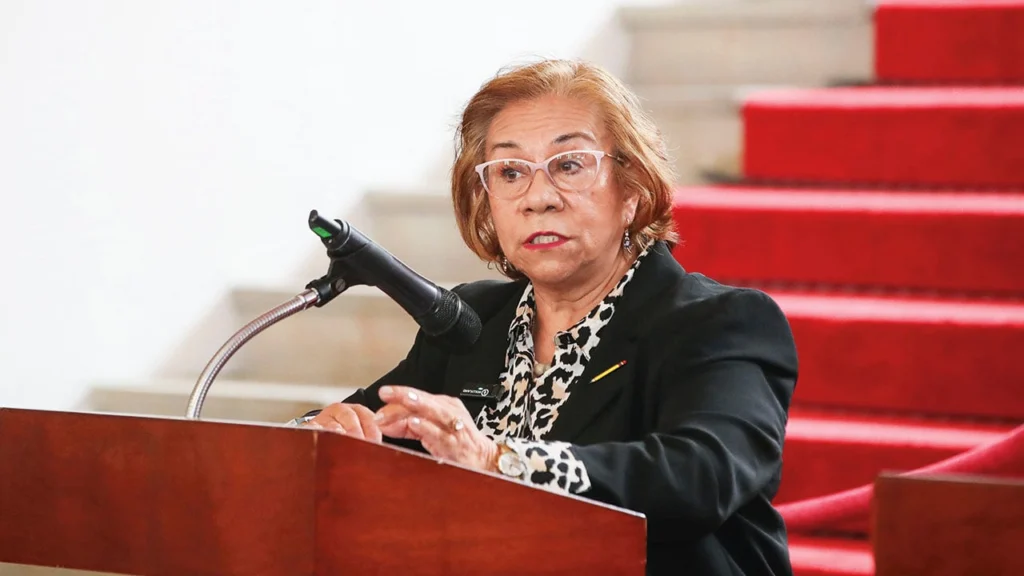
In an interview this Thursday, December 11, Colombian Foreign Minister Rosa Yolanda Villavicencio expressed her country’s rejection of the awarding of the Nobel Peace Prize to Venezuelan far-right activist María Corina Machado.
Villavicencio explained that the objection stems from the laureate’s belligerent stance, as she has repeatedly called for military intervention in Venezuela. While acknowledging the autonomous nature of the organization that awards the prize, the Foreign Minister considers this award incompatible with the essence and purpose of the recognition.
RELATED:
Norwegian Peace Movement Opposes 2025 Nobel Peace Prize for Maria Corina Machado
Furthermore, referring to the recent statements by US President Donald Trump regarding Colombia, the Foreign Minister rejected the threats, insisting that relations between nations must be based on “mutual respect, dialogue, and consensus,” and not on unilateral force.
📌#ANÁLISIS | El abogado de derecho público, Jesús David Rojas, expresó que el Premio Nobel de la Paz 2025 perdió su valor, manifestando su postura de que no debería recibirlo una persona que contribuye a la guerra, que pide invasiones contra su país, apoya el genocidio en… pic.twitter.com/uUaRS2Qj1g
— teleSUR TV (@teleSURtv) December 11, 2025
The Foreign Minister also emphasized that Colombia does not accept threats against any other country and stressed that the use of force or unilateral power leads to “greater conflicts and instability.”
In this regard, the head of Colombian diplomacy reaffirmed the country’s commitment to the principles of the Charter of the United Nations, which advocate for multilateralism as a fundamental tool for global coexistence.
The recent statements by Donald Trump, regarding the possibility of expanding anti-drug military operations to nations such as Colombia and Mexico, have generated greater concern in the region. This concern is heightened by the current context of increased US military presence in the Caribbean and Pacific Oceans, justified under the pretext of combating drug trafficking.
US military actions have involved the deployment of military forces and the execution of lethal operations against what they describe as alleged drug trafficking vessels. However, these operations have been condemned by various international organizations and governments around the world.
Contrary to Washington’s accusations, data from the United Nations (UN) and the US Drug Enforcement Administration (DEA) itself indicate that Venezuela (one of the countries singled out by the White House) is not a primary route for drug trafficking into the United States. More than 80 percent of narcotics transit the Pacific route.
From teleSUR English via This RSS Feed.