

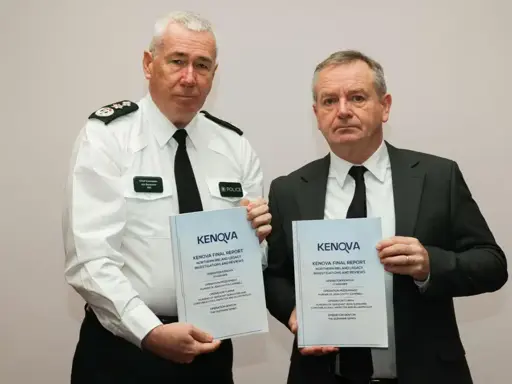
A review into 98 cases of serious criminality linked to the so-called ‘Glenanne Gang’ has confirmed that there was extensive and “deplorable collusion” between loyalist paramilitaries and British security forces. A summary of the findings is found within the larger Kenova Report, set up to look into cases linked to an IRA infiltrator known as Stakeknife, who was responsible for multiple murders and kidnappings.
Operation Denton was the section set up to investigate the ‘Glenanne series‘, a spate of brutal sectarian killings of Catholics in the Northern Ireland and Republic of Ireland between 1972-78. The murders were associated with a cell of Ulster Volunteer Force (UVF) terrorists based at a farmhouse in the village of Glenanne, assisted by corrupt members of the Royal Ulster Constabulary (RUC) and other security forces elements. However, the report concluded that the 100+ “shootings and bombings resulting in death or serious injury to hundreds of victims” were tied to a much larger network of loyalist violence.
Collusion long known, yet detailed report arrives 45 years late
Collusion between UVF members and the RUC in the Glenanne cases has been known since 1978, when the kidnapping of Father Hugh Murphy by two police officers led to their arrest. One of them, William McCaughey admitted various other offences and began implicating other RUC staff, including Police Sergeant John Weir. Weir said that:
…among those who knew of the activities of the gang were RUC chief inspector Harry Breen and chief superintendent Brian Fitzsimmons, head of the Newry-based RUC special branch.
Weir said Breen was:
…doing his job as a policeman and carrying out official policy.
The Cassel report of 2006 found that:
In 12 cases — 11 murders and one attempted murder — former RUC officer John Weir accuses RUC officers and agents or UDR [Ulster Defence Regiment] soldiers of participation. The panel finds Weir’s allegations, in general, to be credible.
Breen was later assassinated by the IRA in 1989. Various other reports also found evidence of collusion, before the judgement of a judicial review in 2017 in favour of Edward Barnard. The UVF killed his 13-year-old brother Patrick in a 1976 bomb attack that also ended the lives of three others.
The PSNI’s Historical Enquiries Team had been looking into 3,269 cases of unsolved murder from The Troubles, but the police service shut it down in 2014 when restructuring in the wake of the Conservative government’s austerity policies. Their report into Glenanne was 80% complete when it was abandoned. The ‘Barnard Judgement’ ruled that the work must be completed.
Operation Denton has now conducted the most thorough review of Glenanne so far, and has confirmed that there was:
…clear evidence of the active involvement of members of the security forces with loyalist paramilitary groups. This collusion involved extremely vicious and serious criminal activity, including bombing attacks and murder.
The report also states that:
…paramilitary groups regularly supplied with intelligence by members of the security forces and that UVF members and sympathisers existed within the UDR, the RUC and RUC Reserves and the Territorial and Army Volunteer Reserve (TAVR).
It also found that intelligence indicating involvement of loyalist death squads in serious crimes was “not…adequately acted upon”. The report is highly critical of how families of victims were treated, saying:
Many did not receive an adequate response from the authorities in terms of the level of compassion and care provided. For many, providing an account to Operation Denton was the first time they had a positive experience with state authorities.
Victims’ families mistreated amid stifling secrecy regime
Livingstone also states that:
The anger and frustrations of many families have been compounded over subsequent years through having to deal with an inability or reluctance on the part of the security forces to provide answers to their legitimate questions.
The extreme secrecy of the security forces is outlined in the Stakeknife case, in which MI5 still refuse to publicly confirm that Fred Scappaticci was the man involved, despite it being in the public domain for over 20 years. MI5’s criminality even extended to breaking into a safe used by the Operation Kenova team.
The Kenova investigation also looked at the Dublin and Monaghan attacks, which were a series of bombings carried out by the UVF in 1974. 33 people were murdered and 300 injured by four car bombs that exploded during rush hour. They found “no evidence of collusion”, though said it “cannot
be categorically excluded”. Families of the victims are still adamant that the horrifying attack — the worst of The Troubles — was assisted by state forces.
Despite the massive scale of what the report correctly calls the “horrific activities” of the UVF and security forces, Denton has determined that:
…there do not appear to be any realistic opportunities from an investigative or forensic perspective, to warrant any form of criminal re-investigation into these attacks.
In the absence of any new and compelling evidence coming to light, or admissions of guilt from those suspected of involvement in the attacks, the prospect of any successful criminal justice outcome by way of prosecution in the future is extremely unlikely.
Benn falsely claims moral divide between British security forces and paramilitaries
This is part of a pattern in which proper enquiry is delayed for years by the British government, either through the collusion of forces at the time, cuts to investigation budgets or unjustifiable secrecy of intelligence services. By the time cases are properly looked at, those involved have died and evidence is lost or decayed, making prosecution much harder.
Kenova’s interim report in 2024 made various recommendations, such as the creation of a new framework for looking at cases from The Troubles. The authors also recommended separate apologies from the British government and republican leadership. When discussing new legislation to look at legacy cases, Secretary of State for Northern Ireland Hilary Benn said:
There is no moral equivalence whatsoever between those members of our armed forces who acted lawfully in carrying out their duties and paramilitaries who were responsible for barbaric acts of terrorism.
As the Kenova Report confirms, precisely the opposite was true — British security forces and the paramilitary murderers they were meant to stop were often one and the same.
Featured image via Police Service of Northern Ireland
From Canary via This RSS Feed.