

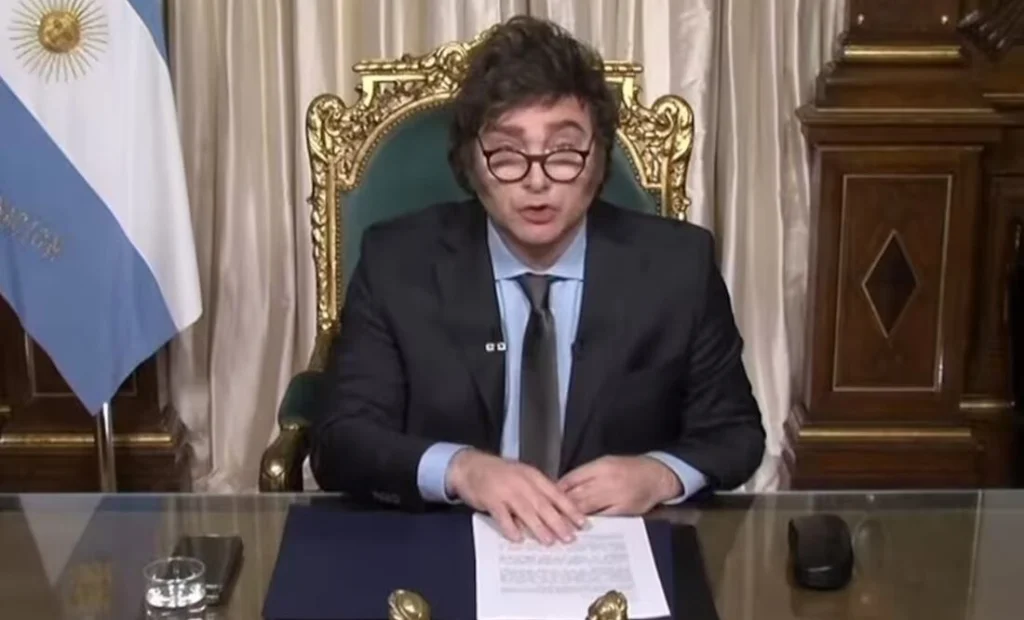
Argentine President Javier Milei signed the “Labor Modernization” bill on Thursday, December 11, and sent it to Congress for discussion, seeking to accelerate his reform package by taking advantage of the new legislative composition.
The bill, which contains 182 articles, has been described by various sectors as a “slave labor” reform that aims at precarious employment, longer working hours, and a reduction in workers’ rights, granting advantages to employers.
RELATED:
Milei Unveils “Educational Freedom Law” in Argentina, Sparking Fears of Privatization and Defunding
Accompanied by Chief of Staff Manuel Adorni, the president signed the text that seeks to modify labor conditions in Argentina. The government bases its proposal on the need to reverse the “chronic stagnation of formal employment” which, according to the far-right party La Libertad Avanza (Freedom Advances), has pushed millions of Argentinians into the informal sector.
El Presidente de la Nación firmó hace unos instantes el proyecto de modernización laboral que se enviará inmediatamente al Congreso de la Nación. El mismo representa la transformación más grande de la historia argentina en materia laboral.
Dios bendiga a la República Argentina.… pic.twitter.com/rJCrDJ3VY6
— Manuel Adorni (@madorni) December 11, 2025
The Executive Branch blames the combination of high litigation costs, imprecise regulations, and a rigid labor structure for hindering the creation of formal jobs. The initiative promises to simplify registration, clarify the salary components that make up severance pay, modernize leave policies, and strengthen the predictability of the system, with a special focus on benefiting small and medium-sized enterprises (SMEs).
The government’s legislative strategy aims for preliminary approval of this bill in December, taking advantage of the extraordinary session period that extends until the 30th of this month.
To defend and explain the bill, Milei appointed the Minister of Deregulation and State Transformation, Federico Sturzenegger; his secretary, Maximiliano Fariña; and the Secretary of Labor, Employment, and Social Security, Julio Cordero, as official spokespeople.
The Casa Rosada (Presidential Palace) hopes that the debate on labor reform will conclude in early 2026, specifically between the end of January and the beginning of February, the same period in which they will also seek to pass other bills.
⚠️ Que CGT y CTA convoquen plan de lucha. Abajo la reforma laboral esclavista: el 18 a las 18h, todas y todos a las calles.
Derrotemos la reforma penal represiva y el paquete de leyes contra el pueblo trabajador. La ley de glaciares no se toca
Exigimos un paro activo nacional… pic.twitter.com/ahWfrw9496
— PTS | Frente de Izquierda Unidad (@PTSarg) December 11, 2025
The government’s legislative strategy seeks to secure preliminary approval for this legislation in December, taking advantage of the extraordinary session period that extends until the 30th of this month. Despite attempts to expedite the legislative process, the bill will not pass without resistance and street protests. With the possibility that the debate will begin in the Senate next Thursday, December 18, various sectors have already begun calling for a mobilization to Congress.
The call is being driven by unions, internal commissions and militant delegate bodies, university, college, and secondary school student centers, human rights organizations and social movements, and political parties of the Left Front Unity coalition.
The call is to gather on December 18 at 6:00 PM local time at the intersection of Avenida de Mayo and 9 de Julio to march to Plaza Congreso, under the slogan “Down with the exploitative labor reform and all anti-popular reforms.”
The sectors in resistance demand that the leadership of the General Confederation of Labor (CGT) and the Central Union of Workers of Argentina (CTA) abandon the “truce” and call for assemblies in the workplaces and a general strike to impose a plan of struggle that defeats the plan of a Government more interested in meeting the demands of the International Monetary Fund (IMF).
From teleSUR English via This RSS Feed.