

Just over a year ago, the now-mayor-elect Zohran Mamdani told us: “Despair thrives in isolation, but dies in organization.” This was part of a call to join DSA only a few weeks into the NYC mayoral campaign.
Yesterday, Zohran joined several progressives in endorsing Brad Lander for New York’s 10th Congressional District, a direct blow against NYC-DSA’s endorsement of Councilwoman Alexa Avilés for the seat back in November. This marks one of Zohran’s swiftest endorsements this cycle, coming faster than any of the NYC-DSA-launched campaigns, including Diana Moreno, who is officially running for his former Assembly seat with DSA backing.
The same day as Brad’s statement, Alexa announced she was no longer pursuing NY10. She had a much longer runway of publicly exploring her run for Congress than Lander. How could it be that “no one knew” (assuming an earlier NYT report is true) that Zohran had promised support for Lander’s candidacy if he didn’t land an appointment in City Hall?
Unlike Zohran’s personal intervention against endorsing Chi Osse, Alexa’s endorsement process concluded without his or his team’s direct participation. Members were aware of potential progressive challengers, which echoed the competitive primary that delivered Dan Goldman the seat in 2022. Still, they were confident that Alexa could clear the lane and approved her candidacy by a supermajority at every level. Zohran chose to circumvent the democratic process, relying on public silence and backroom maneuvering to ensure Brad’s path to victory was a fait accompli.
What can explain Zohran’s transition from a heralded cadre candidate and vocal champion of the organization to a power broker willing to use his influence to undermine our endorsement process?
We must first dismiss out of hand the idea that this move stems from eithera lack of sufficient support from DSA, or a lack of organization. His campaign could not have been won without NYC-DSA members serving as a core base of supporters, canvassers, staffers, and fundraisers. Zohran, during his initial pitch for endorsement, acknowledged he could not and would not run without NYC-DSA. This decision reflects the power inherent in our party project.
Although the chapter did not move forward with requesting a national endorsement for Zohran, this did not stop National DSA from broadly supporting his candidacy and celebrating his victories. After the primary, the National Electoral Commission (NEC) hosted the NYC Co-Chairs to share insights from the campaign. The National Political Committee (NPC) released statements for the primary and general elections, underlining the importance of these wins. Our national electoral effort went on to raise $100,000+ this cycle and push 13 DSA-endorsed candidates to victory across the country. DSA has grown by 11,000 members in under two months since the launch of the national fall membership drive, surpassing the 90,000-member mark for the first time in our history. And NYC-DSA alone has doubled in size in the last year, reaching over 13,000 members.
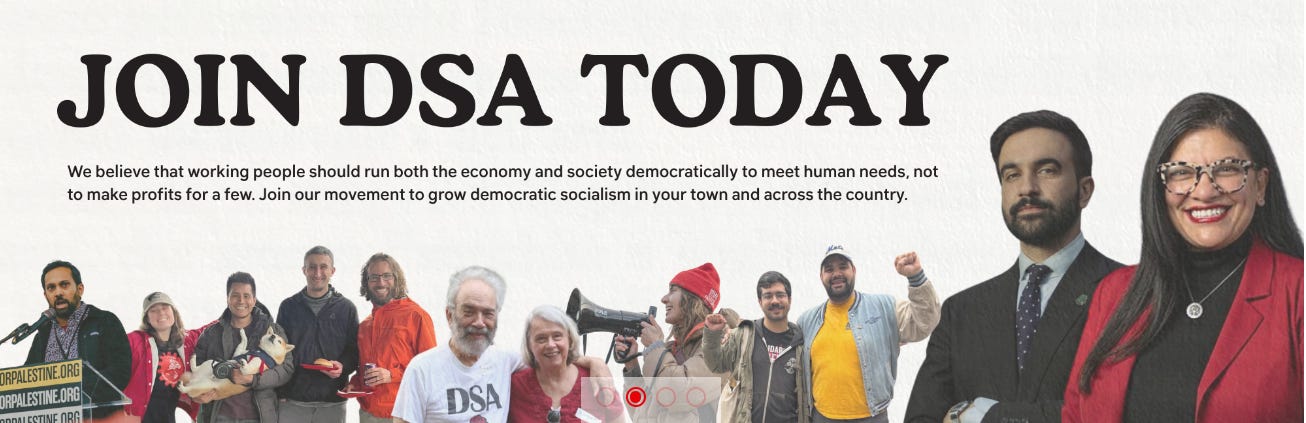
Zohran Mamdani, as pictured on the front page of www.dsausa.org
One Step Forward, Two Steps Back
Zohran’s move to spite his own party stems from the historical leeway given to NYC chapter-endorsed Socialists in Office (SIOs) to achieve their own legislative ends.
In 2022, State Senator Julia Salazar introduced the NYCHA Trust bill, which allowed for NYCHA complexes to raise funds via private bonds, and which many saw as opening the door to privatization. The ramifications of Salazar’s bill split both our membership and our endorsed elected officials, breaking the Socialist bloc vote in the State Legislature. Rather than take a position, chapter leadership chose to remain on the sidelines. When members of the Housing Working Group (HWG) tried to organize and pressure Salazar into retracting her bill, chapter leaders moved to silence these members.
That September, Tiffany Caban supported a developer-backed rezoning proposal in her district, despite opposition from the Queens HWG. After the working group expressed criticism publicly, the 2022 NYC-DSA Convention passed the “Protocol for Public Announcements of Reproach of Elected Officials,” which expressly prohibited the critique of elected officials by chapter bodies and created a multi-layered filter to suppress dissent and disagreement. The 2022 Convention also rejected measures to set policy around democratic discipline. The 1-2-3-4 Proposal, which would have established that socialist elected officials consistently cross-endorse, run on a common platform, and vote as a bloc, was voted down. (We should note that Zohran was one of the only SIOs to support this proposal.)
The 2024 Convention, which approved Zohran’s campaign, also saw some progress toward setting policy around the SIO committee acting as a unified body. The proposal “A Mass Action Electoral Strategy for NYC-DSA” reestablished some basic expectations for why and how we run electoral campaigns. Along with the standard that candidates we endorse “publicly identify themselves as socialist,” we reiterated the expectation that “all NYC-DSA endorsed elected officials and candidates should support each other via cross-endorsement.”
Still, turning expectation into reality requires commitment. Several SIOs remained publicly noncommittal of Zohran’s candidacy. In January 2025, a Brad Lander for Mayor launch party featured SIOs Phara Souffrant Forrest and Tiffany Caban on the same night as a Zohran-hosted fundraiser just a mile away. Though Phara ultimately did not attend, she stated that she would not make any endorsements “until after the petitioning process is over in April.” With some exceptions, the endorsement delays continued well into the primary.
As the months passed, patience ran thin. A resolution calling on SIOs to “Endorse Zohran #1 and Build the Party” swept the support of several branches and passed in the Citywide Leadership Committee (CLC). Only after these efforts did holdouts like Julia Salazar and Emily Gallagher come on board. Tiffany Caban and Alexa Aviles endorsed Zohran on May 9, a week before the deadline that, per the resolution, would’ve been a mark against them in the next endorsement cycle. For NYC-DSA, this was a moment of democratic discipline on elected officials rarely seen in the chapter. We should note, however, that this resolution only went as far as it did because it had the backing of a faction of chapter leadership that usually rejects discipline.
Ironically, it was Zohran’s team that foreshadowed he might be the next obstacle to building DSA’s electoral project into a democratic and disciplined bloc. Weeks after winning the primary, his campaign manager signaled that Zohran would not automatically endorse DSA candidates. Instead, he would “make decisions on endorsements based on who could help him deliver on his agenda.”
Zohran’s decision to endorse Brad Lander over fellow SIO Alexa Aviles is largely a reflection of the precedent we’ve set for our socialists in office. “Endorse Zohran #1” was successful because it relied on member participation to both set and enforce basic standards. Hundreds of members across the chapter were involved in writing, endorsing, and voting to approve the resolution. This process communicated the broad legitimacy and support that democratic discipline can have in the chapter, which would not be possible if a similar resolution had been passed via the Steering Committee or under executive session in the CLC. The resolution’s hard deadline—and a willingness to take a failure to meet it seriously—communicated to the holdouts the commitment of membership to the demand.
Member-led programmatic politics have always been the core of DSA’s success, and a lack of commitment to this principle has been the source of many failures. DSA’s 2025 National Convention passed “Principles of Party-Building.” The first point of the resolution establishes that “the fundamental purpose of a socialist party is to be a mass association of the working class formed for collective political action.” An SIO is a member of the organization elected to office. If we set the precedent that they are free to vote in opposition to other SIOs on the same bill, or against the positions of the organization as a whole, DSA becomes less of a place for “collective” political action than the individual action of isolated public officials.
The Resolution goes further: “The foundation of party democracy is freedom of information, association, and discussion.” Though Alexa’s endorsement for Congress involved thousands of ballots sent to members via “One Member One Vote,” the ultimate decision was made under executive session in the CLC. Deciding endorsements under executive session is atypical because membership has a vested interest in knowing whether our leaders support or oppose proposed campaigns.
The initial New York Times report that rumored Brad Lander would enter the race was published just one day before NYC-DSA announced Alexa’s endorsement, which had already been delayed for several weeks. The use of executive session and the juxtaposition of the announcement with the NYT’s report suggest that Zohran’s support for Lander may have been known by chapter leadership much earlier than what was presented to members. The delayed (and slightly muted) announcement for Alexa’s endorsement was unprecedented for such a highly visible race.
These were the conditions that set up Alexa for failure. Without an early willingness to commit to backing up Alexa’s candidacy, members could not donate, pledge funds, commit to volunteer, or strengthen Alexa’s candidacy in any material way. Zohran has effectively disorganized DSA’s intervention in NY10. That battle is unfortunately behind us. But we will surely face new and unprecedented challenges as NYC-DSA runs our largest-ever slate in 2026. Only through a consistently serious approach to member-led democratic discipline can we develop long-term solutions to the problems we face in building a durable Socialist Party.
From The Socialist Tribune via This RSS Feed.