

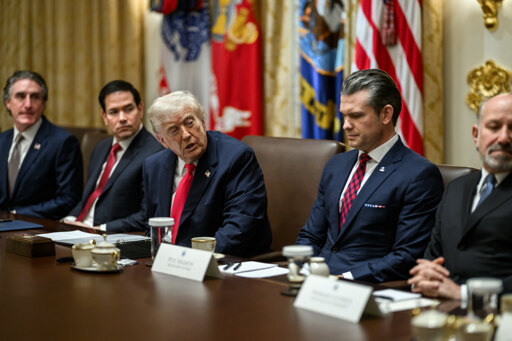
For those who’ve followed Trump and his cabinet’s foreign policy, there is nothing surprising in the administration’s new National Security Strategy (NSS). But now, the administration’s foreign policy agenda is laid out bluntly and in writing.
The Trump administration is an expression of the end of decades of neoliberalism and unmatched U.S. hegemony that defined the post-Cold War international order. The system in which the United States leaned on its control of international institutions to enforce its hegemony is no longer feasible. The United States has been stretched too thin. As I have written before, the real material limits of U.S. power are a basis for understanding Trump’s foreign policy. If this is still unclear, the new NSS puts it bluntly.
A strategy must evaluate, sort, and prioritize. Not every country, region, issue, or cause—however worthy—can be the focus of American strategy. The purpose of foreign policy is the protection of core national interests; that is the sole focus of this strategy.
Despite Trump’s “America First” slogan, which is mentioned throughout the document, Trump is no isolationist. What the NSS clarifies, however, is that the administration’s understanding of U.S. intervention is limited by the weakness of U.S. industrial capacity and domestic cohesion. The document vows to address these issues by deregulating the U.S. economy to encourage investment and tech innovation, ramping up fossil fuel production, and “securing” the country’s borders. The document claims that such a policy will be “Pro-American Worker.”
In reality, Trump’s vision of rebuilding U.S. industrial capacity to re-establish economic and military power requires gutting worker protections. His war on immigrants is a way to keep American workers isolated from our international class siblings, stratify workers within the United States, and build up a domestic apparatus of repression which can be turned from war on immigrants to war on any form of dissent or rise in class struggle.
A Focus on China, a Battleground in Latin America
The NSS goes on to rank the main regions of the world in terms of their level of significance to the administration, and summarizes the administration’s approach to each region. The Western Hemisphere is listed as the top priority for the first time, replacing Asia. Europe, the Middle East, and Africa are listed afterwards in that order.
This approach shamelessly embraces the Monroe Doctrine in which the United States sees Latin America and the Caribbean as its backyard and intervenes to remain economically, politically, and militarily dominant throughout the region. It reeks of imperial arrogance, considering that throughout the NSS Trump pays lip-service to the importance of not meddling in other countries’ affairs.
While the NSS doesn’t explicitly mention China as the main U.S. rival in the Western Hemisphere, it vows to “deny non-Hemispheric competitors the ability to position forces or other threatening capabilities, or to own or control strategically vital assets, in our Hemisphere.” This is a not-so-subtle reference to China which has greatly expanded its influence in Latin America.
Where competition with China is much more explicit is the section on Asia. As the first sentence of this section says:
President Trump single-handedly reversed more than three decades of mistaken American assumptions about China: namely, that by opening our markets to China, encouraging American business to invest in China, and outsourcing our manufacturing to China, we would facilitate China’s entry into the so-called “rules based international order.”
The rest of the section mostly marks the continuity that has defined the United States’s Asia-policy from Trump’s first term through Biden’s administration to Trump’s return. The NSS deems Asia “among the greatest economic battlegrounds of the coming decades,” and vows to “rebalance” U.S. economic relations with China. The strategy makes clear that a U.S. lead in innovation of emerging technologies such as AI is essential to curbing China’s advantages. Additionally, the document says the United States must enlist its allies including Japan, South Korea, Mexico, Canada, European countries, and Gulf countries to play a role in rebalancing trade with China. The strategy also elaborates on the need for the United States and its allies to militarily contain China in the region, arguing military superiority is the most effective way to deter a more direct confrontation.
Attempting to Retreat from Other Regions
The NSS section on Europe is perhaps the most provocative. Some on the Left have called it outright white supremacist. And it is incredibly reactionary, claiming that Europe faces civilizational collapse due to immigration, which supposedly threatens Western identity. Much like Trump’s fear-mongering over immigration in the United States, his view of Europe is clearly informed by the racist “great replacement theory” which scapegoats immigrants for the Western imperialist countries’ economic crises. The document even voices support for far-right parties in Europe, echoing as official policy previous instances of Trumpist figures, most notably Vice President J.D. Vance, intervening in European politics to strengthen far-right allies.
Trump also makes clear his desire to have Europe take on the bulk of responsibility for the military defense and leadership of NATO. The document urges an end to the war in Ukraine and reintegration of Russia into relations with Europe and the United States. While Russia-hawks cite this as proof that Trump is supposedly subservient to Putin, the reality is that the war in Ukraine has been a costly distraction for an administration eager to shift its focus to Latin America and Asia, and continues to be a sinkhole for U.S. military resources. However, Trump’s efforts to strong-arm Russia, Ukraine, and Europe into accepting an end to the war that favors U.S. interests have gone nowhere.
The last region covered substantively by the document is the Middle East. Similarly to Europe, Trump’s aim is to get U.S. allies to take on greater responsibility for regional security so that the United States can focus elsewhere. Trump’s vision of achieving this is through the Abraham Accords which would normalize relations between Israel and the Arab regimes. Again, as with Ukraine, this is much easier said than done given how profoundly the Palestinian cause has changed regional dynamics and sparked an international movement with powerful expressions in the United States and Europe’s imperialist countries.
More than anything, Trump’s National Security Strategy is the confirmation of a major shift in U.S. foreign policy that the administration has been developing since January. It is incredibly reactionary. It is hypocritical. It claims respect for other countries’ internal matters while vowing to dominate Latin America and telling Europe to crack down harder on immigration. It claims to champion peace while continuing support for genocidal Israel and building up military alliances in the Pacific. It claims to value American economic power for the interest of workers, while promising to gut regulations that protect workers and to terrorize immigrant workers.
The fact that this far-right agenda to rebuild U.S. imperialism is now written out as official strategy shows the need for an internationalist strategy which confronts U.S. imperialism, and offers a vision for workers around the world who want to fight militarism, U.S. intervention, xenophobia, genocide, and a rising Far Right.
The post Trump’s National Security Strategy Makes His Reactionary Views Official Imperialist Policy appeared first on Left Voice.
From Left Voice via This RSS Feed.