

TRIGGER WARNING: mental health and suicide
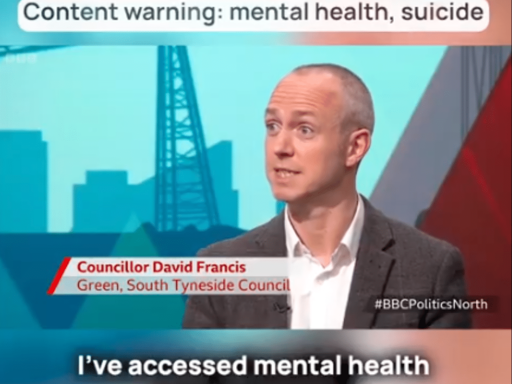
Green councillor David Francis spoke to the BBC about the UK’s worsening mental health crisis among men. And emphasising the role neoliberal austerity policies have played, he said:
if you look at the recent white paper, there’s a graph of life expectancy and there’s a slow upward trend and you hit 2010 and it flatlines. Now what happened in 2010? I think we all know. The coalition government – beginning of austerity. So I don’t think you can solve a men’s health crisis without solving other kinds of equality in society and without tackling poverty as well.
“I don’t think you can solve a men’s health crisis without tackling poverty”
Cllr David Francis on the crisis in men’s health and the long-term health impacts of austerity.
CW: mental health, suicide pic.twitter.com/PJQceUUweU
— The Green Party (@TheGreenParty) December 8, 2025
The South Tyneside councillor also highlighted the shocking statistic that:
People of all genders suffer mental-health disorders. But while women seem to face them more often, there are some big and very concerning differences with men, who are less likely to seek help. For example:
According to the Office for National Statistics (ONS), three out of four people who take their own lives are men (75%)
And numerous sources, including mental-health charity Mind, highlight that a key factor leading to these struggles is:
Other factors include physical health concerns, social exclusion or discrimination, trauma, physical appearance, and social media.
When we reported specifically about suicide risk among students in September, men were again most at risk. We highlighted how masculine gender norms and expectations played a role. Isolation and the strain of competing responsibilities did too. We also looked at the role culture, ethnicity, and religion may play, while highlighting that:
as research about the general population reveals, both poorer people and disabled people are more at risk of suicide.
Neoliberalism has been worsening our mental health
The capitalist extremism of the last five decades — neoliberalism — has placed more and more power in the hands of a tiny, obscenely wealthy group of people.
It has brought us privatisation, austerity (cuts to public spending), freeing companies from rules, and encouraging people to compete with each other rather than cooperate. Even many mainstream economists say this system has deepened inequality, undermined democracy, and slashed most people’s living standards.
Whether it’s a direct aim or a side effect, this process has severely damaged our health. Since the 1990s, there’s been a big increase in mental health problems. But more recently, it’s the austerity offensive of the Tories and their allies from 2010 onwards that has had an impact.
The political establishment made ordinary people pay the price for the 2007/8 financial crisis of the super-rich, by slashing health spending. And this squeezed mental health services in particular. Doctors treated symptoms as best they could. But the lack of resources meant they often had to make tough decisions about whose care was ‘most urgent’.
Severe underfunding has meant longer waits, rationing of services, and more bare-bones support. The private sector hasn’t been able to keep up with demand either. And lack of support for people struggling with their mental health has too often led their situation to spiral.
People the system has impoverished or minoritised have borne the brunt of this assault on our wellbeing. And the youngest people, whose mental health has also declined, have grown up within it.
To solve this crisis, we need to dump neoliberalism
Whether you’re anti-capitalist or not, it’s clear that things don’t have to be this way. Not only do more equal societies have less mental illness. Proper funding could actually save us money in the long run.
At the same time, neoliberalism helps to nurture toxic masculinity. Its focus on competition and wealth puts aggression and dominance on a pedestal. Both are dangerous and destructive. And they don’t just fuel abusive behaviour. They are also a massive challenge to men’s mental health.
Western society has encouraged men to be ‘strong and in control’. And neoliberalism has fostered this idea. So too many men focus too little on what they need for their own mental wellbeing. It’s no surprise, then, that they have:
lower levels of life satisfaction than women, according to the Government’s national well-being survey
And part of fitting in with what society expects is hiding when we are struggling.
To solve the mental-health crisis, though, we don’t just need to challenge toxic masculinity. We also need:
- Proper funding for accessible mental-health services
- Community-building – more interaction and cooperation with others
- And a system that fosters healthy routines – not a constant grind to survive
All of that means defeating neoliberalism. And we need more people like David Francis who will say that clearly and unapologetically.
Featured image via Green Party
By Ed Sykes
From Canary via This RSS Feed.