

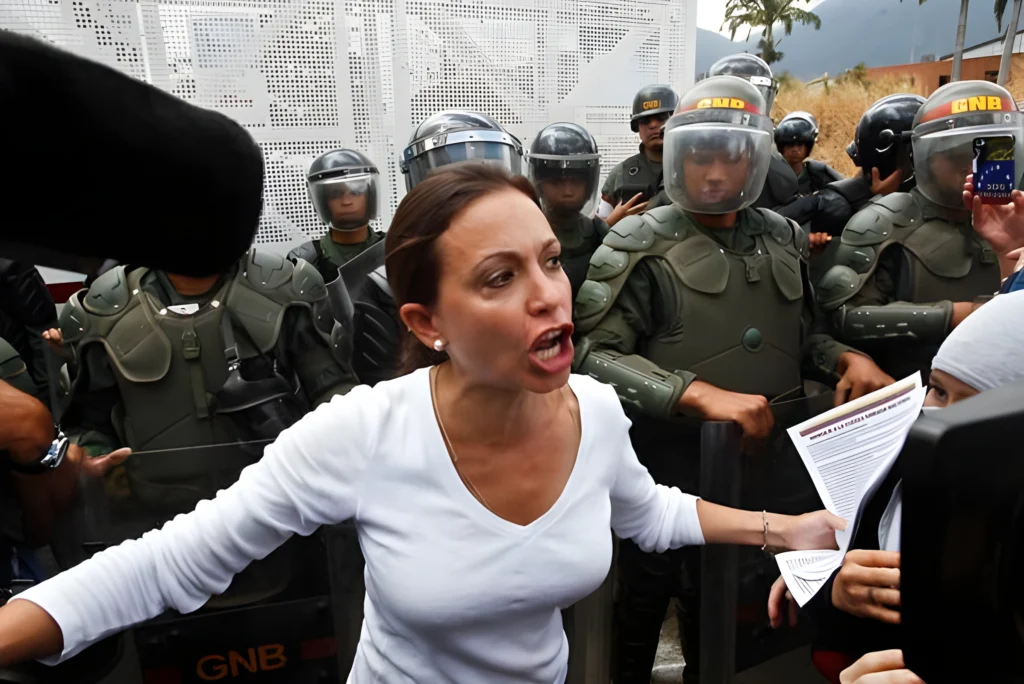
Examining the Hardline Machado’s Role in the Violent ‘Guarimbas’ and the Geopolitical Agenda for Regime Change.
The term “guarimba” in Venezuela is not synonymous with peaceful protest. It is a controversial word that defines a specific, confrontational tactic used by radical sectors of the country’s right-wing opposition.
RELATED:
Machado Embodies the Weaponization of the Nobel Peace Prize
Derived from a word meaning a safe space, the political “guarimba” became its deadly opposite: a strategy of urban paralysis and chaos.
They were not spontaneous uprisings but calculated operations, first seen in a major wave in 2004 and later intensified in 2014 under the banner of “La Salida” (The Exit), always aimed at the extra-constitutional ouster of a democratically elected government.
At the center of this strategy stands María Corina Machado, a figure tied to the wealthiest sectors of the Venezuelan elite.
This in-depth analysis explains how the guarimbas became a political weapon, tracing their violent history, the direct role of Machado in inciting military intervention, and civil conflict.
And how her connection to these destabilization efforts, and foreign sanctions led to her political disqualification, intending to distinguish genuine democratic opposition from the aggressive, anti-popular agenda of the hardline right.
Estados Unidos financió y apoyó las “Guarimbas” en Venezuela, intentando crear con mercenarios y vándalos tarifados una “primavera árabe”, para derrocar al Chavismo, pero fracasaron.
Maduro los derrotó si echar un tiro, los desalojó de las calles, encerró a los violentos y… pic.twitter.com/aH0ldlDdmn— SonPolemicas (@SonPolemicas) November 19, 2025
The text reads: “The United States financed and supported the “Guarimbas” in Venezuela, attempting to create an “Arab Spring” with mercenaries and paid vandals to overthrow Chavismo, but they failed.
Maduro defeated them without firing a shot, cleared them from the streets, imprisoned the violent protesters, and restored peace to Venezuela. They couldn’t, and they won’t be able to.”
The “guarimba” strategy
The guarimba strategy is a radical, high-conflict tactic employed by opposition sectors, including those led by Machado, to provoke the extra-constitutional ouster of the Venezuelan government.
A guarimba is a form of street protest marked by the blocking of public roads and avenues using improvised barricades.
These barricades are typically built with burning tires, trash, and debris to halt both vehicular and pedestrian traffic, and are often operated by masked groups known as ” guarimberos .”
Key characteristics of the guarimba as a political weapon include:
- Human toll: The first wave of guarimbas in 2004 resulted in nearly ten deaths, while the intensified 2014 campaign under the slogan “La Salida” caused at least 43 fatalities and more than 800 injuries; the Public Defender described the barricades as “traps to hunt human beings”.
- Intentional disruption: These blockades represented a systematic denial of citizens’ fundamental rights, preventing access to schools, hospitals, and vital medicines such as insulin.
History of coup plotting, calls for force, and foreign backing
The 2014 protests were explicitly organized as the “La Salida” campaign, co-led by Machado and Leopoldo López, and framed as a “soft coup attempt”. This campaign was held responsible for the deaths of 39 people, including six National Guard members.
Machado played a direct role in inciting these actions. On January 23, 2014, the day the protest wave was launched, she urged followers to “light up the streets of Venezuela, every corner, the markets, the schools, the universities and plazas”, a call that was followed by street violence, confrontations with security forces, and the use of homemade explosive devices.
Her political trajectory has rejected the electoral route in favor of extra-constitutional mechanisms to remove the government. This longstanding support for anti-democratic actions and foreign intervention directly underpins her political disqualification.
Machado’s anti-democratic record dates back to the April 2002 coup d’état against President Hugo Chávez. She signed the Carmona Decree, which dissolved the Constitution, the National Assembly, and the Supreme Court, endorsing the de facto regime of Pedro Carmona Estanga.
In 2014 she appealed before the US Congress for military intervention in Venezuela, stating that “the only path left is the use of force”, and in 2017 she addressed soldiers outside a military base, declaring that “the time has come to act, to lay down your arms” and calling for a “quiebre” (break) in the system.
She is described as an “egregious agent of the empire”, heading a hardline faction that has received substantial financial and political backing from foreign entities.
She “tirelessly advocated” for harsh US and European economic sanctions, which the Supreme Court of Justice (TSJ) describes ruling as a “criminal blockade” that severely damaged public health by preventing the purchase of antiretroviral medicines for HIV/AIDS patients and essential vaccines.
¡DOBLE RASERO!
Durante “La Salida”, la extrema derecha reclutó a jóvenes, entre ellos niños, para promover las guarimbas.
Vea el material ARCHIVO donde un guarimbero confesaba que le ofrecían dinero y drogas. 👇🏻 pic.twitter.com/byImFYYvEB
— Michel Caballero Palma (@MichelCaballero) October 6, 2024
The text reads: “Double standards! During “La Salida” (The Exit), the far right recruited young people, including children, to promote the violent protests. See the archive footage where a protester confessed that he was offered money and drugs.”
Disqualification for crimes against the nation
In January 2024, the TSJ ratified the 15-year disqualification of Machado from holding public office:
- Grave corruption: Her complicity in the Guaidó-led scheme to strip the country of foreign-held assets such as CITGO.
- Violation of health rights: Her support for economic sanctions that blocked the import of essential medicines, inflicting documented harm on public health.
- Loss of parliamentary seat: Her violation of the Constitution in 2014 by accepting accreditation as Panama’s Alternate Representative to the OAS, which led to the loss of her investiture as a Deputy.
The Venezuelan government presents this ruling as a constitutional measure to hold opposition leaders accountable for treason and economic damage, while Machado and US-aligned governments denounce it as “politically motivated” and designed to bar her from running for office.
Legitimizing the “regime-change toolkit”
The international recognition and support Machado receives, including a Nobel Peace Prize, is portrayed as a “political tool” meant to legitimize a possible invasion of Venezuela.
By honoring a figure who has openly called for foreign military intervention, signed a coup decree, and backed weakening sanctions, the decision is interpreted by Latin American movements as a way to legitimize a “regime-change toolkit” backed by powerful states of the Global North.
Machado has publicly dedicated the prize to President Donald Trump, praising his “decisive support of our cause”, despite his administration’s aggressive military posture in the Caribbean.
Accusations of assassination and terrorism
Venezuelan authorities have repeatedly accused Machado of involvement in an assassination plan against President Nicolás Maduro.
This alleged plot is described as part of a broader strategy combining street protests and a failed coup attempt to “promote a bloodbath” and justify foreign intervention.
More recent government allegations link Machado to the orchestration of “violent clandestine units” in 2025, including an attempted bombing in Plaza Venezuela in June 2025 with three kilograms of TNT and the discovery of a large arsenal in Maturín in August 2025, where more than 54,000 explosive charges and detonating cords were allegedly destined for attacks on strategic infrastructure.
Her position is further weakened by accusations of “linkage with the drug trafficking transnational”, including an alleged pact to “hand over strategic drug-trafficking routes to the US DEA” using aquaculture exports as a front to finance “coup operations”.
El “Tren de las Guarimbas” se activó y ya está dejando destrucción, muertos y heridos en Venezuela.
La cabecilla, María Corina Machado, es quien financia toda la “logística” de las Guarimbas, es la principal responsable del derramamiento de sangre. pic.twitter.com/6oHHuNXEkm— SonPolemicas (@SonPolemicas) July 30, 2024
The text reads: “The “Guarimba Train” has been activated and is already leaving destruction, death, and injury in its wake in Venezuela. Its leader, María Corina Machado, finances all the logistics of the Guarimba protests and is primarily responsible for the bloodshed.“
Chronology of imperial destabilization
The actions of Machado’s hardline faction are situated within a 22 ‑year chronology of attempts to destabilize the Bolivarian Revolution.
- Early coup and sabotage (2002–2003): The process begins with the military–business coup against Hugo Chávez in April 2002 and the subsequent oil sabotage (December 2002–February 2003), which caused economic losses of around 20 billion US dollars.
- Guarimbas and “La Salida” (2004–2014): The first major guarimba wave hit in 2004, followed by the more violent 2014 “La Salida” campaign co-led by Machado, which left 43 dead and more than 800 injured.
- Military conspiracies and sanctions (2015–2019): This period was marked by multiple coup plots, the 2015 designation of Venezuela as an “unusual and extraordinary threat” by the United States, and the attempted assassination of President Maduro in 2018.
- Recent insurrection (2024): After the July–August 2024 presidential re-election, Machado and opposition candidate Edmundo González Urrutia again alleged fraud and called for protests that escalated into a “criminal insurrection” with 25 deaths and 131 injuries.
Bolivarian Venezuela Defends Popular Sovereignty
The figure of Machado sits at the center of a long-running and confrontational political conflict in Venezuela.
Her political record is marked by a sustained association with anti-democratic actions, from signing the 2002 coup decree to co-leading the violent 2014 guarimbas that produced dozens of deaths, while her promotion of US and European sanctions is cited by the Supreme Court of Justice as a central reason for her 15 ‑year political disqualification.
The evidence presented depicts a clash between a government supported by the poor majority and a hardline opposition led by a fraction of the country’s wealthiest elite, who seek to restore their power through destabilization, violence, and foreign intervention.
Sources: teleSUR – Venezuelanalysis – Misión Verdad – Eva Gollinger – La vanguardia – Con El Mazo Dando – BBC
From teleSUR English via This RSS Feed.