

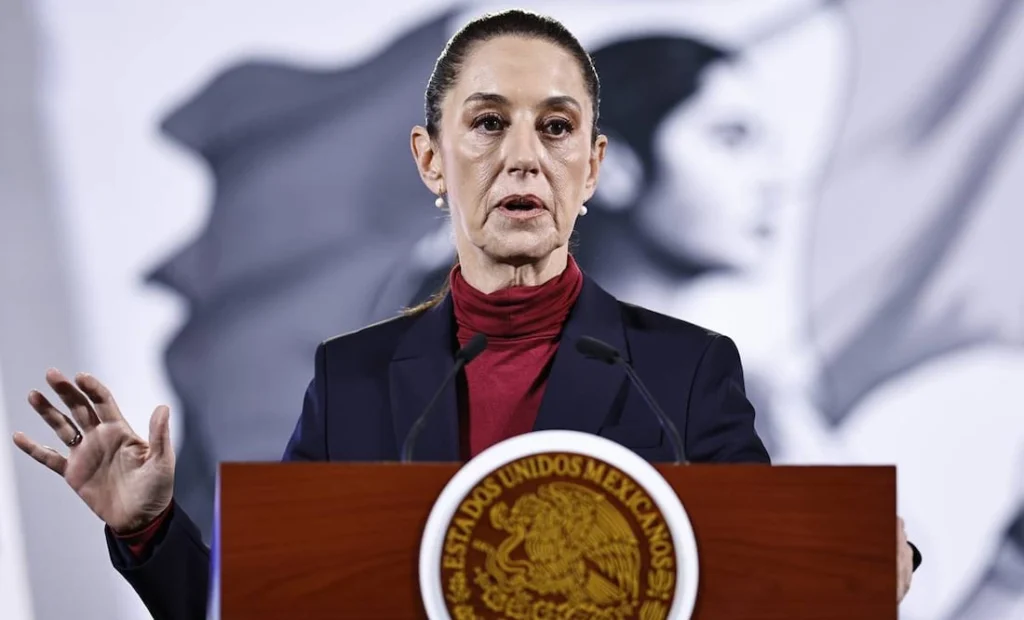
Mexican President Claudia Sheinbaum reaffirmed national sovereignty this Wednesday, December 10, rejecting the idea of a military intervention in Mexican territory previously raised by US President Donald Trump.
In her morning press conference, Sheinbaum emphasized that Mexico is a sovereign country that “would never accept foreign intervention” and that military action is unnecessary. “It’s not going to happen,” the president stated, assuring that there is already an understanding with the United States on security matters.
RELATED:
Trump Sets a 5% Tariff on Mexico to Pressure for Water Transfers
Trump’s statements, in which he mentioned the possibility of extending anti-drug military operations to countries like Colombia and Mexico, have generated concern, especially in the context of the US military buildup in the Caribbean and the Pacific, under the pretext of the fight against drugs.
These US military operations have included the deployment of a significant force and the execution of lethal operations against suspected drug trafficking vessels. However, these actions have been condemned by international organizations and other governments in the region.
#FromTheSouth News Bits | Mexico: President Claudia Sheinbaum said that her country will not give in to the pressure of the media war promoted by right-wing sectors. pic.twitter.com/TwaZuUdlK1
— teleSUR English (@telesurenglish) December 10, 2025
The United Nations (UN) and the US Drug Enforcement Administration (DEA) have stated that Venezuela, one of the countries accused by Washington, is not a primary drug trafficking route to the United States, as more than 80 percent of drugs use the Pacific route.
Furthermore, the Head of State reported on the progress of negotiations with the United States under the 1944 Water Treaty. According to Sheinbaum, Mexico’s fundamental premise is to comply with the treaty without compromising the essential supply for human consumption or the volume required by Mexican farmers.
RELATED:
Sheinbaum Emphasizes Respectful U.S.-Mexico Relations Amid Trump Criticism
Sheinbaum emphasized that, although Mexico operates under the principle of respecting agreements, guaranteeing water for the population is an unavoidable priority. Last Tuesday, December 20, the fifth virtual binational meeting of the year began between the two governments to monitor water deliveries and conduct the relevant technical evaluations.
The president explained that there has been an exchange of offers, with an initial Mexican proposal followed by a U.S. response and a counterproposal sent that evening.
Unified Position and Legal Framework
A crucial point highlighted by the president is the ongoing coordination with the governors of the northern border states (Tamaulipas, Nuevo León, Chihuahua, and Coahuila). The goal is to ensure a unified position that avoids internal conflicts and presents a fair framework to the United States that reflects the actual availability of water resources in each region.
Sheinbaum clarified that a complete renegotiation of the 1944 Treaty, which she considers favorable for Mexico, is not required. The president expressed her confidence in reaching a beneficial agreement, which will be made public once finalized. She reiterated the commitment that compliance will be based on the rainy season and actual water availability, without jeopardizing Mexico’s water security.
Donald Trump escalated bilateral tensions by threatening to impose a 5 percent tariff on Mexico if it does not deliver the water volumes that, according to Washington, it owes under the 1944 Water Treaty. The president’s warning, issued on Monday, December 8, sets a deadline of December 31 for Mexico to release the 246.6 million cubic meters allegedly missing from the current cycle.
The White House occupant pointed out that Mexico’s total water debt over the past five years exceeds 986.4 million cubic meters and warned that noncompliance with the agreement will continue to cause economic harm to American farmers and ranchers.
In this regard, Sheinbaum reiterated that the bilateral agreement is “very clear” in establishing that, in the event of a five-year drought, the obligation to deliver water to the United States must be replenished in the following five-year cycle.
From teleSUR English via This RSS Feed.