

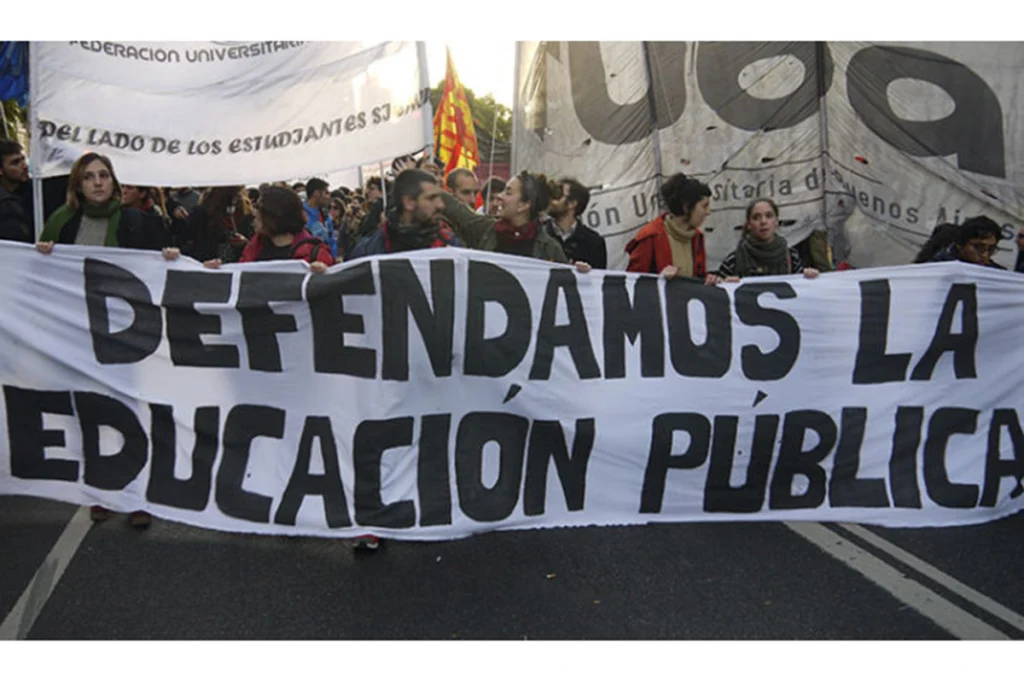
Over the last year, Argentines have been defending their right to high-quality education.
In April 2024, an image swept across Latin America: the streets of Buenos Aires and every major Argentine city filled with students, professors, union members, and citizens.
RELATED:
Retirees and People with Disabilities Protest in Argentina Against Milei’s Vetoes
The Federal University March was more than a protest against austerity. It was the roar of a nation defending one of its most cherished social pacts: the right to free, high-quality public education.
President Javier Milei’s educational reforms, rooted in radical free-market principles, represent a strategic effort to transform the right to free, high-quality public education into a commodity governed by market forces.
This is the “Chainsaw in the Classrooms”: a fierce ideological battle that pits the government’s neoliberal zeal against the principles of democracy, inclusion, and national sovereignty.
The Austerity Axe: Restructuring via Defunding
The central pillar of Milei’s reform is not a sophisticated new law, but a brutal and simple arithmetic: defunding.
The administration froze operational budgets for national universities for 2024 and 2025 at the nominal levels of the 2023 budget.
In a context of triple-digit inflation, this became a major real-term cut, estimated between 35% and 50%, recasting what was labeled an adjustment as institutional sabotage.
For public universities, which depend on the national government for 80% to 90% of their income, this means they can no longer guarantee basic functioning.
Institutions have been pushed into “survival mode”: delaying infrastructure repairs, cutting research funding, and witnessing the exodus of nearly 10,000 teaching staff, a forced brain drain that deliberately erodes the human capital of the public system rather than improving efficiency.
El Gobierno de Javier Milei publicó este martes la «Ley de Libertad Educativa» con la que pretende reformar puntos esenciales de la educación, entre los que están la eliminación de su financiamiento progresivo hasta el 6 por ciento del PBI de #Argentina. pic.twitter.com/CaVoHE4sWk
— Director Atención Cliente Eléctrica Las Tunas (@JuanCarlos55811) December 10, 2025
The text reads, “The government of Javier Milei published this Tuesday the “Educational Freedom Law” with which it intends to reform essential points of education, including the elimination of its progressive funding up to 6 percent of the GDP of Argentina.”
The Veto Wars and Institutional Blockade
When the opposition-led National Congress attempted to halt this collapse by approving a bill to update university funding and staff salaries, President Milei responded with his veto pen.
He repeatedly rejected the University Funding Law, arguing that it would cause a “fiscal imbalance,” even though stabilizing the system required only around 0.14% of Argentina’s GDP.
This strategy of defunding and legislative obstruction reveals the government’s deeper intent. In Milei’s radical free-market worldview, the State is a “criminal organization” to be dismantled from within, and public universities are dismissed as centers of “ideological indoctrination.”
By deliberately manufacturing crisis conditions, the administration seeks to delegitimize universities as public institutions and reduce them to empty shells, stripped of free research, social extension, and critical thinking, preparing the ground for privatization and the full marketization of education.
Threat of the Educational Freedom Law
If the budget vetoes are the chainsaw that cuts off oxygen, the proposed Educational Freedom Law is the wrecking ball aimed at the foundations of the public system.
This bill, intended to replace the democratic and progressive 2006 National Education Law, is the clearest expression of the government’s radical project, as highlighted by critical outlets such as Página 12 and Barricada TV.
The draft law elevates principles like “efficiency” and designates the family as the “natural and primary agent” of education, downgrading the State from guarantor of a social right to a mere subsidiary actor.
It redefines the education system as a “set of initiatives promoted by society and the State,” displacing the collective and democratic meaning of public schooling and weakening the notion of education as a universal right.
Javier Milei fired 50,000 government employees, cut the government by 30%, & reduced the government ministries from 18 to 8.
All while lifting 2.4 million children out of poverty, killing inflation, & providing a fiscal surplus every month of 2025. pic.twitter.com/6baS7YfhIx
— Bryce M. Lipscomb (@BryceMLipscomb) July 22, 2025
Vouchers and Disinvestment
The legislative offensive is built on two key mechanisms of marketization:
- Voucher system The law proposes vouchers, bonds, or fiscal credits, a mechanism Milei repeatedly promoted during his campaign. This would convert institutional funding into “demand-based financing,” transforming students into “consumers” and forcing public and private institutions to compete for fiscal credits. Critics warn that this will create educational apartheid, accelerate the closure of under-resourced public schools, and consolidate a private, subsidized sector tailored to those who can navigate and top up the voucher market.
- Eliminating the funding mandate The bill also seeks to scrap the 2006 mandate requiring the State to progressively increase education funding to 6% of GDP. The removal of this financial floor signals a permanent retreat of public investment, locking in crisis conditions and pushing families toward private alternatives as the only viable option.
The ideological impact is profound: by prioritizing “individual and family freedom” over the collective good, the law dissolves social ties and equality, constructing a segmented education market. Critics argue that this regression effectively dismantles 150 years of Argentine educational history and redefines schooling as a commodity rather than a right.
Destroying Argentine Science
Beyond the university gates, one of the most devastating consequences of the reform is the systematic destruction of Argentina’s scientific backbone, epitomized by the assault on the National Scientific and Technical Research Council (CONICET).
Milei’s government has repeatedly portrayed scientists as “parasites” and threatened to privatize the council, treating fundamental research as a wasteful expense.
Progressive media and academic voices increasingly describe the situation as a “cientificidio”: the deliberate dismantling of the science and technology sector.
The financial strangulation of CONICET in 2025 has been particularly severe. The budget for the Science and Technology function has suffered a real-term cut estimated at up to 46% across 2024–2025, taking public investment in science to levels even lower than those seen during the 2002 crisis.
Salaries for researchers have lost more than 35% of their purchasing power, forcing many to take second jobs, the “Uberization of the scientist”, or to emigrate, triggering a rapid brain drain among the most qualified young researchers and undermining decades of public investment.
Scientific Sovereignty under Attack
The government has also eliminated or frozen key funding streams, including long-awaited grants such as the PICT 2023 awards, and has redirected remaining resources toward immediately profitable applied research that serves the corporate sector.
Crippling CONICET is, in effect, an attack on national scientific sovereignty. A state that cannot fund its own scientists loses the capacity to innovate autonomously in strategic areas such as public health, energy, and aerospace technology.
By prioritizing short-term fiscal balance over long-term scientific development, the government locks Argentina into structural dependence on foreign technology and expertise, aligning the country with a primary-export, commodity-dependent economic model rather than a project of inclusive, sovereign development.
Public Education as a Battle for Democracy
The scale of the government’s offensive has sparked a wave of resistance that confirms the vitality of Argentina’s popular struggles.
The confrontations of 2024 and 2025 have consolidated social and union movements as the main line of defense against the neoliberal project, turning education policy into one of the defining axes of national politics.
Key actors have articulated a unified and militant response. The teachers’ union CTERA has forcefully rejected Milei’s model, denouncing the “gravísimo ajuste” and branding the Educational Freedom Law a “flat-earth project” that would destroy the education system, while warning that deep cuts to the National Teacher Incentive Fund (FONID) alone strip up to 20% from teachers’ salaries.
The student federation FUA has sustained mass mobilizations, framing the vetoes as an attempt to “discipline those who think differently” and defending university autonomy and public higher education as tools of working-class social mobility.
The educational reform is therefore not a technical budget adjustment, but the ideological imposition of a radical model that seeks to strip the State of its role as guarantor of social rights.
Sources: Barricada Tv – Página 12 – TeleSUR – Izquierda Web – The Guardian
From teleSUR English via This RSS Feed.