

This article by Arturo Huerta González originally appeared in the December 9, 2025 edition of La Jornada de Oriente, the Puebla edition of Mexico’s premier left wing daily newspaper. The views expressed in this article are the author’s own and do not necessarily reflect those ofMexico Solidarity Media*, or the Mexico Solidarity Project.*
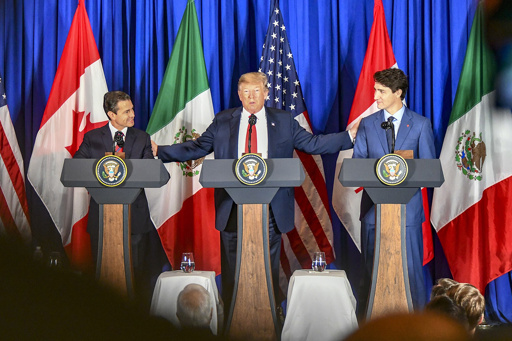
On December 3, 4, and 5, 2025, hearings sponsored by the Office of the U.S. Trade Representative were held regarding the operation of the USMCA , where the U.S. private sector expressed complaints about the judicial reforms and the reform that eliminated autonomous regulatory bodies in 2024, which, according to them, increase uncertainty for U.S. companies and their investments in Mexican territory. This demonstrates that they want to control everything to defend their interests. These reforms do not affect investment decisions or the operating rules of the USMCA. What matters most to decision-makers are the profit prospects they can obtain with the USMCA, and so far, U.S. companies located in Mexico have benefited, as well as those U.S. companies that have flooded the national market with their products. Hence, the representatives of transnational companies in these hearings advocated for “extending and strengthening the Treaty between Mexico, the United States and Canada,” because they have won, and they have won at the cost of displacing [Mexico’s] national producers and leading the national economy to stagnation and dependence on the entry of capital and indebtedness.
They also complained about the 2024 energy reform, which reversed the opening of the sector and grants preferential treatment to Pemex and the CFE [state oil and electricity firms]. They called for addressing the unfair competition from Mexican state-owned companies while simultaneously improving protections for significant, long-standing U.S. investments in Mexico. They want Mexico to stop protecting Pemex and the CFE from U.S. companies and to improve the protection of their investments in Mexico. They are targeting the country’s strategic sectors and demanding better treatment for their companies, which have increased their presence in the country. They want further expansion beyond what they already have and want to see no restrictions placed on it.
Similarly, U.S. agricultural producers urged the U.S. government to extend the USMCA until 2042, as it has allowed them to increase their revenue. This has happened at the expense of displacing domestic producers, with the tacit approval of the Mexican government, which ignores their demands to remove basic grains from the USMCA. If imports of basic grains continue, Mexican producers will continue to be harmed, further diminishing self-sufficiency in these products and increasing our food dependency, as well as our reliance on external financing to purchase them. This will perpetuate high interest rates and currency appreciation that favor financial capital, at the cost of not having an economic policy that promotes growth and employment.
Transnational corporations have won, and they have won at the cost of displacing Mexico’s national producers and leading the national economy to stagnation and dependence on foreign capital & indebtedness.
Donald Trump, for his part, has threatened not to renew the USMCA or to renegotiate another agreement. The US Trade Representative himself stated that “President Trump’s view is that he only wants good deals. The reason we included a review period in the USMCA was in case we needed to review it or withdraw from the agreement.”
The latter is likely to happen, since with the current trade agreement, the US faces a growing trade deficit with Mexico. Therefore, it will end up doing the same thing it has done with other countries, where it has imposed conditions in its favor, such as requiring them to invest in the US, encouraging US companies to return to the US, and demanding that they buy more from Mexico and sell less to it. This calls into question the position of the Mexican government, which is confident that the country will continue to have a “relatively better position compared to other countries.”
The problem is that Mexico is not prepared to face the greater demands and requirements that the US will impose in its favor for the continuation of the USMCA or in a new trade agreement. The country lacks an economic policy framework that favors the industrial and agricultural sectors to cope with the increased market openness demanded by the US to support its exports. As a result, we will face less industry, fewer basic food supplies, fewer jobs, slower growth, a larger trade deficit, and greater financing problems.
It’s important to remember that Mexico’s growth after World War II, up until 1981, was due to protectionist policies that prohibited imports of domestically produced goods. Furthermore, there was a development bank, and the government regulated commercial banks and capital flows to prevent speculative practices, allowing for monetary and fiscal policies that fostered growth. Neoliberalism destroyed all of this.
-

The Failed USMCA Project
December 10, 2025
Transnational corporations won in both NAFTA & the USMCA, and Mexico is not prepared to face the greater demands the US will impose in its favor for the continuation of the USMCA or in a new trade agreement.
-

The Fourth Transformation Punches Back: Soberanía 88
December 10, 2025
600,000 Mexicans rally in support of Sheinbaum on the seventh anniversary of the Fourth Transformation, public health system, minimum wage increase, DEA drug scandal & the Jalisco Nueva Generación Cartel.
-

Bean Producers Face Ruin: Squeezed by Corporations, Government Support Insufficient
December 10, 2025December 10, 2025
Mexico’s government has not met its commitment to enforce its agreed-upon price for farmers, who are forced to sell to an oligopsony of corporations, intermediaries and wholesale operators.
The post The Failed USMCA Project appeared first on Mexico Solidarity Media.
From Mexico Solidarity Media via This RSS Feed.