


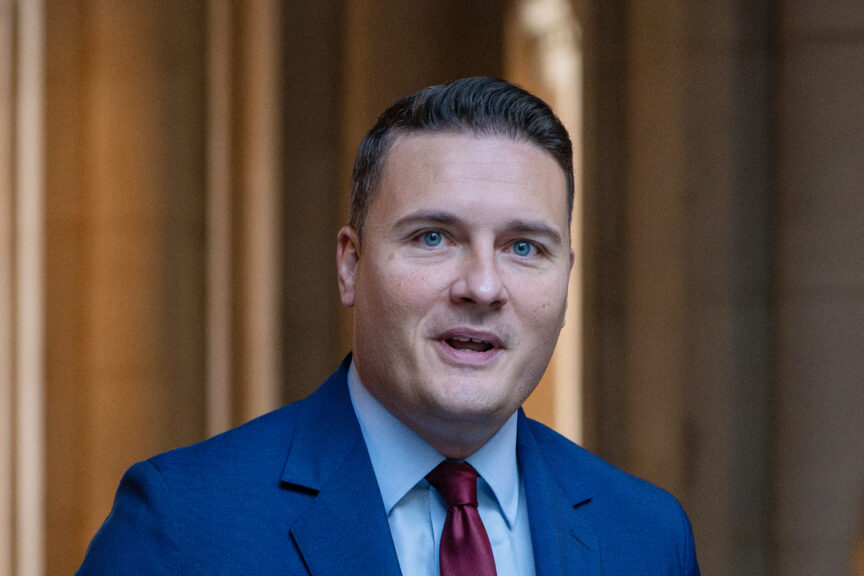
When health secretary Wes Streeting announced an upcoming review into supposed mental health “overdiagnosis”, I felt my chest tighten.
Streeting’s pending investigation, conveniently launched days after Keir Starmer announced upcoming reforms to welfare, was clearly intended to push sick and suffering people back into work. This is an economic agenda disguised as a moral one – taken straight out of the Tories’ playbook. Labour, however, is making this neoliberal policy sound vaguely benevolent. Young people are being “written off”, Starmer and Streeting have said, and are getting trapped in poverty because they think they can’t work.
There is historical precedent for the line that this rightwing Labour party is taking around mental health. Around the 1960s, the anti-psychiatry movement began to challenge the foundations of psychiatry, which held a strong foothold in the form of hundreds of mental hospitals peppered across Britain. While the movement spanned both left and right, its proponents were united in their critique of psychiatric diagnosis, and, at their most extreme, suggested that mental illness itself wasn’t real.
When Margaret Thatcher rose to power, she translated these ideas to policy. She capitalised on widespread anti-psychiatry sentiment by closing state mental hospitals in favour of supposed “community care”. Although the closure of these segregationist and violent institutions was a good thing, the move was part of a larger agenda of austerity and privatisation. Thatcher didn’t close asylums to replace them with kinder forms of mental healthcare, reallocating resources to community care. Rather, deinstitutionalisation was a cost-cutting measure that relinquished state responsibility for the mentally ill. People were now free from the harms of asylums. But they were freshly exposed to the harms of the capitalist labour market, and, without state support, were pushed into low-paid work, homelessness and the prison system.
Streeting’s review, and the discourse used to justify it, carries echoes of Thatcher – leveraging “anti-psychiatry” arguments as an excuse for abandoning people in distress. Our job on the left is to resist this.
This task can feel particularly fraught because, from a radical perspective, many critiques of diagnosis are valid. Anti-psychiatry figureheads were right in their conviction that psychiatric diagnosis can be a tool for social control – weaponised against anti-racist movements, queer communities, women who challenged patriarchal expectations and neurodivergent and disabled people. As I argue in my book Mad World, psychiatric diagnoses are shaped by the qualities that make a person a “good” or exploitable worker within capitalist economies. Those who experience behavioural or emotional states that can make it difficult to go to work are often pathologised, medicated and pushed back onto the production line. We have every reason to be wary of psychiatric power given its ability to punish the deviant, dissenting and distressed.
Critics of diagnosis have also pointed out that medicalisation has a tendency to individualise and obscure symptoms of a sick society. Those who suffer under capitalism, and show signs of distress under the strain of poverty, austerity, border violence, or intolerable living or working conditions, are labelled as “sick” and in need of medical interventions that don’t address the root cause. No amount of medication or cognitive behavioural therapy can prevent you from being laid off from your precarious gig economy job, or from being evicted by your landlord. To label understandable distress as disorder risks placing responsibility on the individual, rather than the structures that harm them.
But as history shows us, seemingly radical arguments that deny the existence of mental illness are too easily co-opted by rightwingers. We can’t hand them the chance to dismiss mass suffering under capitalism as a failure to weather the stresses and strains of ordinary life.
So how do we tackle the complexity of diagnosis without ceding ground to the likes of Streeting, Starmer and Thatcher?
Firstly, it’s important to call the “overdiagnosis” panic what it is: a culture war. Like all culture wars, it uses social and moral issues to distract from concrete political and economic ones.
In order to resist getting drawn in, we must always tie diagnosis to material conditions. At their worst, conversations about diagnosis concern themselves with identity labels, and whether they help or hinder. This kind of “labelling theory” critiques the label rather than the conditions that produced the label. It fails to capture the fact that capitalist society excludes certain people from work regardless of the label that is attached to them. A person who feels too low to go to work will not magically be able to clock in if their depression diagnosis is taken away. The same goes for someone who struggles to concentrate within work contexts that increasingly demand we look at a screen all day. Whether we label this difficulty as ADHD or not, their struggles will still exist.
While critiques of medicalisation can lead us to important questions about how we understand and treat societal distress, an exclusive and dogged focus on language distracts us from the material reality of suffering. For Marxists, and anyone invested in reducing suffering, our focus needs to be on changing our material conditions, such as the unhealthy and precarious working conditions that exclude vast swathes of the population from participation, and harm those who do participate.
Our other focus must be state support. In the coming year, Starmer is going to attempt to push through substantial welfare cuts for the second time in his premiership. When politicians attack “overdiagnosis”, we must reframe the problem as one of a society that disables so many people, then punishes them for their distress. It’s this that needs to remain the focus of our attention, mobilising and organising. Let’s not allow Labour to misdiagnose the problem.
From Novara Media via This RSS Feed.