

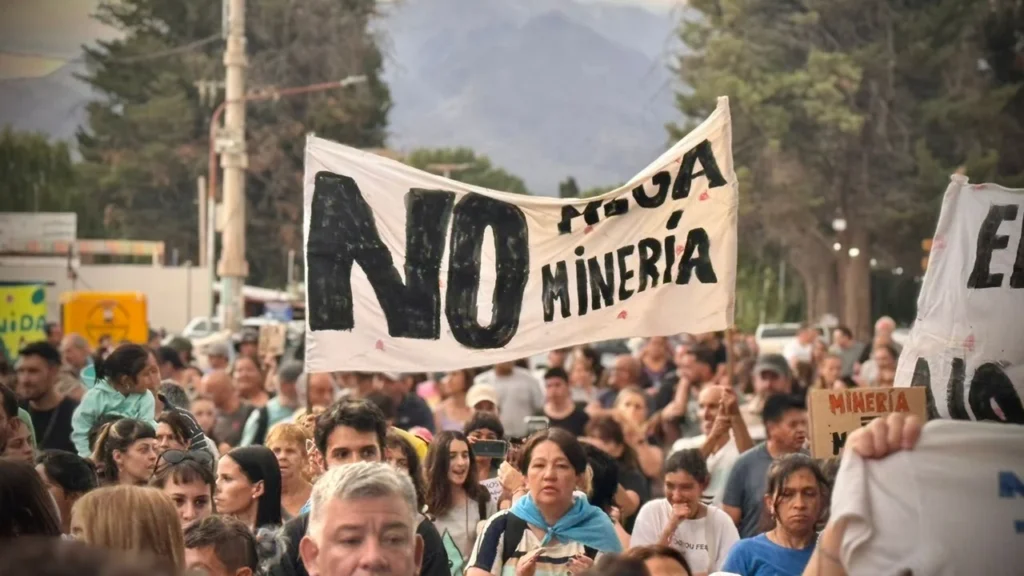
Argentina’s Mendoza Senate approved the Environmental Impact Statement for the San Jorge mining project—despite large protests outside the legislature and strong criticism over environmental risks.
The Argentinean provincial senate of Mendoza, approved on Tuesday the Environmental Impact Statement of the PSJ Cooper of Mendoza mining project (ex-San Jorge), in the middle of a major police operation and despite the popular rejection for its potential to contaminate the local water basin.
RELATED: Argentina’s Industrial Sector Cuts Jobs as Production Falls
The current protest was reflected in a caravan that, over two days, traveled more than one hundred kilometers from the town of Uspallata to the provincial capital.
Residents, cyclists, teachers, rural workers, and young people marched from different parts or the province demand that senators halt what they describe as a “direct assault by the mining lobby.”
From the early hours of today, the slogan “Mendoza’s water is not negotiable” set the tone for the protests.
With 29 votes in favor, six against, and one abstention, the measure, promoted by the provincial Government of Governor Alfredo Cornejo and backed by the neoliberal President Javier Milei, reignited long-standing tensions in a province known for defending its water resources.
The chamber also approved the Environmental Impact Statement for the Malargüe Western Mining District II (MDMO II), which includes 27 exploration initiatives. That measure passed with 31 votes in favor and three against.
#Marcha contra la #mineria en Mendoza, después del aval legislativo a la declaración de impacto ambiental del proyecto minero San Jorge, en Uspallata.
Ambientalistas marcharon de manera pacífica desde San Martín y Garibaldi hasta Las Heras, Belgrano y Arístides Villanueva. pic.twitter.com/A510WPJNdn— Roxana Badaloni (@roxibadaloni) December 10, 2025
Environmental concerns
Ahead of the vote, the Environment and Natural Resources Foundation (FARN, in Spanish) warned that the San Jorge assessment contained serious weak points, including potential risks to water sources. The organization argued that the approval defers critical environmental safeguards to later stages, violating national and provincial legislation.
Technical reports from the General Irrigation Department, the National University of Cuyo Foundation, and the National Research Council Scientific and Technical (CONICET, in Spanish) also pointed to structural flaws in the project’s environmental analysis. They highlighted missing hydrogeological data, outdated water-use figures from 2008–2010, insufficient rock samples to evaluate acid drainage risks, and uncertainty about possible impacts on key aquifers connected to the Mendoza River, which provides water to 75% of the provincial population.
FARN stressed that these gaps trigger the “precautionary principle,” arguing the project should not advance until uncertainties are resolved. Indigenous communities in the area have also withheld their consent.
Notwithstanding the outcome of the legislative vote, civic assemblies throughout the province are preparing for demonstrations in the near term against this extractivist project. Their objective is to achieve a breakthrough comparable to 2019, when popular mobilization thwarted a regressive modification of Law 7,722—the legislation prohibiting the use of toxic substances such as cyanide and sulphuric acid—and compelled a retraction of the proposed easing of environmental oversight.
From teleSUR English via This RSS Feed.