

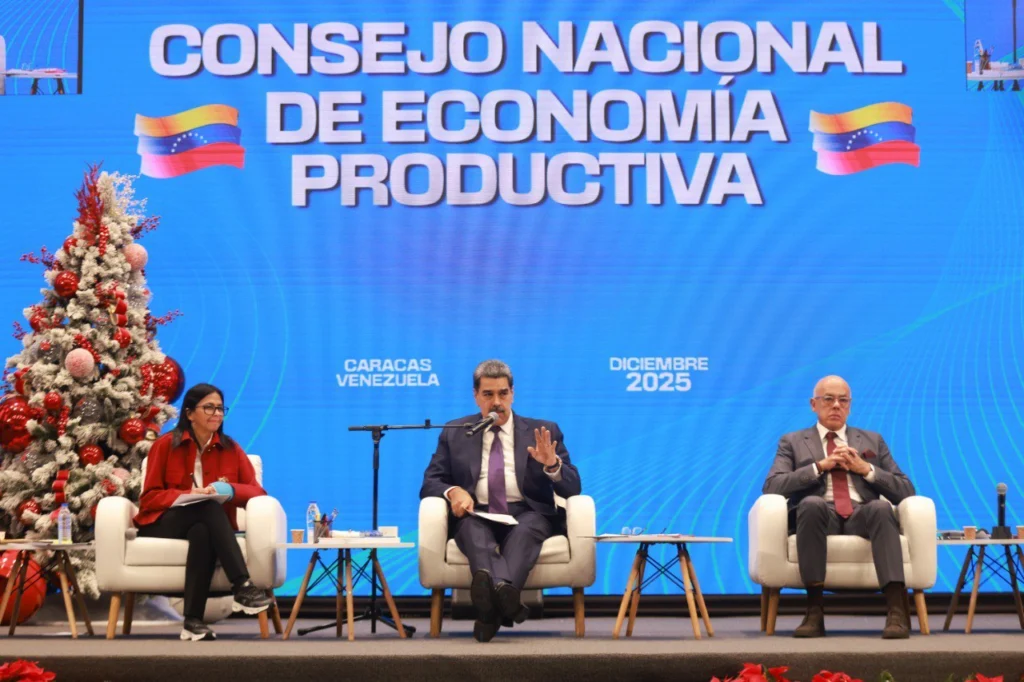
The President of the Bolivarian Republic of Venezuela, Nicolás Maduro Moros, chaired the National Council for Productive Economy, a key body for consolidating the country’s economic recovery and strengthening the 13 engines of the Bolivarian Economic Agenda.
This forum brings together the business sector, public and private banks, the Executive Cabinet, sectoral vice presidents, and representatives of chambers of commerce and business associations, with the common goal of promoting a prosperous and self-sufficient Venezuela.
RELATED:
Venezuelan Economy Remains Stable Despite U.S. Threats
The Venezuelan economy has registered 18 consecutive quarters of growth, a remarkable achievement in the regional and global context.
During a recent address at the National Hall of the Popular Government System, the president announced that, by 2026, 77% of the national budget will be allocated to social investment, prioritizing projects decided directly by communities through democratic participation mechanisms.
Commitment to Social Welfare and Resistance to the Blockade
The Bolivarian Government’s approach focuses on counteracting the effects of unilateral coercive measures through inclusive and sustainable economic policies.
Within this framework, GDP growth of up to 9% is projected by the end of 2025, exceeding the estimates of the Economic Commission for Latin America and the Caribbean (ECLAC).
The forum also promotes productive diversification, the strengthening of strategic sectors such as mining and oil, and the promotion of public-private partnerships to increase non-oil exports. These actions are part of a comprehensive strategy aimed at national economic recovery and the consolidation of productive sovereignty.
For her part, Executive Vice President Delcy Rodríguez stated during the session that “there is not a single productive sector in Venezuela that is not currently showing growth.”
She highlighted the joint effort between workers, business owners, and social movements as a fundamental pillar for overcoming the effects of the economic blockade and external threats.
Rodríguez highlighted national cohesion as a determining factor in economic stabilization and celebrated the recent inscription of the joropo on UNESCO’s Representative List of the Intangible Cultural Heritage of Humanity, symbolically linking it to the resilience of the Venezuelan people. “Here we have a great treasure of humanity: the good men and women of Venezuela,” she stated.
At the close of the year, the Vice President emphasized that the National Council for Productive Economy is ending with a positive balance: “A year-end where Venezuela can tell the world, ‘Here we are, the Venezuelan men and women who love our country… who with great hope are committed to the well-being of our sons and daughters.'”
From teleSUR English via This RSS Feed.