

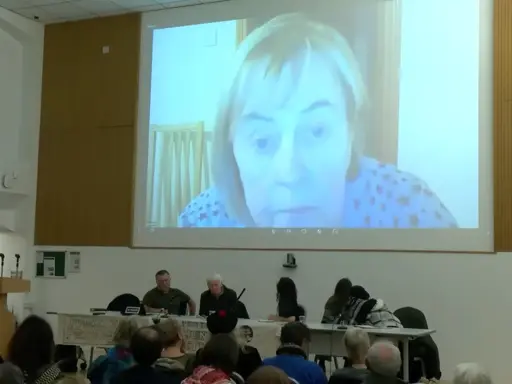
The eight Palestine Action-linked prisoners on hunger strike are mounting the most significant challenge to the British state since the 1981 hunger strikes by republican prisoners in Northern Ireland. Police arrested the activists for anti-genocide actions including alleged raids on weapons manufacturer Elbit and spraying paint on British warplanes.
It was significant that Tommy McKearney, a participant in the 1981 strike, was present a London meeting on Friday, 5 December, to show solidarity with the anti-genocide campaigners.
Also in attendance was Bernadette Devlin McAliskey, a leading advocate for prisoner rights 45 years ago. Partly as a result of that work, loyalist paramilitaries shot her nine times in 1981. Gary Donnelly also spoke at the event. He is one of the Raytheon Nine, the precursor to the establishment of Palestine Action. The group is best known for driving out war criminals Raytheon from Derry after occupying their factory and smashing up computers used for illegal activity.
Irish activists organised the meeting on Friday, whose intention was to show solidarity with the prisoners and all those campaigning for them.
Prison authorities have been subjecting them to appalling conditions of confinement, which include extended periods of solitary confinement, frequent strip searches, censorship of letters and inadequate access to legal representation.
In response to this, and out of a desire to continue highlighting British involvement in so-called Israel’s genocide in Palestine, the strikers have issued five demands.
Among these demands are calls for the de-proscription of Palestine Action, and the closure of Elbit. These demands echoes those issued by republicans in the early 1980s.
Irish hunger striker once hours from death speaks on his experience
As several of the Palestine Action prisoners enter a dangerous new phase of their strike after over four weeks of refusing food, McKearney outlined how close he came to death in 1980:
We were on hunger strike for 53 days. By the final week, I had succumbed to severe malnutrition. I collapsed into a state of semi-consciousness, enduring considerable distress. My eyesight was failing due to the collapse of the optic motor nerve, causing my vision to flicker up and down. My hearing was impaired, and I suffered from intense headaches and sharp pains in my stomach and legs.
This intensified until, unknowingly, I was receiving daily visits from my parents. The medical authorities in the prison believed I was close to death. When the hunger strike finally ended after 53 days, I later learned that doctors had estimated I had only 24 to 48 hours left to live. That is how close I believe I came to dying.
It took me about two months to get back on my feet, and several years before my optic motor nerve was fully restored and my eyesight was steady once more.
McKearney and his fellow strikers campaigned to be treated as political prisoners, rather than the criminals the British state wanted to characterise them as.
Among their demands were the right to refuse wearing a prison uniform and the right to be excused from prison work. Ten prisoners starved to death before the strike was called off on 3 October 1981. The British government under Margaret Thatcher had refused to meet the prisoners’ demands, though negotiations occurred in secret. Thus far, those representing the Palestine Action prisoners have reported no official response from the Starmer regime.
The Labour Party has doubled down on its authoritarian decision to proscribe Palestine Action, treating its young, non-violent members and supporters as terrorists, with thousands arrested, while Downing Street appears indifferent to their suffering, even as they risk permanent harm or death for opposing a holocaust the British state has enthusiastically participated in.
British government lawlessness is nothing new, it’s just returning home
However, Bernadette Devlin McAliskey reminded those in attendance that massive abuses of power have long been the modus operandi of the British ruling class:
…you see that the colonial mindset is deeply embedded in the political class, regardless of party. This is understandable, as it is difficult to give up the power secured on the rape, plunder, and conquest of other continents.
McKearney, in a statement seen by the *Canary,*outlined the hypocrisy of a state that presents itself as a beacon of lawfulness but which has been engaged in incessant criminality:
This is the state that proudly claims to have inherited an ancient legal system dating back to the Magna Carta. Yet, within living memory the British state’s armed forces have carried out mass killings of innocent, unarmed civilians in Ireland.
He continued:
…simultaneously British governments introduced interment without trial, abolished jury trials and were responsible for brutal interrogation techniques meted out to detainees and persistent mistreatment of prisoners.
McAliskey went on to denounce the cowardice of the media in failing to adequately cover the mistreatment of Palestine Action:
The Filton case is now being used as a gag order on the press. Journalists are using “Filton 24” as an excuse not to report on the hunger strike, claiming it’s “complicated” and requires legal consultation. There is nothing complicated about reporting on a hunger strike.
The Filton 24 are a group of activists cops arrested for targeting Elbit. Among the group is Irish citizen, Jordan Devlin. Despite police arresting him prior to the Palestine Action proscription, prison authorities nonetheless treat him as a terror suspect would be. He has been held on remand since August 2024.
Speaking to theDitch, Devlin’s sister Brogan told of his treatment and that of others from the Filton group:
They’ve all had their mail withheld. Visits are blocked. Jordan is locked up 23 to 23 and a half hours a day. Anything he’s made, even art projects, is confiscated.
She also said:
They’re x-raying him and strip-searching him twice a day. He’s freezing too.
Jailers often hold the prisoners in cold cells for hours prior to court appearances.
Tragedy and comedy as hunger striker defies prison regime
It was left to Ella Moulsdale, close friend of striker Qesser Zuhrah, to highlight the spirit of defiance still being shown by those suffering through the gruelling protest action. Describing a scene that comical, tragic, and inspiring, she spoke of Zuhrah’s recent visit to a hospital. The hospital had no private rooms available, forcing her to use the crowded public waiting area.
Moulsdale explained:
Now, if anybody knows Qesser, this is their first mistake because she made sure everybody in that waiting room knew about the hunger strike, knew about Palestine.
In a further reminder of the link between Ireland and those currently enduring the brutality of the British government, she said Qesser was:
…desperately trying to look around the room and try to find a friendly face. And she told me, “I never look for white people.” But then I remembered the Irish and I thought, “Well, there could be Irish people here.” So she desperately tried to look and see if she could identify Irish people in the waiting room.
Despite dehydration and exhaustion, as the guards dragged Zuhrah out of the hospital:
…she went “Free Palestine!” And the whole waiting room looked up and finally met her gaze.
Featured image via the Crispin Flintoff Show
From Canary via This RSS Feed.