



Photo by Ye Jinghan on Unsplash
Erin In The Morning is a reader-supported publication. To receive new posts and support my work, consider becoming a subscriber.
A federal judge issued a scathing ruling against Georgia lawmakers last week, declaring that SB 185—the blanket ban on gender-affirming care for incarcerated transgender people, signed by Governor Brian Kemp in May—constituted “cruel and unusual punishment” under the Eighth Amendment.
It’s a victory, advocates say, for the civil rights of trans people across the country.
“[The] decision is a powerful reminder that the Constitution applies to everyone, including trans people in prison,” said Center for Constitutional Rights Senior Staff Attorney Chinyere Ezie, whose attorneys represented the plaintiffs. “Trans people have the same right to medically necessary healthcare under the Eighth Amendment as anyone else behind bars.”
Courts have ruled time and time again that withholding necessary health care, including gender-affirming health care for trans people, is unconstitutional. Often these laws come in the form of blocking state funding for such treatment, but Georgia went even further, according to court documents.
“During hearings about SB185, bill sponsors indicated that the statute was also intended to prohibit incarcerated people from accessing gender dysphoria treatment via ‘self-pay,’” the initial complaint, filed in August, says. “Since the law’s passage, several named Plaintiffs have also reported the same.”
Denying trans people access to health care increases risk of suicide and self-harm, and sudden detransition can lead to a myriad of mental and physical health issues.
Judge Victoria Marie Calvert, of the U.S. District Court for the Northern District of Georgia, rebuked the idea that, after a decade since the last time Georgia officials weighed in on the matter, gender-affirming care was no longer considered medically necessary. Even medical professionals brought in as expert witnesses by the state “do not actually dispute Plaintiffs’ experts’ conclusions that hormone therapy can be medically necessary for some gender dysphoria patients,” the ruling says.
Medical professionals are instructed to use industry best practices and exercise independent judgment when providing care, including GAC. But the state’s counsel arguably admitted in proceedings that the ban was motivated by an anti-trans political agenda. The ruling says the state legislature acted with “deliberate indifference” when it threw away industry best-practices in care simply because it “is not something the state supports.”
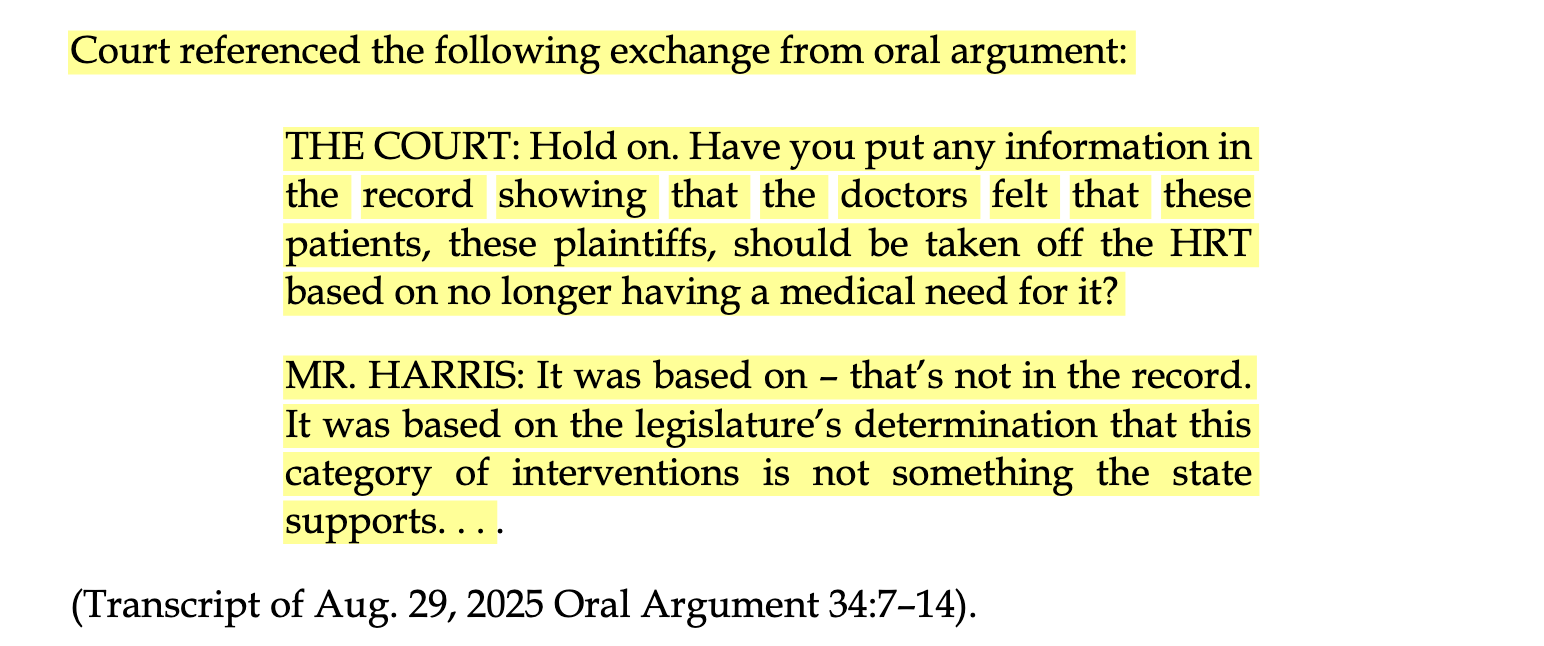
An excerpt from December’s permanent injunction on Georgia’s GAC ban for incarcerated populations.
Meanwhile, Judge Calvert writes, “there are no genuine, material disputed facts in this case” about the necessity of GAC for many trans people.
The class action suit was filed by Isis Benjamin, Fantasia Horton, Naemoi Madison, Brynn Wilson and a John Doe on behalf of over 300 incarcerated trans people in Georgia.
A preliminary injunction halted the full extent of the law from taking effect earlier this year, but this ruling makes it permanent.
Calvert emphasized that medical choices for transgender people ought to be made “by physicians, based on individual determinations of medical need, and for reasons beyond the fact that the prisoners are prisoners.”
Erin In The Morning is a reader-supported publication. To receive new posts and support my work, consider becoming a subscriber.
From Erin In The Morning via This RSS Feed.