

Her nomination reflects the political use of an anti-war symbol.
The 2025 Nobel Peace Prize was awarded to Venezuelan opposition leader María Corina Machado. Rather than honoring peacebuilding, this choice appears to serve as a geopolitical instrument that legitimizes a maximalist regime-change strategy in Venezuela.
RELATED:
Intellectuals and Artists Urge Nobel Committee to Revoke Prize for Machado
Instead of supporting dialogue or de-escalation, the prize reinforces a hardline approach. It reframes the Venezuelan crisis as a global security issue, aligns the opposition more closely with U.S. interventionist interests, and raises the likelihood of militarization in Latin America.
This article examines how the award normalizes a strategy of maximum pressure, traces Machado’s political profile and regional ambitions, analyzes her narrative of criminalization of the Venezuelan state, unpacks her “all-or-nothing” roadmap for transition, and reflects on the broader implications for regional sovereignty and peace.
A peace prize turned geopolitical weapon
The Nobel Committee justified its decision by presenting Machado as a non-violent defender of democracy and as a symbol of resistance against an authoritarian regime that has driven millions of people into exile.
Yet, in political practice, the award amplifies a leader whose strategy rejects negotiated power‑sharing and insists on the total displacement of Chavismo from Venezuelan institutions, validating a confrontational, zero-sum approach.
Supporters within the Venezuelan opposition and among allied governments have celebrated the prize as a diplomatic “lethal blow” to the administration of President Maduro and as confirmation that the “international community” backs their call to recognize Edmundo González as president-elect.
At the same time, critical voices from Latin America and beyond argue that the decision “goes in the opposite direction to peace” because it rewards a figure aligned with some of the most militaristic sectors of the U.S. establishment, thereby reinforcing the government’s narrative that the opposition answers to Washington rather than to Venezuelan popular sovereignty.
The controversy around the prize is also fed by Machado’s own gestures. She has framed the Nobel as proof that the world has finally heard Venezuela’s “cry for freedom,” while dedicating the award not only to the Venezuelan people but also to the U.S. president Donald Trump for his “decisive support of our cause.”
This dedication openly inserts the prize into the architecture of U.S. “law‑enforcement” strategies against the President Maduro government, fusing humanitarian rhetoric with the language of sanctions, extraterritorial prosecutions, and possible military moves in the Caribbean.
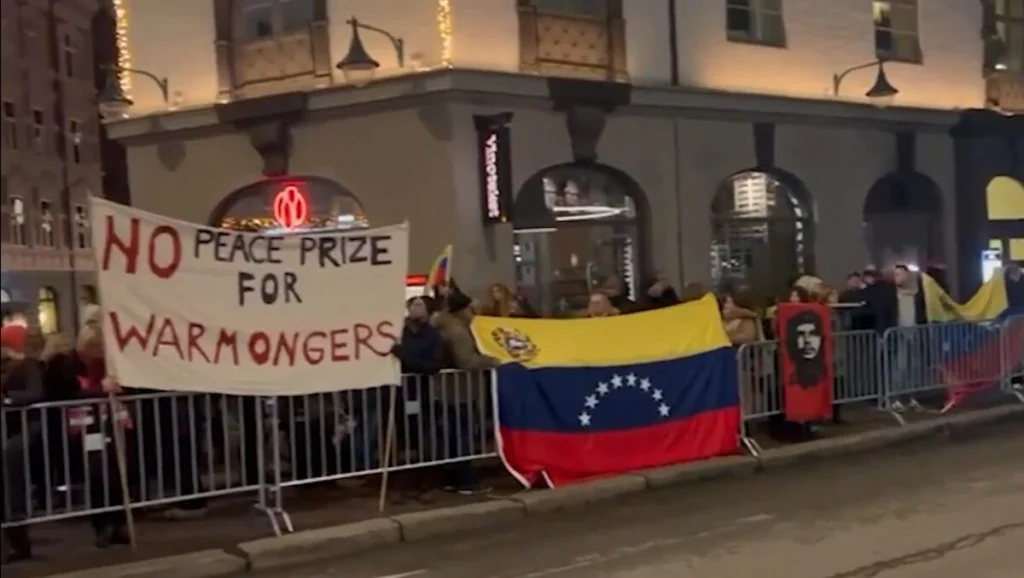
🇳🇴| El rechazo por María Corina Machado sigue creciendo. Miles de personas protestan en las calles de Oslo.
Ni el frío los detiene 👇🏻👇🏻 pic.twitter.com/aFQIVtnH2n
— Indira Urbaneja (@INDIURBANEJA) December 9, 2025
The text reads, “The backlash against María Corina Machado continues to grow. Thousands of people are protesting in the streets of Oslo. Not even the cold can stop them.”
Political profile: liberal elitism and a history of confrontation
María Corina Machado is the paramount leader of Venezuela’s radical right, combining an elite social origin with a hardline ideological project that positions her as the spearhead of an explicitly anti‑left, pro‑market restoration.
Trained as an industrial engineer and coming from an affluent business family, she has long advocated sweeping privatizations, deep deregulation, and the dismantling of the redistributive architecture built under Hugo Chávez, denouncing socialism as the source of Venezuela’s collapse.
Her history in national politics is inseparable from high-intensity confrontation with Chavismo. Machado was with sectors that supported the 2002 coup attempt against Chávez, and with violent demonstrations against the government of President Maduro. A past that calls into question her democratic credentials and portrays her as the civilian face of destabilization.
Even as she speaks of a “peaceful and orderly transition,” critics inside and outside Venezuela argue that her record and discourse are compatible with a strategy that keeps the threat of extra-institutional outcomes on the table to force administration change.
In recent years, Machado has succeeded where other opposition leaders failed: she unified a fragmented anti-Chavista field around a single, non-negotiable objective, the exit of the current government.
After the banned from running in the 2024 presidential election, she transferred her political capital to Edmundo González while insisting that the July vote produced a clear opposition victory and that this result is “not negotiable,” a line that leaves no room for transitional arrangements that include Chavista participation in power.
For Machado, the Venezuelan struggle is the first domino in a regional counter‑offensive: she has declared that the fall of the President Maduro government will bring “the fall of the Cuban regime, the fall of the tyranny in Nicaragua,” projecting the conflict as a crusade to eradicate what she calls “communist dictatorships” from the continent.
This continental ambition links with the agenda of allied right‑wing governments in the region, such as those of Argentina, Ecuador, Paraguay, and Panama, whose presidents have publicly embraced her in Oslo, and situates the Nobel Prize within a broader operation to reconfigure the political balance of Latin America.
🇳🇴 Desde Noruega, manifestantes salen a las calles en rechazo a la entrega del Premio Nobel de la Paz a Maria Corina Machado por promover en reiteradas veces invasiones militares contra su país. pic.twitter.com/MHjr5lcYyB
— Agencia Venezuela News (@AgenciaVNews) December 9, 2025
The text reads, “From Norway, protesters take to the streets to reject the awarding of the Nobel Peace Prize to Maria Corina Machado for repeatedly promoting military invasions against her country.”
Criminalization narrative: from political conflict to “narco‑terrorist” threat
The Nobel Prize also magnifies Machado’s most controversial narrative move: the systematic criminalization of the Venezuelan state as a way to justify escalating external pressure.
In her post‑Nobel interviews, she insists that Venezuela is not facing “just another dictatorship” but a “criminal tyranny” and a “narco‑terrorist” cartel that has penetrated all branches of public power.
She has gone as far as asserting that the President “Nicolás Maduro is the head of the Cartel of the Suns,” turning the government into the command center of a transnational criminal structure.
By framing the conflict in these terms, Machado shifts the terrain from political dispute to security enforcement.
Sanctions, criminal indictments, financial blockades, and even military maneuvers are no longer framed as acts of foreign intervention but as legitimate “law‑enforcement” operations to dismantle a mafia‑state.
She justifies this framing by pointing to links between the Venezuelan state and non‑state armed and criminal actors, from Colombian guerrillas and ELN units to organizations such as Hezbollah, and by highlighting the transnational reach of gangs like the Tren de Aragua.
This narrative culminates in a striking inversion: when asked about the risk of a U.S. invasion, Machado has replied that the “real invasion” already exists, executed by Cuban, Russian, and Iranian actors as well as criminal organizations operating inside Venezuelan territory.
In this logic, any U.S.-led action in or around Venezuela is recast as a defensive response to an ongoing aggression, rather than as an imperial intervention, an argument that finds a powerful amplifier in the visibility of the Nobel Peace Prize.
#Venezuela’s traitor, María Corina Machado, has been groomed by the US empire for decades.
She probably has a mansion in Miami and $10 million in a savings account with Bank of America. pic.twitter.com/LVjQGo9uZI
— S.L. Kanthan (@Kanthan2030) July 30, 2024
The maximalist roadmap: no negotiation
The post-Nobel moment has strengthened Machado’s maximalist line: President Maduro departure is non-negotiable, and the only acceptable outcome is recognition of the opposition’s claim that Edmundo González is “president‑elect.”
Her message, “he leaves with negotiation, or he leaves without negotiation, but he leaves,” closes the space for transitional formulas that include Chavista sectors or power‑sharing arrangements.
Machado dismisses international mediation and “soft diplomacy” as complicity with tyranny, rejecting figures like former Spanish prime minister José Luis Rodríguez Zapatero and pushing to replace dialogue frameworks with coordinated external pressure. Even the Nobel itself is turned into leverage: she has conditioned her attendance in Oslo on “Venezuela being free”.
Diaspora, regional domino, and militarization risk
The Nobel Peace Prize for María Corina Machado crystallizes a dangerous paradox: a prize nominally dedicated to peace now reinforces a maximalist, regime‑change agenda that rejects negotiation and legitimizes external pressure against Venezuela.
The award amplifies a leader whose discourse criminalizes the Venezuelan state as a “narco‑terrorist” cartel, recasts U.S. sanctions and potential military moves as “law enforcement,” and connects the fall of President Maduro to a broader right‑wing crusade against progressive governments in Cuba and Nicaragua.
At the same time, the prize has energized a transnational movement: it has boosted the morale of Venezuelan opposition sectors, activated the diaspora as a global pressure force, and put Venezuela at the center of international debate about democracy, sovereignty, and intervention.
By dedicating the award to both the Venezuelan people and Donald Trump, Machado turns the Nobel into a lever for harder confrontation and a symbol of a continental reordering project whose outcome remains uncertain.
Sources: teleSUR – Democracy Now – ABC Diary – Nobel Prize – El Mundo
From teleSUR English via This RSS Feed.