

This article by Luis Hernández Navarro originally appeared in the December 9, 2025 edition of La Jornada, Mexico’s premier left wing daily newspaper.
Since 2002, the date of the 47-hour coup against Hugo Chávez, Washington has unsuccessfully sponsored and supported regime change in Venezuela time and again. In the name of human rights, freedom, and democracy, economic sanctions, color revolutions, oil strikes, recognition of illegitimate leaders, theft of foreign currency and infrastructure, assassination attempts, media offensives, military uprisings, and threats of ground invasion have been instigated or combined without interruption.
Many of these attacks, aimed at seizing the largest oil reserves on the planet, are acts of international piracy. They have caused immense damage to the country and enormous suffering to its people. They have resulted in billions of dollars in lost oil revenue. Countless Venezuelans have been forced to migrate to other nations to survive. Meanwhile, a segment of the old, corrupt oligarchy lives the high life in their mansions in Miami and Madrid.
But despite the lethality of the punishments and the harshness of the siege, the Bolivarian Revolution continues. Certainly, some Chavista political leaders have betrayed the cause. A few military and intelligence officers have gone over to the enemy ranks. Intellectuals have succumbed to the siren song of metropolitan power. But, against all odds, the majority of the population draws a line in the sand against gunboat democracy; they remain loyal to a project that allowed them to recover their dignity and advance in popular power.
For 27 years, Bolivarianism has won almost every election. Desperate in the face of this setback, the empire has tried other formulas for regime change. In December 2007, Enrique Krauze laid his cards on the table. “If Hugo Chávez has thought of turning Venezuela into a Cuba with oil, the Venezuelans who oppose him have discovered the antidote. It is the student movement,” he wrote. So the far right latched onto this movement and tested an insurrectionary scheme. However, the reactionary forces clashed with a reality that wasn’t in their playbooks. So they left to make their fortunes abroad.

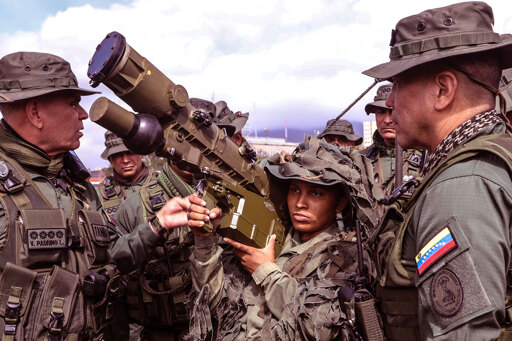
All imperial attempts at regime change have run up against what, until now, seems insurmountable: the unity of the Bolivarian National Armed Forces (FANB). There is not a single indicator showing any internal divisions. Part of the key to this unity is the development of a new military doctrine known as the Comprehensive Defense of the Nation. This doctrine seeks to confront the US military threat based on a set of actions designed to deter a technologically and numerically superior enemy.
This strategy has three central elements: strengthening military power, deepening the civil-military union (between the people and the soldiers), and bolstering popular participation in national defense tasks. Previously, the armed forces were fragmented into divisions and brigades. Commander Chávez organized the country into regions, and each region has a military structure with all its components: Army, Navy, Air Force, National Guard, militias, and the people.
If someone attacks a region, that region has the capacity to defend itself. It doesn’t need to move units from elsewhere. On February 23, 2019, under the pretext of bringing in humanitarian aid from Colombia, the Contras and Washington attempted to establish a beachhead in Táchira that would give the illegitimate Juan Guaidó control of a strip of Venezuelan territory to establish a “seat of government.” For 17 hours, fierce clashes erupted between Chavistas and Venezuelan paramilitaries and guarimberos, who operated mostly from the Colombian side. The skirmish ended with the opposition’s defeat.

Diosdado Cabello
There, amidst the events, at the military installation beside the Simón Bolívar Bridge, I spoke with Diosdado Cabello, then president of the National Constituent Assembly. Most of the FANB (National Bolivarian Armed Forces) chiefs were also present, whom he introduced to me as his friends and as longtime collaborators of Hugo Chávez. I asked him about the resolve of his troops. In good spirits, he explained: “President Maduro has visited every barracks. He shows up in the early morning.”
He arrives, runs with them, shares, does military exercises with them. We have total contact with them. We are like brothers. Many of us have been in this movement since we were children. We support each other and follow each other. We are a family. They will not break us…” Regarding the role of the militias, he told me: “For the friends of the State, they are a diamond. For the enemies of the State, they are the worst news.” A military intervention by a foreign country in Venezuela is very complicated, and not only because of the civil-military alliance.
Caracas has modernized its weaponry by acquiring it from Russia, China, and Iran, with whom it also maintains an alliance. Furthermore, it covers an area of almost one million square kilometers. Its topography is highly diverse: the Andes mountain range, the Coastal Range, and the Guiana Shield, along with the extensive Orinoco River basin. It boasts 4,208 kilometers of coastline and dense rainforests. The poor neighborhoods of cities like Caracas are dangerous. It shares a 2,341-kilometer border with Colombia, a 2,199-kilometer border with Brazil, and a 789-kilometer border with Guyana.
No neighboring country desires armed conflict on its borders. Venezuela possesses the men, weapons, determination, and territory capable of sustaining a prolonged popular resistance, turning any attempt to occupy the country into a quagmire for whoever tries it. Regardless of what might happen on the day of the occupation, the true military challenge for an invading force lies in what to do in the days that follow. However, beyond what may happen in the future, in Venezuela, today is the time for peace.
Luis Hernández Navarro is the Opinion editor of La Jornada*, and the author of numerous books, including* Chiapas: La nueva lucha india and Self-Defense in Mexico: Indigenous Community Policing and the New Dirty Wars*.*
-

Venezuela, The Day After
December 9, 2025
Venezuela possesses the people, weapons, determination, and territory capable of sustaining a prolonged popular resistance, turning any attempt to occupy it into a quagmire for whoever tries.
-

People’s Mañanera December 8
December 8, 2025
President Sheinbaum’s daily press conference, with comments on the 4th Transformation anniversary, employment stats, new high schools, water law, US relationship, & 2026 World Cup.
-

Tren Maya on the Tracks of History
December 8, 2025December 8, 2025
An interview with Étienne von Bertrab, author of the new book Más allá: una historia del Tren Maya.
The post Venezuela, The Day After appeared first on Mexico Solidarity Media.
From Mexico Solidarity Media via This RSS Feed.