

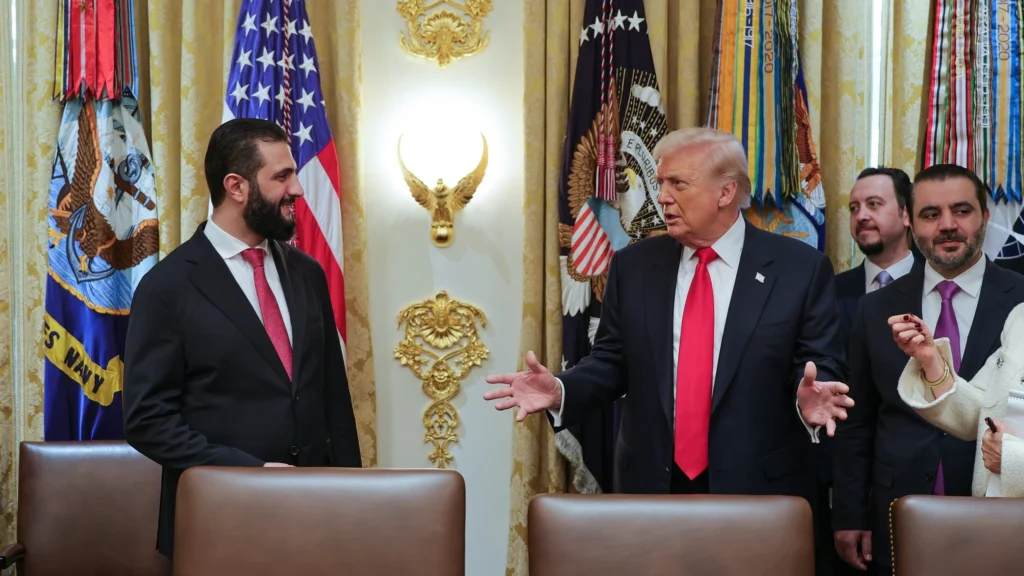
The U.S. is set to revoke the 2019 Caesar Syria Civilian Protection Act, according to the draft National Defense Authorization Act (NDAA) for fiscal year 2026, effectively ending the sanctions that obstructed reconstruction efforts under the Bashar al-Assad administration since 2020.
The provision — still pending House approval — would unwind secondary sanctions in phases, contingent on verified progress by Syria’s new leadership.
RELATED: Syrians See Israel as a Threat to Their Security
Ahmed al-Sharaa, who assumed power after ousting al-Assad, would be required to meet a series of U.S.-monitored benchmarks before sanctions relief becomes permanent.
A Conditional Rollback of Sanctions
The U.S. president must certify within 90 days, and then every 180 days for four years, that Damascus is taking measurable action in key areas:
- Dismantling the Islamic State of Iraq and Syria (ISIS) and other extremist groups
- Protecting minority rights
- Refraining from hostile actions against neighboring states
- Combating money laundering and terrorist financing
- Prosecuting crimes against humanity allegedly committed under Assad
- Eliminating drug production networks
If any two consecutive reports find insufficient progress, sanctions could snap back immediately.
⚡️⭕️ Trump : We lifted sanctions on Ahmad Al Sharaa (Syria’s president, he’s a tough guy) based on the request of Israel and Turkey pic.twitter.com/UR0s7cpKu1
— Middle East Observer (@ME_Observer_) November 8, 2025
Diplomatic Overtures Already Underway
The legislative move follows a rapid series of diplomatic shifts over the past year. Washington began suspending sanctions in late 2025, using renewable 180-day waivers while negotiating with Syria’s transitional authorities. The process accelerated after a high-profile meeting between then-President Donald Trump and al-Sharaa in Saudi Arabia last May, leading to an executive order that lifted comprehensive sanctions in June.
The U.S. later removed Hayat Tahrir al-Sham (HTS) from its Foreign Terrorist Organization list and delisted al-Sharaa as a Specially Designated Global Terrorist.
Al-Sharaa, previously known by the pseudonym al-Jolani, served as the head of the al-Nusra Front (Al-Qaeda’s branch in Syria) until its reported dissolution and the subsequent formation of HTS.
Trump on Ahmed al-Sharaa:
He is a very strong leader, he comes from a very tough place and he is a tough guy.
I liked him, I get along with him.
We will do everything we can to make Syria successful. pic.twitter.com/MG8gRfH6e3
— Clash Report (@clashreport) November 10, 2025
Security Landscape Remains Volatile
According to U.N. reports, the transitional period has been marred by massacres in coastal areas and Sweida, widespread lawlessness, institutional collapse, and continued human rights abuses.
Violations include extrajudicial killings, kidnappings, sexual violence, arbitrary detentions, and looting — with minority communities such as Alawites (which AL-Assad belonged to), Druze, Christians, and Bedouins particularly affected.
The U.N. warns that the integration of former armed factions into security forces, without adequate oversight, has fueled instability.
Repeated Israeli airstrikes have added to civilian casualties and infrastructure damage.
Since the fall of al-Assad, the Israeli government has been sending Israel Defense Forces (IDF) troops into the demilitarized buffer zone of the Syrian Golan Heights, advancing its creeping annexation of the territory.
Addressing the @UN General Assembly in New York today, the UN #Syria Commission of Inquiry (@UNCoISyria) warned that renewed, brutal violence is jeopardizing the hard-won optimism that followed the fall of the former government last year. #UNGA80
👉 https://t.co/DkeYtPWoaW pic.twitter.com/ERXqzTci15
— UN Human Rights Council Investigative Bodies (@uninvhrc) October 30, 2025
From teleSUR English via This RSS Feed.