

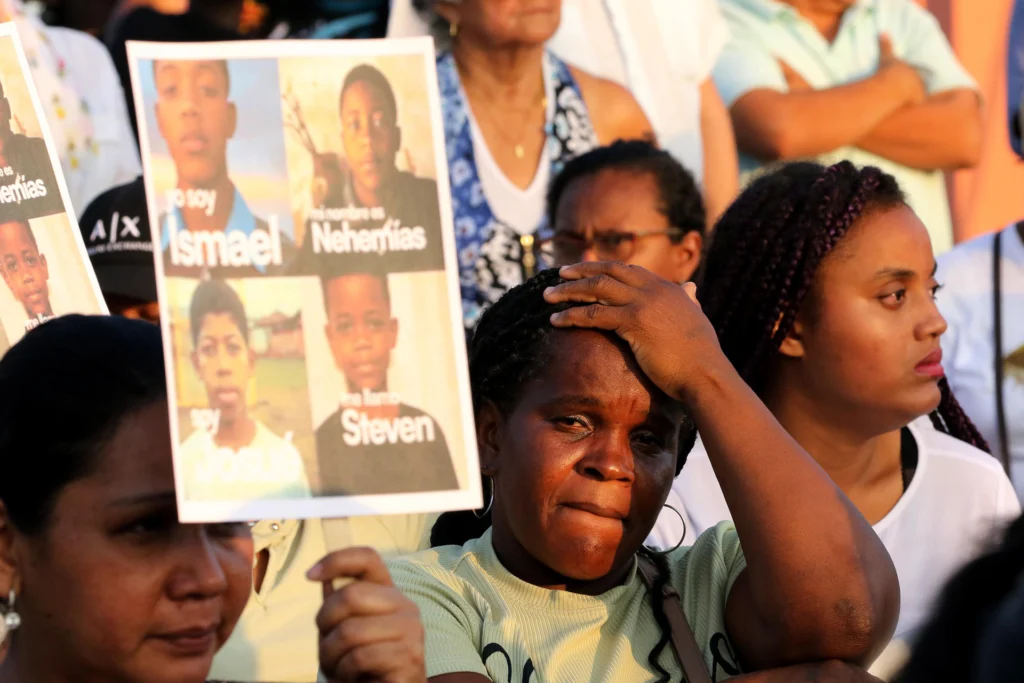
Families and Human Rights groups in Ecuador marched through Guayaquil to demand justice for four children from Las Malvinas who were disappeared and killed by ecuadorian soldiers, turning grief into a collective call for truth, accountability, and an end to impunity.
On December 8, 2025, the streets of southern Guayaquil filled with grief and determination as families, Human Rights organizations, and Afro-descendant collectives marched to honor the memory of four children killed by members of the military forces, a case considered one of Ecuador’s most severe state crimes against children.
RELATED: Six People Killed in Armed Attack in One of the Most Violent Areas of Ecuador
The march, titled “For the Right to Memory”, marked the first anniversary of the disappearance and subsequent murder of Josue and Ismael Arroyo (14 and 15 years-old respectively), Nehemias Arboleda (15 years-old), and Steven Medina (11 years-old), all residents of the Las Malvinas ecuadorian neighborhood.
The symbolic procession began at the Casa Comunal de Las Malvinas and retraced the paths of the victims’ lives, stopping at their homes to hold readings, artistic performances, and community tributes. Participants carried banners with slogans such as “Neither forgiveness nor forgetfulness”, demanding justice, truth, and guarantees of non-repetition.
Inicia la romería en homenaje a los cuatro niños de Las Malvinas, asesinados hace un año.
Desde la memoria viva y la tradición andina, explican sus asistentes, este caminar colectivo no solo honra sus nombres y sus vidas arrebatadas, sino que siembra en la tierra y en la… pic.twitter.com/1513M1PzKA— Elena Rodríguez Yánez (@ElenaDeQuito) December 8, 2025
Text reads: Begins the march in tribute to the four children of Las Malvinas, killed a year ago.
From living memory and the Andean tradition, explain their assistants, this collective walk not only honors their names and their lives taken away, but sows in the earth and in the conscience of the people a promise: that forgetfulness never has the last word.
Ronny Medina, Steven’s father, tearfully remembered his son as “a boy who loved football and studying.” He recounted the harrowing details of how the four adolescents were detained by a military patrol on 25 de Julio Avenue and subsequently transported to Taura. There, they were subjected to aggression, disappeared, and ultimately murdered. “I wish this were a dream,” Medina expressed, highlighting the initial discrimination they faced for being from a “low-income neighborhood.”
Similarly, Katy Bustos, the mother of Josue and Ismael, shared the poignant detail that her son Josue “dreamed of being a military man, of wearing the camouflage uniform of the Armed Forces.” She underscored the profound irony that “it was the uniformed men, whom he admired, who are the alleged perpetrators of his disappearance amidst a series of revelations of racist insults, beatings, and gunshots during their detention.” Bustos further shared the ongoing grief, explaining that her nine-year-old daughter cries every night, asking: “Mom, why did the military do all that to my brothers?”
The march culminated at La Coviem Park, which was symbolically renamed “The Four Children of Las Malvinas” as an act of reparation in the face of impunity, in a demand for justice and truth.
Ver esta publicación en Instagram
Una publicación compartida de BILM (@blackindigenousliberation)
Concurrently, on December 8, the trial against the accused military personnel entered its final phase. The Attorney General’s Office has requested a sentence of 34 years and eight months in prison for the 17 military members, in addition to fines equivalent to 800 basic salaries, and comprehensive non-repetition measures.
This deeply moving case has profoundly impacted the nation, unfolding within the broader context of an internal armed conflict declared in January 2024 by President Daniel Noboa. This declaration significantly expanded the operational role of the Armed Forces in efforts against organized crime, a policy framework that critics argue facilitated such abuses.
The families of Josue, Ismael, Nehemias, and Steven continue to demand justice, transforming their grief into collective resistance, with a powerful message: that memory must prevail over silence, and that the pursuit of justice is essential to ensure such atrocities are never repeated.
From teleSUR English via This RSS Feed.