

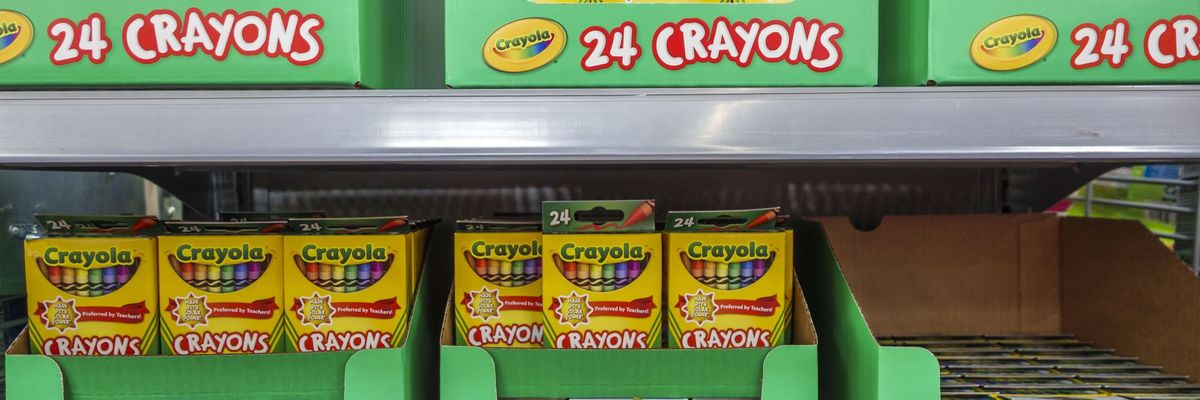
A detailed investigation released Thursday reveals that the e-commerce behemoth Amazon is using its market dominance and political influence to gain a foothold in local governments’ purchasing systems, locking school districts into contracts that let the corporation drive up prices for pens, sticky notes, and other basic supplies.
The new report by the Institute for Local Self-Reliance (ILSR), titled Turning Public Money Into Amazon’s Profits: The Hidden Cost of Ceding Government Procurement to a Monopoly Gatekeeper, is based on purchasing records from nearly 130 cities representing more than 50 million Americans.
ILSR found that “cities, counties, and school districts spent $2.2 billion with Amazon in 2023—a nearly fourfold increase since 2016.”
“Through its Amazon Business platform, the company has maneuvered to become the default source for office products, classroom materials, cleaning supplies, and other routine goods,” the report states. “Today, it is embedded in most local governments, making inroads into state agencies, and dominating a new program designed to reshape how federal agencies buy commercial products.”
Unlike the fixed pricing that’s typical for government contracts, the agreements that Amazon has secured with local governments across the US entail “algorithm-driven pricing” to “covertly raise prices and inflate costs for governments.”
“The result is dramatic price variation: One city bought a 12-pack of Sharpie markers for $8.99, while a nearby school district paid $28.63 for the identical pack that same day,” ILSR said. “Our data contain thousands of similar examples, with some agencies paying double or even triple what others paid for the same items.”
- Hard to believe, but Amazon has persuaded schools and cities across the country to abandon competitive bidding and fixed price contracts. Instead, they’re signing contracts with Amazon that specify dynamic pricing. The result: Paying $37 for 12 pens or $74 for 36 markers. pic.twitter.com/afIIkPucZL
— Stacy Mitchell (@stacyfmitchell) December 5, 2025
Overall, ILSR found that school districts bound to Amazon contracts spend twice as much per student as school districts without an agreement with the $2.5 trillion company.
“Public officials should be deeply concerned by what we found,” Stacy Mitchell, co-executive director of ILSR, said in a statement. “Amazon is reshaping public procurement in ways that expose taxpayer dollars to waste and risk. It has persuaded cities and schools to abandon safeguards meant to ensure fair prices and accountability—while driving out independent suppliers, eroding competition, and putting Amazon in a position to dictate terms.”
Having gained sweeping access to local government purchasing processes, Amazon is increasingly inserting itself into state and federal systems. ILSR noted that “Amazon dominates the General Services Administration’s Commercial Platforms Program, a new system for agencies to make purchases below $15,000 that do not require competitive bids.”
“During the first two years of the program’s pilot phase,” the group found, “Amazon captured 96% of sales.”
ILSR emphasized that Amazon’s dominance is by no means inevitable and can, with concerted action, be rolled back.
“A handful of cities and counties have recognized the risks of relying on Amazon and taken steps to restore transparency and keep public dollars local,” the report observes. “Tempe, Arizona rejected an Amazon group-purchasing contract after hearing concerns from a local business owner. Between 2017 and 2023, the city cut its Amazon spending by 84% while increasing purchases from local suppliers. Phoenix likewise prioritizes local bids and has spent almost nothing with Amazon over the last decade.”
Kennedy Smith, co-author of the report, said that “when local officials put real safeguards in place and prioritize local suppliers, they save money, strengthen their economies, and restore public control over public dollars.”
To keep their procurement system free of the kinds of tactics Amazon uses to line its pockets with taxpayer money, ILSR urged state and local governments to prohibit so-called “dynamic pricing” in purchasing contracts and to prioritize buying from local businesses.
“By reclaiming control of public procurement, governments can safeguard dollars, strengthen local businesses, and ensure that the goods that sustain our schools and public services are supplied through systems that are transparent, competitive, and democratic,” the group said.
From Common Dreams via This RSS Feed.