

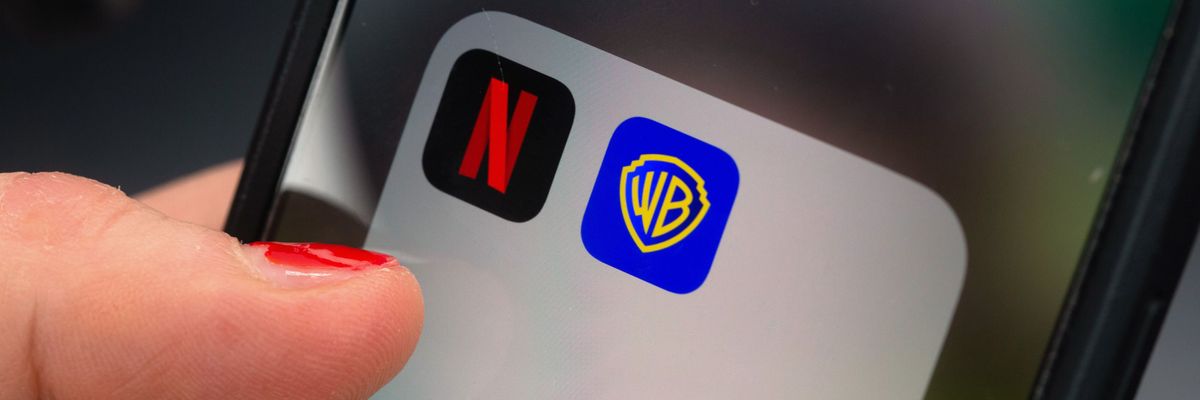
Netflix announced a deal Friday to acquire Warner Bros. Discovery’s film studio and streaming business for $83 billion, a merger that—if approved by the Trump administration—would create a media behemoth that critics say threatens industry competition, higher costs for consumers, the rights of entertainment workers, and democracy.
Netflix, the largest streaming company in the world, and Warner Bros. Discovery (WBD), owner of the third-largest streaming platform HBO Max, unveiled the proposed agreement after a closely watched bidding war that included Paramount Skydance, the company that the Trump administration reportedly favored to acquire WBD. Paramount is owned by David Ellison, the son of billionaire Republican megadonor Larry Ellison—a close ally of President Donald Trump.
David Ellison reportedly met with Trump administration officials on Thursday to “press his case” against Netflix’s pending acquisition of WBD. An unnamed senior official told CNBC on Friday that the Trump administration is treating the Netflix-WBD deal with “heavy skepticism.”
While some expressed relief that Paramount appears—at least for now—to have lost the bid for Warner Bros., antitrust advocates argued such a view overlooks the much broader and more serious threat of corporate consolidation.
“Does anyone think Netflix won’t do what Trump wants to get their deal through?” asked Matt Stoller, director of research at the American Economic Liberties Project. “The threat to democracy isn’t the Ellisons, it’s media consolidation.”
The American Prospect’s David Dayen expressed a similar sentiment, writing on social media: “Keeping WBD out of Paramount’s hands is good. Putting it in Netflix’s is still unlawful consolidation though. This is the #1 streamer merging with #3. State enforcers should speak up.”
“If we don’t speak now, we may have no industry—and no democracy—left to defend.”
In a newsletter post following news of the merger agreement, Stoller argued the Netflix-WBD deal is plainly illegal under the Clayton Antitrust Act and “a recipe for monopolization.”
“The ideal scenario now is a trial that puts the secrets of Hollywood executives and financiers on display, and crushes the financiers who think mergers are the only move in business,” Stoller wrote. “Then Hollywood can get back to the business of making good TV shows and movies.”
Sen. Elizabeth Warren (D-Mass.) said that “this deal looks like an anti-monopoly nightmare.”
“A Netflix-Warner Bros. would create one massive media giant with control of close to half of the streaming market,” said Warren. “It could force you into higher prices, fewer choices over what and how you watch, and may put American workers at risk.”
“Under Donald Trump, the antitrust review process has also become a cesspool of political favoritism and corruption,” the senator continued. “The Justice Department must enforce our nation’s anti-monopoly laws fairly and transparently—not use the Warner Bros. deal review to invite influence-peddling and bribery.”
Ahead of the announcement, major figures in the entertainment industry sounded alarm over the possibility of a Netflix takeover of WBD. In a letter to members of Congress on Thursday, a group of film producers warned that Neflix would “effectively hold a noose around the theatrical marketplace” if it acquired WBD.
The Writers’ Guild of America, which represents film and TV writers, has said it would oppose WBD merging with any “major studio or streamer,” warning it “would be a disaster for writers, for consumers, and for competition.”
“Merger after merger in the media industry has harmed workers, diminished competition and free speech, and wasted hundreds of billions of dollars better invested in organic growth,” the union said in a recent statement.
Jane Fonda, the renowned actress and activist, wrote Thursday that “the threat of this merger in any form is an alarming escalation in a consolidation crisis that threatens the entire entertainment industry, the public it serves, and—potentially—the First Amendment itself.”
“Consolidation at this scale would be catastrophic for an industry built on free expression, for the creative workers who power it, and for consumers who depend on a free, independent media ecosystem to understand the world,” Fonda wrote. “It will mean fewer jobs, fewer opportunities to sell work, fewer creative risks, fewer news sources, and far less diversity in the stories Americans get to hear.”
“If we don’t speak now, we may have no industry—and no democracy—left to defend,” she added.
From Common Dreams via This RSS Feed.