

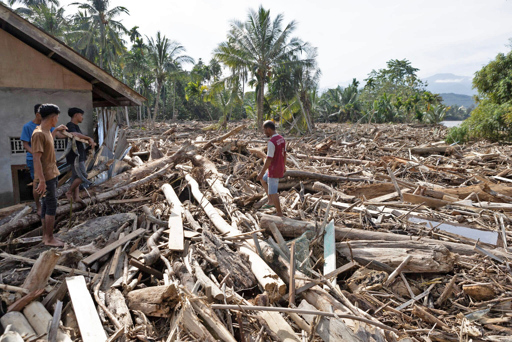
JAKARTA — The Indonesian government has announced what it describes as a sweeping, science-based effort to reassess environmental governance, zoning and corporate accountability in the wake of floods and landslides that killed more than 1,100 people across the island of Sumatra. The disasters were triggered by extreme rainfall linked to Tropical Cyclone Senyar, but government officials, scientists and environmental researchers say the scale of the destruction can’t be attributed to the weather alone. They point instead to long-term land-use changes — including deforestation and large-scale forest conversion — that have weakened natural buffers in Sumatra’s upland watersheds, leaving landscapes unable to absorb intense rainfall. The government has acknowledged that human-driven changes to land cover have fundamentally altered Sumatra’s landscapes, reducing their capacity to prevent severe flooding and landslides when extreme weather hits. “These changes are caused both by anthropogenic factors — such as the conversion of forest cover into non-forest areas — and by heavy rainfall, combined with the geomorphological characteristics of our soils, which are unable to adapt to these pressures,” Environment Minister Hanif Faisol Nurofiq said. The acknowledgment marks a significant shift in tone. Rather than treating the disasters solely as natural events, the government is now explicitly linking loss of life and environmental damage to development decisions, land-use planning and corporate activity — and signaling that permits and licenses may no longer shield companies from accountability. On Dec. 23, 2025, Hanif announced a three-pronged intervention covering Aceh, North Sumatra and West Sumatra, the provinces most severely affected…This article was originally published on Mongabay
From Conservation news via This RSS Feed.