

This story was co-published and supported by the journalism nonprofit Economic Hardship Reporting Project.
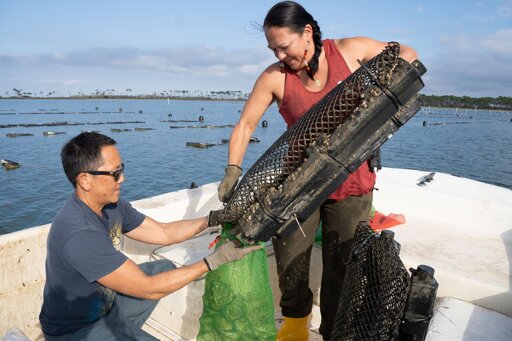
On a late afternoon in early November, Xochitl Bervera launches The Roxie Girl from St. George Island into the gentle waters of Florida’s Apalachicola Bay. Almost as soon as the boat gets up to speed, she kills the motor and drifts the final feet toward her destination: a 2.5-acre grid of buoys and bags floating in Rattlesnake Cove. This is her farm, Water Is Life Oysters.
Bervera and her partner, Kung Li, launched the business in 2022, not long after the state implemented a five-year ban on harvesting the bay’s beloved but imperiled wild oysters, leaving the surrounding community without its economic engine and sense of identity.
As the sun sinks toward the horizon, Kung Li hauls in a bag of oysters and samples a mollusk to be sure it meets muster. They pop it open with a twist of an oyster knife and find everything that has made Apalachicola oysters famous for generations: briny liquor surrounding firm, sweet meat. “That,” Kung Li exclaims, “is a good oyster.” They put five bags on ice.

Freshly shucked Apalachicola oysters from Water Is Life Oysters. (Photo credit: Xochitl Bervera)
Oysters have been eaten for millennia from this estuary, where freshwater from the Apalachicola River meets the salty Gulf of Mexico to form an ideal breeding ground. In its heyday, the bay supplied 90 percent of Florida’s oysters and 10 percent of the country’s. But after a 2013 fishery failure all but wiped out a $9 million annual harvest that once supported 2,500 jobs, the state officially closed the bay in 2020 for five years.
Since the closure, locally farmed oysters—Crassostrea virginica, the same species as their wild predecessors—are the closest thing anyone’s had to that old familiar flavor. Water Is Life is among a few dozen farms that have attempted to fill the void, hoping to preserve the bay’s oyster culture while the state embarks on a costly reef restoration. Bervera, a former criminal justice organizer, and Kung Li, a former civil rights lawyer, harbor a vision for a revived Apalachicola Bay. They believe a vibrant local food system can once again feed this community and restore dignified jobs that protect the bay’s health rather than diminish it.
“I look around the country and maybe that’s not possible in many places any more,” Bervera says, “but it’s very possible here.”

Apalachicola, Florida, calls itself the Oyster Capital of the World, but for many years, oysters have been trucked in from out of state. (Photo credit: Ben Seal)
In a controversial decision, the state reopened the commercial oyster fishery on Jan. 1, leaving this small community on the Forgotten Coast—named for its relative quiet and lack of development—anxious about its economic future. If the oysters come back, so will the industry. If they don’t, roughly 5,000 residents in Apalachicola and its neighbor Eastpoint fear their towns will be overtaken by resort-style development like so much of Florida’s coastline, pushing out both their culture and their communities.
It’s a heavy weight to rest on a 3-inch mollusk.
‘The Heartbeat of Apalachicola’

Apalachicola Fish and Oyster Company workers shucking oysters in 1946. (Photo credit: State Archives of Florida, Florida Memory)
Charles Wilson can trace his lineage in Apalachicola back to 1860, right around when oysters overtook timber as the area’s chief economic resource. At the turn of the 20th century, his grandfather ran one of the many oyster houses that lined these shores, where shucked shells piled into mountains.
Like so many tongers—as oystermen are called here, after the long wood-and-metal tongs used for plucking the mollusks off the reef—he started going out on his father’s boat when he was just 7, heading into the bay every evening after school to fill buckets. Even at 78, he still has forearms like Popeye and thickly muscled hands from decades spent gripping his tongs.
When Wilson was young, trucks left the bay in droves, packed full with thousands of gallons of oyster meat headed far and wide. The abundance seemed inevitable. “It was there and it was never gonna run out,” he says.
For most of Wilson’s lifetime, the bay’s oysters were the center of an economic constellation—not just tongers, shuckers, restaurants, and distributors, but also boat builders, welders, mechanics, and more. In the water, too, the oysters were foundational. Blue crab, shrimp, redfish, flounder, and black drum flourished in the clean water they filtered and the nooks and crannies of their reefs, providing both sustenance and steady work for fishermen around the bay.

Apalachicola Fish and Oyster Company workers tonging for oysters in 1947. (Photo credit: State Archives of Florida, Florida Memory)
“The oyster was the heartbeat of Apalachicola,” one local told Betsy Mansfield, a postdoctoral researcher at Florida State University who has studied the ripple effect of the fishery closure. Mansfield calls oysters a “multidimensional foundation species” for their economic, cultural, social, and nutritional importance.
Oysters served as the community’s hub for generations. When someone fell on hard times, their neighbors organized a fish fry to rally support or took them tonging and passed on the day’s pay. Oystering was more than a job.
“It meant independence,” Wilson says. “It was an income. And it was a lifestyle.”
Apalachicola’s oysters held on longer than most. By the time the fishery failed, 85 percent of the world’s beds had disappeared. Locals attribute the longevity to the pristine waters of the Apalachicola River, the shelter from predators offered by the barrier islands, and an ethic that insisted on taking only what the bay could give. Even after Hurricane Elena in 1985 reduced oyster populations in Apalachicola by as much as 95 percent, the bay rapidly recovered.
But the state responded to the 2010 Deepwater Horizon oil spill by encouraging harvesters to grab what they could before the slick reached the bay. (It never did.) Coupled with a drought that limited freshwater flow into the bay and welcomed in saltwater predators, the rush to harvest led to quick collapse. Almost immediately, landings of 3 million pounds dropped below 1 million; they kept falling until the state Fish and Wildlife Commission pulled the plug in 2020.

A father shows his son how to shuck oysters in 1972 on Apalachicola Bay. (Photo credit: Holland, Karl E., State Archives of Florida, Florida Memory)
With the oysters went the work, including much of the supplementary shrimping, crabbing, and fishing. Oyster houses closed or pivoted to become restaurants. Boats were left to rot and tongs to rust. Poverty and drug use increased, residents say. Today, many former oystermen get by mowing lawns or cleaning houses for eco-tourists who visit the bay without realizing the seafood they came for is mostly trucked in from elsewhere in the Gulf. Until aquaculture picked up, the only oyster available in a place that calls itself “The Oyster Capital of the World” came from Texas or Louisiana.
The collapse sparked dread around the bay that tourism will fully replace seafood as the local industry. About 100 miles northwest of the bay, Destin serves as a cautionary tale. It’s a miles-long amusement park of monolithic beachfront resorts and chain restaurants. In Apalachicola and Eastpoint, the prized seafood and a two-story building limit have kept unchecked development at bay. Nearby, though, St. George Island is already filling in with pastel-painted vacation homes skirting the zoning laws. Residents fear a sudden influx of development if the oysters don’t rebound.
“It’s like a wounded animal with a bunch of hyenas,” says Wayne Williams, a longtime tonger and president of the Seafood Work and Waterman’s Association, which has advocated for the bay’s reopening. “Or a plate full of French fries left out for the seagulls.”
Residents ‘Kill the Drill’
For a beleaguered bay community, the past year showed what is still possible. In April 2024, the Florida Department of Environmental Protection (DEP) prepared to hand out a permit for exploratory oil and gas drilling in the Apalachicola River floodplain. The river snakes through more than 100 miles of Florida’s panhandle, passing through marshes and floodplain forests that serve as habitat for dozens of endangered species, on its way to the bay. The ecosystem has historically been protected on both sides of the river. Its clean waters are vital to the bay’s marine life. A drilling mishap could have threatened any hope for the future.
The response was swift. The Apalachicola Riverkeeper filed a legal challenge and organized a “Kill the Drill” coalition of seafood workers, boat captains, and residents, including Bervera and Kung Li. The legislature eventually passed a bill prohibiting the DEP from issuing permits within 10 miles of a National Estuarine Research Reserve, ensuring the run of the river would stay protected; Governor Ron DeSantis signed it in June. A judge also urged the state to reject the permit, leading the DEP to reverse course.
The whole affair “was a blockbuster movie in terms of twists and turns,” says Adrianne Johnson, executive director of the Florida Shellfish Aquaculture Association, which was part of the coalition. It was also a reminder that although opinions are divided about the bay’s health and the potential for wild-caught oysters to return, its disparate communities share something unmistakable.
“People here have a relationship to the bay that is deep and real,” Kung Li says. “That relationship is what will turn despair into hope when the bay starts to come back.”

In 2024, “Kill the Drill,” a coalition of Apalachicola seafood workers, boat captains, and residents, joined together to prevent the state from allowing exploratory oil and gas drilling in the Apalachicola River floodplain. (Photo credit: Ben Seal)
For it to come back, though, restoration will need to succeed, providing habitat that allows oysters to accumulate and cling to one another as they grow into massive reefs. Diminished by overharvesting, the bay’s depleted reefs couldn’t withstand erosion from tides, currents, and storms. The degradation was so vast that in most of the bay “there were literally no reefs left” to build upon, says Sandra Brooke, a Florida State University marine scientist.
Restorationists have made headway in other bereft waters that once teemed with oysters, including the Chesapeake Bay and New York Harbor, but human mimicry of a natural process can be slow. Multiple projects have attempted to rebuild Apalachicola’s reefs with different materials, including Kentucky limestone, oyster shells, and concrete. Over and over, the bay buried or washed away inadequate substrates.
Since 2019, the Apalachicola Bay System Initiative, led by Brooke, has convened scientists, public officials, seafood industry members, and environmentalists behind an effort to understand the root causes of the decline and restore the bay’s health. The massive undertaking is still underway.
Shannon Hartsfield, a tonger subcontracted by the initiative, says he expected better results by this point—enough to support a meaningful harvest with economic value for oystermen. “We’ve only made small steps,” he says.
Despite more than $38 million of research and restoration that’s been poured into the bay since 2019, Brooke doesn’t believe it’s ready.
“From a scientific perspective,” she says, “I would have liked to have seen it closed for another five years or so.” From a cultural perspective, though, she understands the meaning of reopening the bay, even at a modest scale. “It’s one of the last vestiges of the way old Florida used to be,” she says.
The Fish and Wildlife Commission (FWC) confirmed in November that it won’t extend the bay’s closure, despite a recent analysis that found its historic 10,000 acres of oyster habitat had dwindled to just 500. In 2026, the state will open four oyster reefs to harvest, allowing just under 5,000 total bags to be split evenly among all harvesters—about 0.1 percent of the historic harvest.
The first season will span January and February—provided the oyster limit isn’t immediately triggered—and future seasons will extend from October through February. Securing a license requires a history of commercial oystering in the bay. A small amount of recreational harvest will also be allowed, all of it to be monitored by FWC officials. The FWC’s goals are twofold: restore 2,000 acres of reefs by 2032 and re-establish an oyster fishery.

Oyster shells piled high outside Leavins Seafood, an Apalachicola distributor that hasn’t offered locally caught oysters since the bay’s collapse in 2020. (Photo credit: Ben Seal)
“We understand that people are frustrated by the current state of the resource, and that there is a desire to return to the days when oysters were abundant and provided an important source of income for Franklin County residents and businesses,” the commission said in a written statement in November. “However, the bay is still in recovery.”
That recovery is aided by how quickly oysters grow here, Brooke says. It might take three years for an oyster to reach market size in New England, but in Apalachicola it happens within a year or so, thanks to the bay’s warm, nutrient-rich waters. Still, skepticism abounds about the FWC’s ability to enforce bag limits and protect the reefs enough to avoid a prompt relapse.
“The bay is going to provide. It’s a delicious bay,” Bervera says. “But if we don’t take care of it then it can’t really take care of us.”
The Promise of a Path Forward
For generations, oystering in Apalachicola was handed down from father to son, a promise that led many to drop out of school with their career laid out before them. There was nothing to replace it when the fishery declined—not just for the current seafood workers, but also for those to come. The health of the bay will determine their future.

Retired Apalachicola oysterman Charles Wilson with his long wood-and-metal tongs, used to pluck oysters from their reefs. (Photo credit: Ben Seal)
As soon as the fishery fell apart, Joe Taylor recognized the need for alternatives. As executive director of the nonprofit Franklin’s Promise Coalition, he pivoted his organization from anti-poverty work to youth workforce development. Today, his Oyster Corps—a subset of Americorps—trains residents between 18 and 25 in coastal resilience measures and habitat restoration, focused on oyster reefs, marsh grasses, sea grasses, and dunes. Workers receive a stipend for protecting local ecosystems, and many stay employed in related work after the program, often with the FWC and state parks. Oyster Corps teaches them skills that can offer a path forward, whether or not the seafood industry returns.
“People see the oysters and think about eating,” Taylor says. “But we also see oysters as the foundation for the healthy world that we want to live in.”
Taylor helped 450 seafood workers navigate the fishery collapse as part of a broader retraining and job placement initiative, helping fishermen find work in transportation, welding, and other trades.
Among them was Tony Foley, whose son, Holden, an Oyster Corps graduate, is now the organization’s director of restoration. Holden Foley started going out on boats with his father and grandfather when he was small, filling 5-gallon buckets of oysters for $5 a pop. He’s applying for an oyster harvesting license to make some extra money on weekends, but he knows his community needs more opportunity. Only a few of his classmates remain. Still, Foley believes the harvest can return and the community can rebuild.
“The area’s beautiful. It’s peaceful. It’s quiet,” he says. “When I travel and come back, I know why I stay here.”
Food and Freedom
In Rattlesnake Cove, the sun continues its descent as Bervera navigates The Roxie Girl around the buoys to check on her oyster gear. As she and Kung Li hoist up sinking bags and repair broken parts, they check on a clutch of juvenile oysters placed in the bay a few months ago. Dozens have died, inexplicably. It’s a reminder that farming is hard work—physically, financially, and sometimes emotionally. They toss the shells overboard and lament the loss. “Sadness,” Bervera says.
Bervera is fond of quoting the food sovereignty activist Leah Penniman’s refrain that “we have to feed ourselves to free ourselves.” For generations, the bay has made that possible. People here still trade—eggs for fish, oysters for shrimp, gator for boar—and they still host fish fries as a way to care for their community.

Kung Li on an old oyster boat that Li and business partner Xochitl Bervera repurposed to sell oysters directly to the community. (Photo credit: Xochitl Bervera)
Farmed oysters have served as a bridge to their wild cousins for the past five years. A former oysterman even shed a tear when he tried one from Water Is Life. “This is the oyster,” he told Bervera.
If wild oysters can thrive once again, it could sustain a local food system and way of life so many here desire.
“We’ll know we’re doing it right because we won’t see the Sysco trucks bringing seafood to a seafood town,” Kung Li says.
A week later, Kung Li and Bervera head down the coast a few hours to Cedar Key and come back with baby oysters to replace those they’ve harvested. The new seedlings are smaller than a fingernail. Kung Li and Bervera tuck them into fine-mesh bags to begin the year-long journey to harvest size.
They lean over the side of the boat and slide the babies, thousands at a time, into the waters where so many oysters have thrived before.
The post A Florida Oyster Fishery and Its Community Fight for Their Future appeared first on Civil Eats.
From Civil Eats via This RSS Feed.