


Amelia Schafer
ICT
As 2025 came to a close, economic uncertainty and the potential for another government shutdown carried into the new year. On a brighter note, the new year will bring historic Indigenous representation to the FIFA 2026 World Cup and a potential for Indigenous athletes to shine at the 2026 Winter Olympics and the 150th anniversary of a historic Indigenous victory at the Battle of Little Big Horn.
Economic uncertainty, unemployment rates double for Natives in rural areas
Above all else, the United States is headed toward continued economic uncertainty in 2026. Over half of all states have declared a recession following stagnant economic growth in 2025.
There’s a lot of conflicting information at the moment, said Matthew Gregg, a senior economist at the Center for Indian Country Development.
Despite strong nationwide figures, with 3.8 percent GDP growth but a 4.3 percent unemployment rate, a majority of states are either in a recession or at high risk of being in one. For tribal communities and Indigenous workers, any hit to the economy is going to be felt harder and more deeply.
“Historically, when the economy or when the unemployment rate is creeping up and it increases, it increases by more for communities and people that have historically high unemployment rates,” Gregg said. “When the economy worsens and unemployment grows, those groups are disproportionately worse off.”
For Indian Country, things are a bit more bleak, as indicated by data from the Center for Indian Country Development. Part of the Federal Reserve System, the center studies how tribal economies and Indigenous employees are fairing and provides data on Indian Country’s economy.

Volunteers with the Rapid City-based nonprofit COUP Council serve meals at the Pejuta Waste Day Center. Credit: Courtesy of COUP Council
Unemployment among American Indian/Alaska Native people in urban areas sits at 5.7 percent and unemployment among American Indian/Alaska Native people in rural areas sits at a stark 8.8 percent, double that of the nationwide average.
Currently, the unemployment rate among AI/NA individuals in non-urban areas has declined throughout the year, peaking at 12.3 percent unemployment in June 2025 and dipping back down to 8.8 percent in December.
“Most experts call the present-day economy a low-hire, low-fire economy,” Gregg said. “What that means is that the hiring rate has been really low for a while, but the layoff rate has been really low for a while. It’s basically really hard to enter the labor market now and look for a job.”
Labor force participation among AI/NA individuals in urban areas has steadily grown throughout 2025, as shown by Center for Indian Country Development data, with 63.9 percent currently employed or seeking employment. For those in non-urban/rural areas, participation has declined since June, with only 54.5 percent of AI/NA individuals seeking employment or currently employed.
Compared to non-Native individuals, labor force participation among AI/NA individuals in urban areas is higher than that of non-Native individuals but lower among those in rural areas.
This phenomenon is not uncommon among those in rural areas, said Gregg. Living in a rural area is typically associated with increased difficulty finding employment, something further exasperated by how extremely rural reservation and tribal communities can be.
“We’re in a situation where we don’t have a ton of job growth,” Gregg said. “So there’s not a lot of job creation. The demand for workers is relatively low right now, but so is the supply of workers. We’ve seen a low labor supply growth rate.”
If the economy continues to stay stagnant or even dip into a full-blown recession, there will likely be a decrease in consumer spending. For Indigenous small business owners, this could mean a further decline in sales, which many reported over the holiday shopping season.
For tribal economies that thrive on gaming and tourism, those areas could also see a decline in revenue.
“The Federal Reserve right now is looking at interest rates to try to encourage spending in this kind of weird economy,” Gregg said. “This is a little different, but during the COVID recession we know a lot more about what happened in those service industries that rely on casino gaming, they took a big hit. It is something to look out for.”
A potential government shutdown

President Donald Trump signs the funding bill to reopen the government, in the Oval Office of the White House, Wednesday, Nov. 12, 2025, in Washington. (AP Photo/Jacquelyn Martin)
The clock is ticking for lawmakers who vowed to vote on extending Affordable Care Act subsidies following the longest government shutdown in American history. Lawmakers have until Jan. 30 to pass legislation. If they fail to do so, the government will once again shut down.
As of Dec. 30, lawmakers have passed only three of the 12 appropriated bills needed to fund the government in 2026. If the remaining nine bills aren’t funded, another shutdown is on the table.
The end of Gathering of Nations

Miss Indian World 2022-23 Tashina Red Hawk, Sicangu Lakota. (Photo courtesy of Gathering of Nations website)
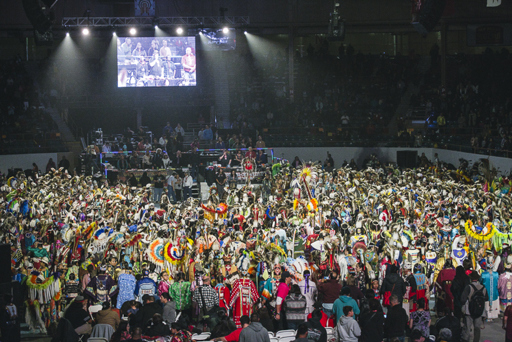
April 24 will mark the beginning of Gathering of Nations’s “Last Dance,” the final time “North America’s largest powwow” will take over Albuquerque, New Mexico.
Powwow organizers, the Matthews family, have not said why the powwow is ending.
The past several years have been marked with controversy for Gathering of Nations.
In 2024, lead organizer Derek Matthews went viral after he gave a 12-minute speech at the powwow in which he held a mirror up to the audience and responded to criticism leveled against him regarding costs of attendance, dancer registration fees, and the fact that Matthews is non-Native, saying Native people should look at themselves and solve their own problems.
Expo New Mexico, where the powwow is held, is also undergoing a costly redevelopment plan that could increase usage fees and drive out events.
Organizers did not respond to ICT’s requests for comment.
150th anniversary of ‘Greasy Grass’

Red Horse pictographic account of the Battle of the Little Bighorn, 1881.
June 25 will mark 150 years since as many as 1,800 Lakota, Cheyenne and Arapaho warriors, led by Lakota chiefs Crazy Horse and Sitting Bull, defeated Gen. George Armstrong Custer and his Seventh Cavalry in Montana on the Crow Reservation in 1876.
The Battle of the Little Bighorn, also known as the Battle of the Greasy Grass, marked a significant victory for Native American people against the US military and is celebrated in many Lakota communities every year.
The nine Oceti Sakowin tribes of South Dakota, Northern Cheyenne Nation and Northern Arapahoe Nation are currently planning a celebratory event to be held June 25, 2026. Event details will be made available as soon as they are made public.
America’s 250th
The United States will celebrate its 250th birthday on July 4, 2026. Several events are planned across the country to celebrate. The Great American State Fair will travel across the country and visit various state fairs, before landing on the National Mall in July 2026 to honor the “most patriotic” state fair.
Milano Olympic Winter Games
The 2026 Winter Olympics will kick off in Milan, Italy, on Feb. 6 and end on Feb. 22. The United States’s roster is not yet finalized, so it’s unclear what, if any, Indigenous athletes will be competing.
Ice hockey, a sport popular among Indigenous athletes, will be a featured sport at the 2026 Olympics.
For Canada’s team, snowboarder Liam Gill, Łı́ı́dlı̨ı̨ Kų́ę́ (Dene) First Nation, could return to the roster. Gill participated in the 2022 Beijing Winter Olympics. Notably, Gill modeled Team Canada’s 2026 Olympic gear for the team in November, hinting that the Dene snowboarder could be on the roster.
Alex Loutitt, Metis, will not be joining Canada’s ski team following a knee injury in September. Loutitt was part of Canada’s 2022 Winter Olympics team and was the first Canadian to win a medal in ski jumping.
World Cup and historic Indigenous partnerships
The FIFA World Cup will begin June 11 in Estadio Azteca in Mexico City, Mexico. Games will be held at various locations worldwide until the tournament ends on July 19, 2026.
A historic first, the World Cup will partner with the Puyallup Tribe for the game in Seattle, marking the first time an Indigenous nation is highlighted in the tournament.
FIFA has pledged that the 2026 tournament will highlight and honor Indigenous peoples following criticism regarding a lack of Indigenous athletes in previous tournaments.
In Canada, FIFA will partner with three additional Indigenous host nations – the Musqueam Indian Band, the Squamish Nation and Tsleil-Waututh Nation for its games in British Columbia.
In Mexico, FIFA said, it will work to honor the nation’s 68 federally recognized Indigenous groups as part of its work with the host city of Guadalajara.
Officials are also working on plans to translate information on rights, safety, protocols and public awareness campaigns into various different Indigenous languages.
It is unclear what Indigenous athletes will be participating in the tournament, as team rosters are not yet available.
Movies and TV

Jessican Matten as Bernadette Manuelito and Zahn McClarnon as detective Joe Leaphorn will reprise their roles in Season Four of AMC’s “Dark Winds.”
Season 4 of AMC’s southwestern noir mystery series “Dark Winds,” starring Zahn McClarnon, Hunkpapa Lakota, Jessica Matten, Red River Metis-Cree, and Kiowa Gordon, Hualapi, will premier on Feb. 15.
Inuit comedy show “North of North” was a hit among Native viewers in 2025, and 2026 will bring the show’s second season. The release date is yet to be announced, but is expected to be sometime in 2026. Filming for Season 2 is ongoing.
The post A glimpse into what 2026 could bring to Indian Country appeared first on ICT.
From ICT via This RSS Feed.