

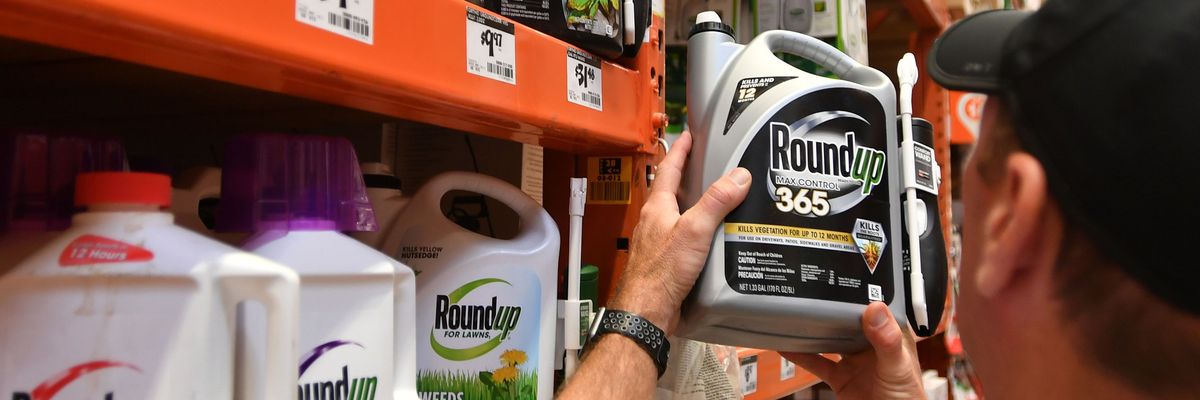
Just two days after President Donald Trump’s administration sided with the maker of glyphosate-based Roundup over cancer victims in a US Supreme Court case, the scientific journal Regulatory Toxicology and Pharmacology retracted a landmark 25-year-old study on the pesticide’s supposed safety, citing various ethical concerns involving Monsanto.
Bayer, which bought Monsanto in 2018, maintains that the weedkiller can be used safely and is not carcinogenic. However, the company faces thousands of lawsuits from people who developed cancer after exposure to its glyphosate products. The retraction stems from the US litigation, which in 2017 revealed Monsanto correspondence about the study.
While Bayer told the New Lede’s Carey Gillam that Monsanto’s role in the 2000 study was adequately disclosed, the journal’s editor-in-chief, Martin van den Berg, does not agree. He wrote in an explanation for the retraction that “the apparent contributions of Monsanto employees as cowriters to this article were not explicitly mentioned as such in the acknowledgments section.”
“This article has been widely regarded as a hallmark paper in the discourse surrounding the carcinogenicity of glyphosate and Roundup,” he highlighted. “However, the lack of clarity regarding which parts of the article were authored by Monsanto employees creates uncertainty about the integrity of the conclusions drawn.”
Of the study’s three named authors—Gary M. Williams, Ian Munro, and Robert Kroes—only Williams is still alive. Van den Berg wrote that he reached out seeking an “explanation for the various concerns,” but “did not receive any response.”
The paper is reliant on company research. As van den Berg detailed, “the article’s conclusions regarding the carcinogenicity of glyphosate are solely based on unpublished studies from Monsanto,” and “the authors did not include multiple other long-term chronic toxicity and carcinogenicity studies, that were already done at the time of writing their review in 1999.”
“Further correspondence with Monsanto disclosed during litigation indicates that the authors may have received financial compensation from Monsanto for their work on this article, which was not disclosed as such in this publication,” he noted.
“The paper had a significant impact on regulatory decision-making regarding glyphosate and Roundup for decades,” he continued. “Given its status as a cornerstone in the assessment of glyphosate’s safety, it is imperative that the integrity of this review article and its conclusions are not compromised. The concerns specified here necessitate this retraction to preserve the scientific integrity of the journal.”
It took years, but finally that Roundup paper ghost-written by Monsanto has been retracted. The whole episode is indicative of a terrible rot that is active in corners of scientific publishing.www.lemonde.fr/en/environme…
[image or embed]
— Joe Rojas-Burke (@rojasburke.bsky.social) December 3, 2025 at 11:58 AM
Michael Hansen, senior scientist of advocacy at Consumer Reports, emphasized the years between the retraction and the release of documents exposing Monsanto’s role in the study. “What took them so long to retract it?” he asked Stacy Malkan of US Right to Know. “The retraction should have happened right after the documents came out.”
Van den Berg, who has been in his role since 2019, told Malkan and Le Monde’s Stéphane Foucart that he began reviewing the paper after a September article from Alexander Kaurov of New Zealand’s Victoria University of Wellington and Naomi Oreskes of Harvard University.
Kaurov and Oreskes’ article in the journal Environmental Science and Policy begins by stressing that “corporate ghostwriting is a form of scientific fraud” and goes on to examine the paper’s impact—or as they put it, “how corporate authorship shaped two decades of glyphosate safety discourse.”
The Netherlands-based van den Berg said that “it simply never ended [up] on my desk being at first primarily a US situation with litigation. The paper of Oreskes triggered it this summer and these authors made an official request and complaint.”
He also told Malkan that “if you have more papers regarding Roundup published in RTP with possible problems, let me know.”
Although Bayer on Wednesday pointed to the thousands of other studies on glyphosate and “the consensus among regulatory bodies worldwide,” the retraction could impact both regulations and ongoing litigation. As Gillam reported:
Brent Wisner, one of the lead lawyers in the Roundup litigation and a key player in getting the internal documents revealed to the public, said the retraction was “a long time coming.”
Wisner said the Williams, Kroes, and Munro study was the “quintessential example of how companies like Monsanto could fundamentally undermine the peer-review process through ghostwriting, cherry-picking unpublished studies, and biased interpretations.”
“Faced with undisputed evidence concerning how this study was manufactured and then used, for over two decades, to protect glyphosate sales, the editor-in-chief… did the right thing,” Wisner said. “While the damage done to the scientific discourse—and the people who were harmed by glyphosate—cannot be undone, it helps rejuvenate some confidence in the otherwise broken peer-review process that corporations have taken advantage of for decades. This garbage ghostwritten study finally got the fate it deserved. Hopefully, journals will now be more vigilant in protecting the impartiality of science on which so many people depend.”
Le Monde’s Foucart noted Wednesday that the retracted study “is cited around 40 times in the 2015 European expert report that led to the herbicide’s reauthorization in 2017.”
In the United States, Nathan Donley, environmental health science director at the Center for Biological Diversity—who has been highly critical of the Trump administration’s various decisions favoring the pesticide industry that contradict its so-called Make America Healthy Again promises—urged the Environmental Protection Agency (EPA) to take action in response to the retraction.
“The pesticide industry’s decades of efforts to hijack the science and manipulate it to boost its profits is finally being exposed,” He said in a statement. “The EPA must take immediate action to reassess its finding that glyphosate is not a carcinogen. That means rather than relying on Monsanto’s confidential research of its own product, the agency needs to follow the gold standard of independent science established by the World Health Organization in its finding that glyphosate probably causes cancer.”
He also pointed to the Monday briefing in which US Solicitor General D. John Sauer urged the country’s top court to hear a challenge to a verdict that awarded $1.25 million to a man who claimed Roundup caused him to develop non-Hodgkin lymphoma.
“Now that much of the research finding glyphosate poses no cancer risk has been undermined, it is especially outrageous that the Trump administration is seeking to bolster Bayer’s case,” Donley said. “Trump promised the American public his administration would protect Americans from dangerous chemicals and pesticides, but now it’s throwing its full weight behind Bayer’s desire to deny cancer victims their day in court. This is a massive betrayal of the public and an unabashed prioritization of corporate wealth over public health, plain and simple.”
From Common Dreams via This RSS Feed.