

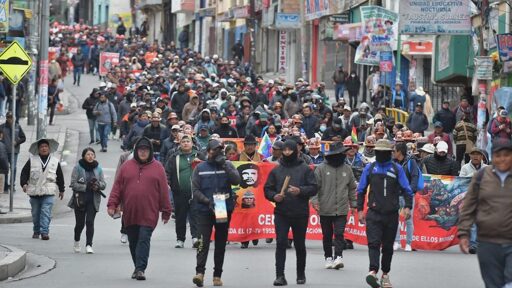
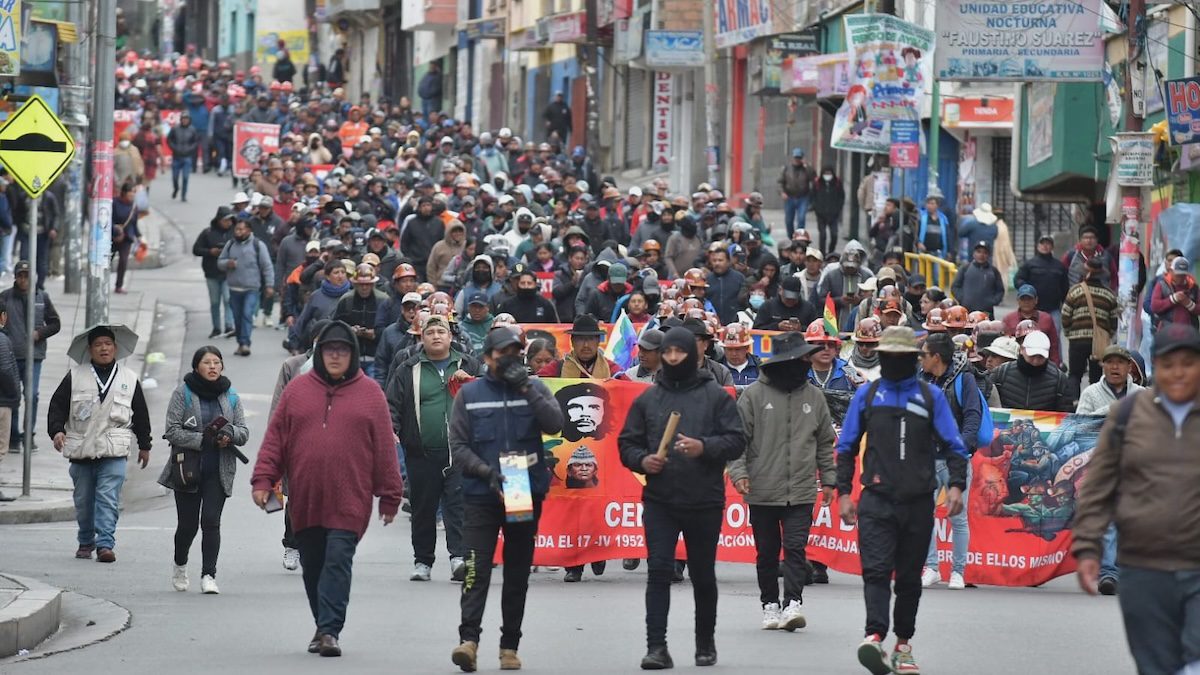
After more than six weeks of street clashes, roadblocks, protests, and confrontations with law enforcement, the protesters have decided to remain in a state of permanent mobilization until right-wing President Rodrigo Paz resigns from office.
The protests began due to Paz’s intention (as an ally of major Bolivian and international capital) to allow the seizure of peasant lands to settle debts. Following several peasant protests, other groups, such as the Bolivian Workers’ Center (COB), presented their demands. As the protest grew, and in the face of Paz’s refusal to yield to the demands, the protesters began calling for his resignation.
Read more: No peace for Paz: Bolivian movements demand president resign
Paz’s response has been varied. At first, he launched a harsh crackdown on protesters to clear the blocked roads. Once he realized that it would be very difficult to quell the protests through repression alone, he chose to replace some of his more belligerent ministers with more conciliatory ones. However, the protesters continued to take to the streets.
Now Paz, whose legitimacy has been called into question, has resumed repressive measures, though he is doing so with new powers and new rhetoric.
New powers for Paz
Indeed, the legislature and Paz enacted Law 1740 on the Regulation of States of Emergency on June 8, which allows the president to unilaterally declare a state of emergency by supreme decree. The law also provides the police with greater powers and the backing of the armed forces.
“The law will allow us to defend the vast majority from those who want to attack us and disrupt this democratic process,” Paz said upon the enactment of the law.
For his part, former President Evo Morales, who has denounced assassination attempts against him and an alleged plan to capture him and deport him to the United States, said: “We are alerting the international community to the passage of a new State of Emergency Law that undermines democratic safeguards and the protection of human rights. The law presumes the legality of state actions, limits judicial and parliamentary oversight, and expands military intervention in internal conflicts.”
Furthermore, he called on international institutions to take action: “We request the ongoing monitoring and oversight of international organizations to safeguard the rule of law and the fundamental freedoms of the Bolivian people.”
Thus, just seven months into his term, Paz has had to resort to amending the law to secure some stability in the face of growing protests. Some members of the opposition fear that this law will lead to further abuses by law enforcement.
A few days ago, videos were released allegedly showing masked state forces taking COB union leaders prisoner while beating them on the ground. Added to this complaint are other allegations that the Paz administration is carrying out excessive attacks on the civilian population.
A new narrative
Furthermore, Paz has resorted to discrediting his rivals by claiming that this is a sort of conspiracy between the left and drug traffickers. This narrative, used in several countries in the region, such as Colombia, Ecuador, and Peru, among others, is not unfamiliar in Bolivia. For several decades, the Bolivian right wing attempted to establish in public discourse the notion that coca growers’ union leaders were drug traffickers. This claim has been categorically rejected by the farmers who cultivate the coca leaf, which is used in Andean countries for consumption but has nothing to do with cocaine, a chemical derivative of the coca plant to which various chemicals are added.
However, Paz has taken up the rhetoric of Bolivia’s traditional right wing. “For the violent ones, the narco-terrorists … their days are numbered. We are going to enforce what the Constitution mandates,” Paz said in a speech attempting to justify the new law.
According to the government, the most radicalized groups among the protesters are linked to criminal drug trafficking factions that, it claims, “seek to undermine democratic order.”
For its part, the COB denounced in a statement that a “manhunt” is being carried out against its leaders through “covert operations.” Among these cases is the arrest of neighborhood leader Justino Apaza, who, according to the prosecutor’s office, is guilty of criminal association, terrorism, and other crimes.Former Senator Simona Quispe was also detained; she was intercepted by hooded individuals and transported in a car without license plates. Quispe was released the following day due to lack of evidence. The same fate befell Yesenia Vargas, secretary of the Carrasco Coca Growers’ Federation, who told the press: “We are here, we stand firm, because this government must go. I will not allow this government to stay in power for five more years and continue plundering our country.”
elevation , June 9, 2026
From BT News via This RSS Feed.