

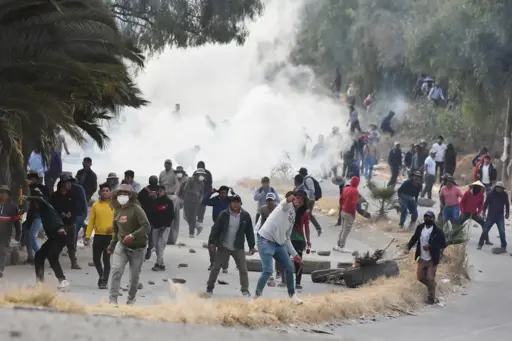
For more than a month, the Bolivian popular masses — in particular the campesinos or peasants, workers, and members of neighborhood organizations — have been carrying out a full-fledged struggle against the right-wing government of Rodrigo Paz. Though various demands have been raised in the course of the struggle, one demand in particular can now be heard most loudly: ¡Fuera Paz!, or Paz Out Now!
Campesino organizations have organized close to a hundred roadblocks throughout the country, a characteristic method of struggle for Bolivia’s rural poor, which have blocked virtually all goods from entering the economic capital of La Paz. Beef, chicken, and other staples have disappeared from markets and stores. Despite the unwillingness of the largest trade union federation, the Central Obrera Boliviana (COB), various sections of Bolivia’s working class have organized strikes, including miners, transportation workers, and others.
Paz is threatening the movement with a state of siege that would grant the police and armed forces extra-constitutional powers to repress demonstrators and use the army to break up roadblocks by force. The Bolivian state has jailed various leading figures within the unions and the social movements, including five members of the COB union federation, a leader of the Ponchos Rojos indigenous organization, and dozens of other demonstrators, all while Paz calls for “dialogue” between the people and the government.
How did Paz enter into such a severe crisis just six months into his term? And what has awakened the working people of Bolivia? As is often the case, there exist immediate causes and root causes for the current upheaval.
The Right-Wing Wave Reaches Bolivia
Rodrigo Paz was ushered into office in late 2025 as part of a wave of right-wing reaction throughout the Central and South America, that has resulted in the presidencies of Nayib Bukele in El Salvador, José Antonio Kast in Chile, and Javier Milei in Argentina, among others. His election can be attributed to the economic crisis that has wracked the country for over two years and the failure of the MAS government to meaningfully improve the conditions of Bolivia’s working people, poor, and indigenous communities — but also to the undemocratic maneuvers of the judicial system which excluded former president Evo Morales from participating in the elections.
In the presidential runoff election Paz was seen as the lesser evil to Jorge “Tuto” Quiroga, the most reactionary and openly pro-Trump candidate. Paz did not employ right-wing populism to the extent of figures like Kast who is building a wall along Chile’s borders to keep out Peruvian and Bolivian immigrants, or Milei who threatened to “burn down” the Argentina’s Central Bank. But like his counterparts in Argentina and Chile, Paz put forward a sweeping program of austerity and anti-popular measures, in particular, reversing the modest reforms made during the years of MAS government.
Within his first two months in office Paz issued a decree ending the more than 20-year-old subsidy on gasoline, which doubled the cost of fuel overnight for millions of Bolivian people. The surge in gas prices coincided with widespread complaints of “junk gasoline” causing breakdowns of vehicles; taxi drivers and bus drivers were left without their means of income.
Then, in April, Paz’s government enacted a law which overturned protections for small land owners, protections that trace their origins to the Bolivian Revolution of 1952. Where before small land holdings could not be confiscated, nor bought up by large property owners, the new law allows for these lands to be used as collateral for loans. And in the event of default, banks can seize the lands and re-sell them. In May, campesino groups launched widespread roadblocks, and some marched as many as 20 days to reach the capital from the rural provinces.
Paz has insisted on his right to impose a state of emergency across the country in order to unleash police and the army to break up the roadblocks that have brought the country to a halt. He has cast the call in “humanitarian” rhetoric, blaming demonstrators for the shortages of food throughout the country. This humanitarian message rings totally hollow when the government’s policy is drastically raising the cost of living for millions and putting the basic needs of the Bolivian people out of reach.
The Bolivian masses are rightly rejecting Paz’s calls for “dialogue” to put an end to the conflict. In this context, dialogue with the Bolivian government can only mean the renunciation of the fights against land concentration and austerity and the delivery of the country’s resources to foreign capital.
A Popular Rebellion Organized from Below
The rebellion that’s underway, from the roadblocks to strikes to fights at the barricades, has relied on advanced methods of self-organization, where decisions are made collectively in assemblies, neighborhood meetings, and other democratic spaces. In so doing, they have challenged the traditional leaderships of the workers and peasants movements, particularly the COB, and the most notable campesino organization, the Confederación Sindical Única de Trabajadores Campesinos de Bolivia (known as the CSUTCB).
These bodies of democratic decision-making from below point the way to reorganize production and distribution in the country. For example, albeit on a still limited scale, neighborhood organizations are directing the roadblocks so that ambulances and emergency vehicles can pass, while preventing other vehicles from breaking the blockades.
However, for the struggle to win, the roadblocks and marches — as massive as they’ve been — will not be enough. The Bolivian working class must exercise its power to paralyze the economy. This means that the COB must fulfill its promise to enforce an active general strike, encompassing all sectors it represents, until Paz falls. Until now, the COB leadership, linked to the MAS, has shamefully refused to take this critical measure. An indefinite general strike, in which all Bolivia’s workers, and particularly those in strategic sectors of the economy participate, is the one measure that would bring the government to heel.
Trump Sets Sights on Hegemony over Latin America
The situation in Bolivia cannot be understood, however, apart from its place in the geopolitical struggle between the United States and China. Trump has turned to Latin America to secure U.S. hegemony, particularly against the rise of China as the largest competitor to the United States. This has become all the more urgent of a task for the Trump administration in light of the strategic failure of the war on Iran. Latin America now holds greater strategic importance far greater than it traditionally held for U.S. interests. Even the weakest pieces on the chess board, like Bolivia, one of Latin America’s poorest countries, possessing one fortieth the GDP of its neighbor Brazil, are key assets for the United States to secure against Chinese influence.
The center-left or post-neoliberal government of Nicolás Maduro in Venezuela was the first to fall under Trump’s National Security Strategy. Following the imperialist military operation in which U.S. forces kidnapped Maduro and his wife, the Trump administration has worked with acting Venezuelan president Delcy Rodriguez to turn the country into a U.S. protectorate. Shortly after attacking Venezuela, Trump announced a naval blockade of Cuba to prevent the island from obtaining any fuel, contributing to a humanitarian crisis across the island nation. And in May, Trump’s Department of Justice announced the “indictment” of 95-year old Raúl Castro. At the same time as these direct military and legal interventions against traditional adversaries of the United States, Trump has sought to intervene in Latin American elections and to shore up support for his right-wing allies; during the 2025 midterm elections in Argentina for example, Trump declared that he would be withdrawing his offer of a $20 billion loan to the country if Milei’s party were to lose.
Paz’s attempts to end protections for small landholders, and to remove subsidies on gasoline are transparent tributes to his government’s sponsor in Washington. The Bolivian president also announced he will be pursuing a $3.3 billion IMF loan for the country, in a major departure from the policies of the MAS governments.
In the midst of the current fight between Paz and the Bolivian masses, the Trump administration has reiterated its support for Paz and sought to vilify the workers and campesinos struggling against the counter-reforms, signaling that violent repression will be supported, if not directly organized by Washington. Pete Hegseth, U.S. “Secretary of War” and one of the most influential members of Trump’s inner circle stated that “The United States is watching,” and will aid Paz “to ensure that narco-terrorists are deterred from profiting on death and destruction in our hemisphere.” Meanwhile, U.S. Deputy Secretary of State Christopher Landau — Marco Rubio’s number two — has characterized the protests against Paz as “violent demonstrators blockading the streets,” and “a coup that’s being financed by this unholy alliance between politics and organized crime throughout the region.”
It would not be the first time Trump backed violent suppression of demonstrators in Bolivia. During Trump’s first term, his administration was among the first to recognize the coup government of Jeanine Áñez Chávez that deposed Evo Morales. And senior Trump officials publicly voiced support for Bolivian state forces, even as they shot and killed 37 demonstrators in what became known as the Sacaba and Senkata massacres, in which an additional 119 people were injured and 270 were arrested.
A History of Struggle
More than any other country in the Americas, Bolivia has been the site of repeated outbursts of intense class struggle in the 21st Century. It is a country in which the people — 80 percent of the whom are of indigenous decent and more than a third of whom today live under the poverty line — have witnessed repeated attempts to plunder the country’s resources, which include various minerals and precious metals, natural gas and lithium. These processes continue a long tradition of indigenous and popular resistance to imperialism and colonialism, a tradition in which, for at least the past hundred years, the working class has played a leading role. In the 20th century the Revolution of 1952 and the Popular Assembly of 1971 were some of the most notable examples.
As the new century opened, workers and campesinos fought back in one of the most emblematic struggles of the neoliberal era, as the state, in cooperation with a foreign multinational, sought to privatize the country’s water resources, raising rates by as much as 300 percent. Pitched battles between heavily militarized police and demonstrators — particularly women and indigenous people — broke out for months in a process that became known as the Water War. Three years later, the country witnessed a similar upheaval when Bolivia’s right-wing president attempted to export the country’s natural gas resources at preferential rates for foreign interests. Again, Bolivia’s working people and poor organized a resistance from below, with roadblocks, strikes, and mobilizations in the streets. This “Gas War” eventually toppled President Sanchez de Lozada, and a year later his successor, and culminated in the election of Evo Morales in 2005, bringing about the country’s first indigenous president.
A 14-year period followed in which Morales’s party, the MAS (or Movement to Socialism), presided, enacting modest reforms, such as the recognition of indigenous languages and culture, and nationalizations or partial nationalizations of a few industries. But the MAS generally allowed big business, the largest landholders, and various multinational corporations to continue profiting at the expense of the Bolivia people. This period of pacification ended in 2019 with the U.S.-backed coup. The coup government immediately sought to reverse previous reforms and restore “friendly relations” — that is to say a relationship of servitude and subordination — with the United States and European imperialist countries.
For nearly a year, Bolivia’s popular masses fought back against the coup and U.S.-backed Añez government, and ultimately succeeded in forcing her from office through strikes, roadblocks, and street demonstrations even as Morales called for “dialogue” to “achieve peace” and “seek unity” from his exile in Mexico.
The Fight against Paz is a Fight against Trump’s Agenda
The Bolivian people — workers, indigenous people, women, and campesinos — are waging a courageous struggle to defeat the plans of Paz and Trump, who seek to unload the crisis facing Bolivia — among various South American nations — on their backs. This agenda means tax breaks for the ultra-wealthy while indigenous and poor communities see skyrocketing prices in the cities and face the dispossession of their lands in the countryside.
Outside of Bolivia, socialists must amplify the demands of Bolivia’s masses: out now with the austerity government of Paz, no agreements with the IMF or other agents of international finance capital, no state of siege and the protection of the democratic rights of all demonstrators. We must call on the COB, as the largest representative of Bolivian workers, to declare a general strike, organized in strike committees from below, until Paz falls along with the plans of Trump and the IMF. In this way, the working class could express its true power, and demonstrate its ability to run society on a different basis, one which serves needs of the vast majority, not the ultra-wealthy who would sell off the country’s resources to U.S. and European multinationals.
In this fight, Bolivian workers and campesinos must rely on their own strength, rather than trusting in the promises of the MAS leadership, which will seek to negotiate between foreign capital and the masses. Through their struggle, they are showing an alternative to the traditional center-left leaderships, who like Delcy Rodriguez in Venezuela, has acted entirely under the directives of Trump after the January coup. Bolivia’s masses, though long oppressed and subordinated, have been the front lines against Trump’s new Monroe Doctrine for the continent. They deserve all the support from working people in the United States and elsewhere around the world to defend their resources and their livelihoods.
The post The Bolivian People Are Waging a Courageous Fight to Oust Trump’s Ally appeared first on Left Voice.
From Left Voice via This RSS Feed.