


On Sunday, June 7, Israeli warplanes launched strikes on the southern suburb of the Lebanese capital Beirut (known as Dahiyeh), just a couple of days after Israel and the Lebanese state reached a US-backed ceasefire agreement.
The major escalation provoked powerful reactions by Iran and its Yemeni ally in the Axis of Resistance, the Ansar Allah movement.
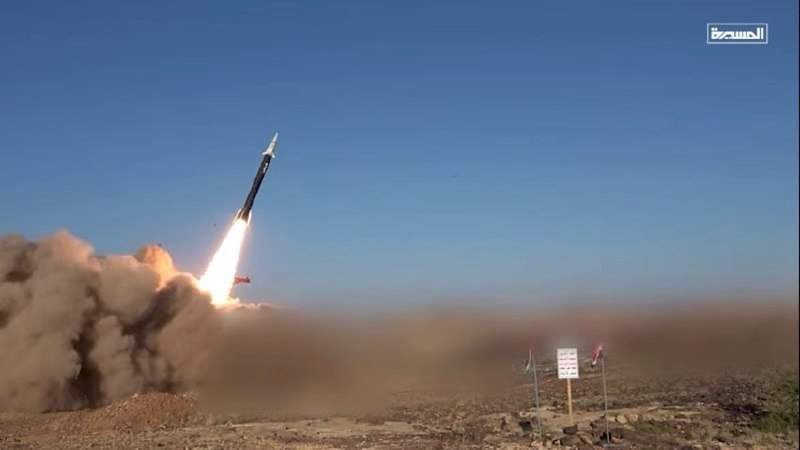
The spokesman of the Yemeni Armed Forces, Brigadier General Yahya Sare’e, announced in a televised statement on Monday, June 8, the launch of new operations against Israel, in retaliation for its escalating aggression on Lebanon and Gaza.
Sare’e clarified that the operations included launching a wave of missile strikes that targeted sensitive Israeli sites in the occupied city of Jaffa, confirming that the goals of the strikes were achieved successfully.
A full ban on Israeli navigation in the Red Sea was also activated as part of Ansar Allah’s retaliatory operations, according to the resistance movement’s spokesman.
Sare’e emphasized that the operations have been launched as part of “confronting the US-Zionist aggression on the Axis of Jihad and Resistance in Iran, Palestine, Lebanon, Iraq and Yemen, and rejecting the Zionist project that aims to establish Greater Israel under the name New Middle East.”
He also insisted that by doing so, Ansar Allah “seeks to break the oppressive and wanton blockade imposed by the American enemy” on the Yemeni people and other free peoples of the Axis of Resistance in Lebanon, Gaza and Iran “within the unity of fields” principle.
Sare’e warned that any Israeli escalation will be confronted with further escalation by the Yemeni resistance movement, and will increase in accordance with the development of events and in coordination with the Axis of Resistance.
It is worth noting that Ansar Allah first joined the recent regional war in early April 2026, a few days before US President Donald Trump had announced a temporary ceasefire with Iran.
It is believed that Ansar Allah’s capability of controlling the navigation in the Red Sea, and potentially the Bab al-Mandab Strait, served as critical leverage to reach the truce then, especially with the Strait of Hormuz being under the full control of Iran.
With Ansar Allah rejoining the regional confrontation again, the possible closure of Bab al-Mandeb, hand in hand with the Strait of Hormuz, came to the fore as a pressure tool in the negotiations, given the impact of its possible closure on the oil market.
Read more: Reflections on the US-Israeli multi-front war in West Asia: How the Axis of Resistance remains resilient
Iran threatens to close Hormuz and Bab al-Mandeb in response to “Israel’s folly in Beirut”
International affairs advisor to Iran’s Supreme Leader,Ali Akbar Velayati,warned Israel on Monday that the Axis of Resistance will close both the Strait of Hormuz and the Bab al-Mandeb, if it continues its aggression on Lebanon.
“The current security of the Bab al-Mandeb should not lead the enemy into a miscalculation,”Velayati said, adding that “the Resistance has the capability to lock both waterways.”
“The choice is yours: stop the folly, or enter the balance of regulated control of the two straits,” the senior Iranian official threatened.
Velayati’s warning came hours after Iran fired missiles on the northern areas occupied by Israel over its offensive on Beirut. Israel later responded by launching airstrikes on the Islamic Republic of Iran.However, Israeli sources said that Israel agreed to halt its assaults on Iran upon request from the US president, but will not stop its aggression on Lebanon.
elevation , June 9, 2026
From BT News via This RSS Feed.