

Germany is prosecuting five activists alleged to be part of Palestine Action Germany in what their lawyers have described as a “show trial” intended to stigmatise protesters “as [if they were] terrorists” and which legal experts argue shows a “deeply concerning development” in how the state is targeting political protest.
The so-called Ulm 5, who are from the UK, Germany, Spain and Ireland, are currently on trial at a high-security court at Stammheim prison in Stuttgart following a break-in at offices of the Israeli arms firm Elbit Systems in Ulm, southwestern Germany, in September 2025.
The defendants face charges of trespassing, property damage and using the symbols of a proscribed organisation.
They have also been charged with belonging to a criminal organisation under Section 129 of the German Criminal Code – a controversial piece of legislation human rights lawyers say is being used to “blur the line between organised crime and the legitimate exercise of people’s freedom of assembly and expression” such that the case will “have a chilling effect on others who are considering engaging in political protest”.
Framed as terrorists.
On 8 September 2025, Zo Hailu, Vi Kovarbasic, Leandra Rollo, Daniel Tatlow-Devally and Crow Tricks are alleged to have broken into the Ulm offices of Elbit Systems wearing signs reading “Palestine Action”.
The indictment, seen by Novara Media, alleges that they caused over €1m worth of property damage to the site, painted slogans including “Child murderer” and “Baby killer” (which the prosecution characterises as “antisemitic” messaging) and chanted pro-Palestinian slogans, including the phrase “From the river to the sea, Palestine will be free” (which some German courts have ruled constitutes a symbol of Hamas). All were arrested without resistance.
The activists are not being tried under terror legislation. Nor are they alleged to have been violent or harmed people. In fact, their lawyers argue this is precisely what they were trying to stop: by damaging the property of Elbit Systems, a company whose centrality to Israel’s genocide in Gaza is well-documented, their aim was to save the lives of Palestinians.
Yet despite this, their lawyers say both the courts and the prosecution are trying to create the impression that the defendants are terrorists.
The choice of venue for the trial is key: a high-security courtroom at Stuttgart-Stammheim prison. Stammheim is best known for the 1970s trial of the leaders of the far-left Red Army Faction (RAF), which was proscribed as a terror group by the West German government. In more recent decades, Stammheim has also been used for the trials of alleged members of outlawed Turkish and Kurdish organisations, Islamist extremists and neo-Nazis.
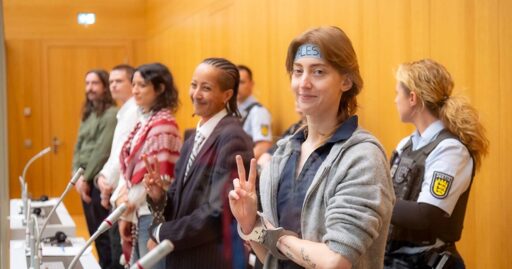
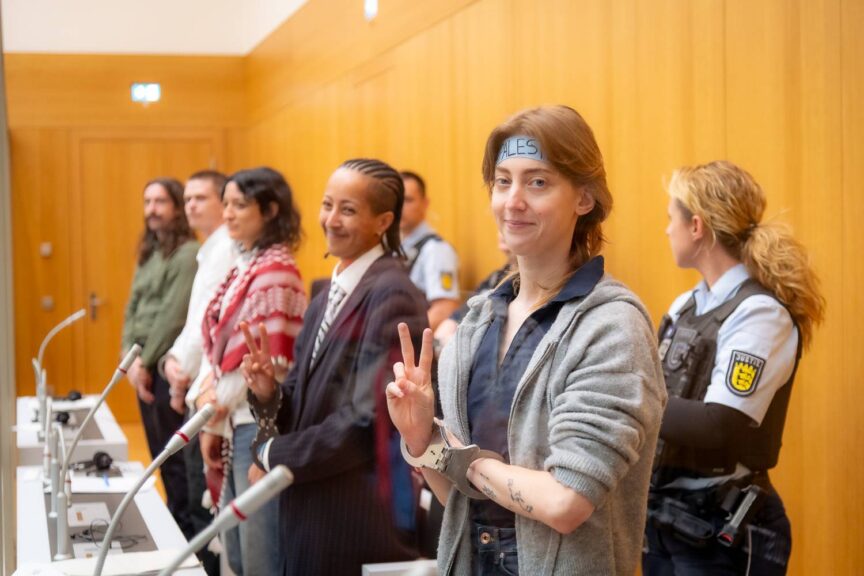
Inside the courtroom, the activists have been handcuffed, placed behind bulletproof glass, and seated far from their lawyers in what the defence called “an unacceptable violation of the defendants’ right to a fair trial”. As a result, court proceedings – which started at the end of April – have been severely disrupted.
Anna Magdalena Busl, lawyer for Rollo, told Novara Media she believes these measures are designed “to make our clients [look] much more dangerous than they are”.
“The fact is that they are stigmatising our clients as [if they were] terrorists,” she said.
Silencing dissent.
The prosecution’s application of Section 129 of the German Criminal Code is also part of a wider attempt to frame the group as political extremists, legal experts say.
Section 129 bans the formation, membership of or support for a criminal group. Although “Palestine Action Germany” has not been outlawed in Germany – in fact, the defendants’ lawyers argue that the prosecution is yet to prove it even exists as a formal organisation – prosecutors are able to charge someone under Section 129 if they allege the group meets the statutory definition.
Crucially, Section 129 allows the state to justify extended pre-trial detention – the Ulm 5 have been held since September, far exceeding the standard six-month pre-trial limit, with the trial not expected to conclude until January 2027 – as well as to deny bail on the grounds that the accused pose a threat to society, and to grant the state extra surveillance powers. Someone charged under Section 129 who is found guilty will also likely face a much harsher sentence than for property damage alone.
Human rights groups have long criticised Section 129 for being a vague and far-reaching statute that can be used to silence political dissent.
“This is a deeply concerning development that we’ve been seeing for a while now,” Yasmin Khuder of Amnesty International Germany told Novara Media. “This particular code […] is being used to criminalise political protest and blur the line between organised crime and the legitimate exercise of people’s freedom of assembly and expression.”
“Just this case [of the Ulm 5] alone will have a chilling effect on others who are considering engaging in political protest.”
Busl explained that “Section 129 is interpreted so broadly that there is always a risk of being charged with forming a criminal organisation if the prosecution claims that the purpose or activities of a political organisation are aimed at committing criminal offenses”.
Prosecutors of the Ulm 5 also repeatedly referenced Palestine Action UK in their indictment of the German activists.
Multiple pages are devoted to describing the UK chapter’s history, organisational structure, tactics, recruitment methods and media strategy, as well as a wide range of actions which it is alleged to have carried out. The indictment also notes that the group was proscribed as a terrorist organisation by the UK government last summer. (The ban was ruled unlawful after a landmark judicial review in February 2026, with the verdict on a government appeal to the decision due later this month.)
Khuder explained that references to Palestine Action UK are designed to support the Section 129 charge against the Ulm 5.
“The prosecution is repeatedly referring to the UK’s treatment of Palestine Action in order to frame the activists in Ulm as part of a broader, extremist or criminal global structure […] which, of course, helps their case to establish them as a criminal organisation,” she said.
Germany’s ‘Staatsräson’.
The attempts by the courts and the prosecution to turn the case of the Ulm 5 into a so-called “show trial” is just the latest escalation in Germany’s crackdown on solidarity with Palestine.
It has been waged through lawfare, heavy policing (including police violence), harassment, censorship and the threat of professional or financial repercussions, amongst other things, with the European Legal Support Centre documenting around 1,000 incidents of repression since 7 October 2023.
This crackdown should be understood in the context of Germany’s Staatsräson, or “reason of state”. This is the idea, first articulated by former chancellor Angela Merkel, that following the Holocaust, Germany has a special responsibility to support the state of Israel.
Staatsräson goes some way towards explaining why courts sometimes seem less concerned with protecting the right to political protest and more with making examples of pro-Palestine defendants, experts say.
Britta Rabe, from the German NGO the Committee for Basic Rights and Democracy, who has been observing the Ulm 5 trial, told Novara Media she believed that “the court is full of this German Staatsräson”.
The trial continues.
From Novara Media via This RSS Feed.