


Editor’s note: This is one in an occasional series on “forgotten” ancestors who may not have been fully recognized for their achievements.
Raymond Wilson
Special to ICT
For decades, Cherokee activist, poet and educator Ruth Muskrat Bronson’s contributions put a spotlight on needed improvements to Native American conditions.
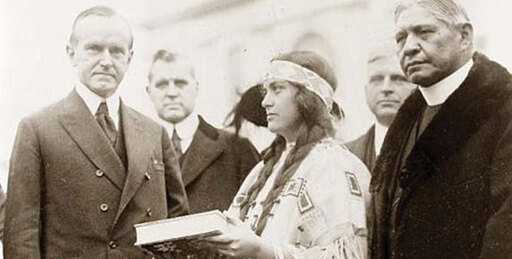
Her words and actions caught the attention of U.S. President Calvin Coolidge in December 1923, when she delivered a speech calling for Indian citizenship, self-determination and support for Native youth while presenting a Native history book to the president. Coolidge was so impressed he invited her to join him and the first lady for lunch.

Ruth Muskrat Bronson, Cherokee, was an educator, poet and activist who worked for Native rights for decades in the United States. She died in 1982 at age 84.
Credit: Historic photo
Ruth was born in the Delaware District of the Cherokee Nation in Indian Territory on Oct. 3, 1897. Her Cherokee father, James E. Muskrat, was a farmer; her non-Native mother, Ida L. Kelly, was of Irish descent. Ruth had six siblings.
At an early age, she became aware of how her Cherokee ancestors suffered during the forced removal from their Georgia homelands to Indian Territory on the Trail of Tears in the late 1830s. Federal legislation including land allotment issues and the acceptance of Oklahoma as a state in 1907 played significant roles in her becoming a major activist for Native rights.
In 1912, after attending rural primary schools in the Delaware District, Muskrat continued with a high school education at the University Preparatory School in Tonkawa, Oklahoma. She studied literature, served as associate editor of the school’s Crimson Rambler, and graduated in 1916.
She then took teacher education courses at Henry Kendall Academy in Tulsa and Northeastern State Normal School in Tahlequah, Oklahoma, and taught in rural schools for two years.
In 1919, Muskrat attended the University of Oklahoma for three semesters, majoring in English.
She found employment during the summer of 1920 with the Young Women’s Christian Association, the YWCA, and worked on youth programs for Native girls on the Mescalero Indian Reservation in New Mexico.
The YWCA recognized her exemplary work there by awarding her a scholarship to the University of Kansas in 1921. Muskrat completed three semesters at the university, majoring in journalism.
Additionally, the YWCA chose her to attend the World’s Student Christian Federation Conference in what was then known as Peking, China, in 1922. Among the places she visited during her six months abroad were Hawaiʻi, Japan, Korea, Manchuria, and Hong Kong. Articles about her appeared in national and international newspapers.
Muskrat’s experiences abroad convinced her that Native Americans must protect their rights and demand racial equality.
In 1923, she received a full scholarship to attend Mount Holyoke College in South Hadley, Massachusetts, entering as a junior and graduating in 1925 with a bachelor’s degree in English.
While still a student at Mount Holyoke, Muskrat gained more fame at the December 1923 Committee of One Hundred meeting in Washington, D.C. The committee, composed of leading Native Americans and non-Natives, was tasked with studying the so-called “Indian problem” and recommending needed reforms.
Dressed in traditional Native attire, she presented the book, “The Red Man in the United States,” by author G.E.E. Lindquist, to the president after delivering her speech calling for reforms.
During the summer of 1925, Muskrat worked briefly as dean of women at Northeastern State Teachers College in Tahlequah, Oklahoma, and in September 1925, she became an eighth-grade English teacher at the Haskell Institute in Lawrence, Kansas. She later assumed administrative duties, including being in charge of the college placement bureau.
Muskrat was a popular teacher who emphasized to her students that they should be proud of their Native heritage and to support Native reforms. She won the 1926 Henry Morgenthau Prize, an award granted for significant achievements to a student one year after graduating from college.
In 1928, she married John F. Bronson, a non-Native mechanical engineer who was a major supporter of her reform agendas. They later adopted a young Native girl.
She left Haskell in 1931 after receiving appointment as the guidance and placement officer for the Bureau of Indian Affairs. She was in charge of scholarship and loan programs and helped Native graduates find employment. Bronson resigned in 1943 but remained a consultant for the BIA Office of Education for two more years.
In 1945, Bronson began working for the National Congress of the American Indian in Washington, D.C., and held leadership positions such as executive secretary, treasurer, and editor of its monthly newsletter.
She also assisted Native delegations in the nation’s capital, defended the rights and land claims of Tlinglit and Haida Natives in Alaska, and vehemently opposed federal termination and relocation policies that threatened Native trust relationships.
In 1956, Bronson accepted a job as a health education specialist at the San Carlos Apache Reservation in Arizona, where she helped combine Western medicine with traditional healing practices to improve health outcomes.
In 1964, Bronson moved to Tucson, Arizona, and began working for the Save the Children American Indian Program as a field representative, and shortly after became program director for the southern Arizona region.
She initiated Indian volunteer communities and community educational programs to identify and improve political, economic, and social reservation conditions. They included programs such as securing financial assistance to address reservation dwellings, land and water issues, and providing leadership training for young and adult Natives on the Tohono O’odham Reservation in south-central Arizona.
Her husband died in1966, and she suffered a stroke in 1972. However, despite these traumatic events, Bronson continued her efforts to improve Native conditions and protect their sovereign rights for the remainder of her life.
Bronson was also a prolific and powerful author of poems, articles, and books for decades. She drew on her Native heritage and oral histories to produce inspirational and significant publications.
A few examples of her works include, “The Wail of the Helpless,” in the Crimson Rambler, 1915; “The Trail of Tears,” in University of Oklahoma Magazine, 1922; “The Serpent,” Mount Holyoke Monthly, 1925; and “Indians Are People Too,” 1944; and “Much Work Needed,” Indian Truth, 1960.
She also received several awards, including the Indian Council Fire Distinguished Indian Award, 1937; the U.S. Department of Health, Education and Welfare Oveta Culp Hobby
Award and the Superior Service Award, 1962; the National Congress of the American Indian Citation of Merit Award, 1969; and the National Indian Child Conference Merit Award, 1978.
A tireless and vigorous activist for decades, Ruth Muskrat Bronson died on June 12, 1982, in Tucson, Arizona. She was 84.
Sources: Cherokee Nation website; Mount Holyoke College website; Ruth Muskrat Bronson Poems online; Kirby Brown, “Stoking the Fire” (2018).
The post LEST WE FORGET: Ruth Muskrat Bronson appeared first on ICT.
From ICT via This RSS Feed.