


Nika Bartoo-Smith + contributed reporting by Jarrette Werk
Underscore Native News + ICT
LITTLEROCK, Washington — On an early spring afternoon, a totem pole with newly attached wings stood tall greeting every person who enters the Cedar Creek Corrections Center. As the sun peeked through the overcast skies, dozens lined up to be smudged before the ceremony to awaken the totem pole.
The totem pole was carved by Albert ‘Al’ Smith, who is Suquamish, Shoshonne-Bannock and Pima Nation. Smith has been incarcerated at the facility since 2024.
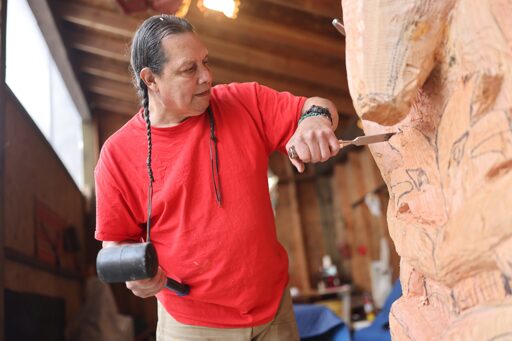
“Carving has helped me because, I mean, if you were to tell somebody that you’re serving prison time, and you’re out carving in a building they put together for you, and bringing all the equipment, and all you do is just sit out there and carve a traditional carving, something that you do on the street, that is just, to me, is phenomenal,” Smith said, who has been carving for nearly five decades.
The totem pole awakening ceremony also served as a day of celebration for the newly established carving program at the correctional facility.
This totem pole carving program is likely the first of its kind in a correctional facility, according to staff. Through the program, Indigenous people who are incarcerated at the facility get to work with Smith to carve totem poles.

Albert “Al” Smith (second from right) stands behind a totem pole with other inmates at Cedar Creek Corrections Center after an awakening ceremony on March 2, 2026. (Jarrette Werk/Underscore Native News)
“Never in the history, to my knowledge, has anything like this ever been done,” said Jeremy Garretson, Northern Arapaho and the reentry director at Unkitawa, an Indigenous nonprofit that helped establish the program. “This is monumental, is groundbreaking, and is trailblazing, to see that an actual carving program has taken place in a facility of this magnitude.”
Cultivating a carving program
When Smith, 64, was incarcerated at Cedar Creek previously, about two decades ago, he talked about carving a totem pole, but no such program existed. Now that program exists because of Smith, an elder who gets to serve as the uncle figure to other incarcerated Native men, teaching them how to carve.
Hearing Smith’s desire for a carving program, staff at Unkitawa’s reentry program worked with members of the Washington State Department of Corrections to establish a cultural carving program at the facility.
“[Al] won me over with his heart, the compassion, the positivity and just the greatness of being who he is,” Garretson said. “He did the same thing with the administration over at Cedar Creek Corrections. The same stories and stuff that he would tell me, and the same talks that he would have with me, he was having with them.”
“This is monumental, is groundbreaking, and is trailblazing, to see that an actual carving program has taken place in a facility of this magnitude.”
Jeremy Garretson, reentry director at Unkitawa
“When you see that, you want to get behind that, you want to find ways to cultivate that and help that,” Garretson continued.
A few months after Smith transferred from Coyote Ridge Corrections Center to Cedar Creek in 2024, he began carving in a makeshift shed, covered in tarps through the winter.
That first pole he carved through the cold winter months in a small temporary shelter, was a piece of cedar that had been at the facility since Smith was previously incarcerated there about 20 years prior. He was released before he could begin to carve the pole.

For Albert “Al” Smith, when he is creating a carving, he does not use a chainsaw or other modern day tools, instead he strictly uses hand tools to do all of the carving, like this set of chisels. (Jarrette Werk/Underscore Native News)
The cedar tree laid on its side at the facility for nearly two decades before Smith returned. Garretson, who was incarcerated at Cedar Creek from 2013 to 2017, even remembers it.
“I think I was 210ed quite a bit for hanging out by this pole. 210 means out of bounds for those who don’t know,” Garretson said, referring to when someone incarcerated at the facility is in an area they are not supposed to be in.
For Garretson, the program itself is a direct result of Smith and his abilities. The rest came down to approval from administration and programming support from Unkitawa, which also meant working to ensure longevity of the program.
Garreston has also coordinated with the Washington State Department of Children, Youth, and Families to use cedar trees cut down at Echo Glen Children’s Center to sustain the carving program at Cedar Creek.
‘There’s a pride with helping create something’
The smell of sage, cedar carvings and freshly brewed coffee filled the air one morning in late February as Smith ran his calloused hands along a totem pole in his carving shed, the second one he has worked on at Cedar Creek.
As he enthusiastically described his carving process, Smith hit his tools into the pole with a thud.
The process of weathering a pole after it is carved, Smith described, is done by letting it sit out through the elements, the wood expanding in the heat and shrinking in the cold. He then goes back through and seals the cracks with a mixture of wood glue and sawdust.
Video by: Jarrette Werk, Underscore News
Reporting by: Jarrette Werk, Underscore Native News, and Nika Bartoo-Smith, Underscore Native News + ICT
“When I carve, to me, this is a mark of who I am. This is who I really am,” Smith said. “That pole that’s out there will be there until the forest burns it down. It’s a traditional mark of my family.”
For Smith, carving totem poles isn’t new. He began learning to carve at 15 years old from his uncles, learning their techniques through their stories. He had to earn his way in the carving studio, starting with cleaning the floors and other small, repetitive tasks.
Now, including the two poles, Smith has carved while incarcerated, he has carved a total of 11 totem poles. All he has given away, with totem poles he carved now residing across Turtle Island from the East Coast to the Pacific Northwest and up into Alaska.
“When I carve, to me, this is a mark of who I am. This is who I really am. That pole that’s out there will be there until the forest burns it down. It’s a traditional mark of my family.”
Albert “Al” Smith
What was once a makeshift shelter at Cedar Creek, is now a fully built out carving shed. Surrounded by photos of his family, hand drums hanging on the walls, a shelf holding a bundle of smudge and barrels of hides for drum making, Smith has created a space dedicated to carving.
Smith smudges everyone who enters and exits the shed with medicine, creating a space grounded in spirituality.
“Everything I do out here is spiritual to me. It’s very important that you don’t cuss out here, be respectful, and we don’t come out here angry or hateful,” Smith said.
Working on totem poles in the carving shed, Smith has invited other Indigenous people who are incarcerated at Cedar Creek to learn a bit about carving themselves.
In particular, Smith has taken Ordez Kompkoff, Aleut, under his wing.
-

Ordez Kompkoff, Aleut, comes from a family of carvers. Although he did not participate in the traditional practice growing up, he now regularly carves with Albert “Al” Smith while serving his sentence at Cedar Creek Correctional Center. Kompkoff helped Smith carve the totem pole behind him.(Jarrette Werk/Underscore Native News)
-

Albert “Al” Smith (seated in center), stands with Cedar Creek Corrections Center inmates and Unkitawa staff members after the awakening ceremony held on March 2, 2026. Ordez Kompkoff, Aleut, stands second from the left. (Jarrette Werk/Underscore Native News)
-

L to R: Jeremy Garreston, Northern Arapaho, Reentry Program Manager for Unkitawa, and Ordez Kompkoff, Aleut, inmate at Cedar Creek Correctional Center who helped carve the totem pole, pose for their photo in front of the new totem pole that was installed on March 2, 2026. Ordez. (Jarrette Werk/Underscore Native News)
-

Ordez Kompkoff, Aleut, and Albert Smith, Suquamish, Shoshone-Bannock and Pima, stand in front of a pole they are currently working on inside the shed that was built for the carving program at Cedar Creek Corrections Center. (Jarrette Werk/Underscore Native News)
-

Ordez Kompkoff, Aleut, whose name and Native Nation are etched into the back of the cedar eagle wings he made. (Jarrette Werk/Underscore Native News)
Kompkoff also comes from a family of carvers, and remembers learning from his uncles starting at about 10 years old. Reconnecting with carving through working with Smith has been a meaningful part of his own healing journey.
Kompkoff painted the eagle wings for the pole that now resides outside Cedar Creek. The wings represent new beginnings for Kompkoff, whose name is etched into the cedar wings.
“The concept that I kept in my head, the medicine, I kept new beginnings. Earning your wings,” Kompkoff said.
Mentoring Kompkoff and other men through the carving process has emphasized, for Smith, the greater need for programs like this within correctional institutions.
Smith knows first hand the healing powers of carving. The importance of creating something — a piece of art that holds a story rooted in cultural teachings — is incredibly meaningful especially when serving a sentence, locked inside mostly away from culture.
“They get to carry that pride of ‘I helped create,’” Smith said, reflecting on the impact the carving program has had on other incarcerated individuals.
-

Albert “Al” Smith, inmate at Cedar Creek Correctional Center, examines a totem pole he carved after the awakening ceremony on March 02, 2026. In total, Smith has completed 11 totem poles. (Jarrette Werk/Underscore Native News)
-

Shonto Pete, performs an honor song during a totem pole awakening ceremony at Cedar Creek Corrections Center on March 2, 2026. (Jarrette Werk/Underscore Native News)
-

Walter Lewis, Chehalis Tribe, performs the awakening ceremony at Cedar Creek Corrections Center on March 2, 2026. (Jarrette Werk/Underscore Native News)
-

Albert “Al” Smith and his brother, Amel Smith, carved their names on the back of the pole along with Pema Nation, a nod to their heritage. (Jarrette Werk/Underscore Native News)
-

Cedar Creek Correctional Center inmates, staff and leaders of Washington state’s Department of Corrections and Department of Children Youth and Families, were joined by members of Unkitawa for an awakening ceremony held on March 02, 2026. The pole is believed to be the first to be properly raised and “awakened” on the grounds of a correctional facility in Washington state. (Jarrette Werk/Underscore Native News)
Smith expects to be released from Cedar Creek in the next few years and plans to stay connected with Unkitawa and the carving program, continuing to offer mentorship to other young carvers.
Garretson is already working to establish other such carving programs in correctional facilities in other parts of Washington. He says one is already in talks at a maximum security facility in another part of the state — the only barrier is finding someone, like Smith, to run the program.
“What I need is somebody that’s willing to dedicate the time to see the whole thing through,” Garretson said.
Part of the success of the program at Cedar Creek is that because Smith is also incarcerated at the facility, he is able to dedicate four to six hours every single day to his carving, and supporting others.
“None of this would be happening without Al’s talent, his character, and again, his own self advocacy,” Garretson said. “He’s such a humble, kind guy. He wants to share the credit all around the table, and the rest of us are over here saying, ‘No, this is your story. We’re just happy to support it.’”
This story is co-published by Underscore Native News and ICT, a news partnership that covers Indigenous communities in the Pacific Northwest.
The post Building a carving community inside Washington State Corrections appeared first on ICT.
From ICT via This RSS Feed.