

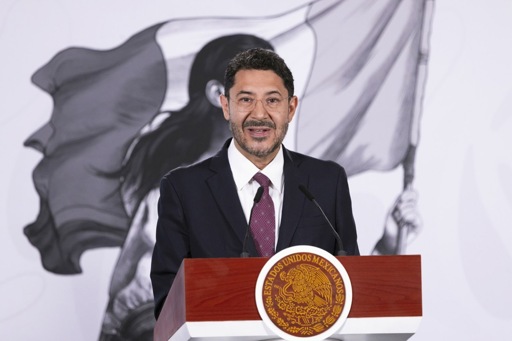
This article by Néstor Jiménez and Alonso Urrutia originally appeared in the June 8, 2026 edition of La Jornada, Mexico’s premier left-wing daily newspaper.
Mexico City. The heads of the Secretariat of Public Education (SEP), Mario Delgado, and of the Institute of Security and Social Services for State Workers (ISSSTE), Martí Batres, declared that the proposal to strengthen Pensionissste and create a public insurer is the “viable option” that can be put in motion at this time to address the teaching profession’s demands. Batres clarified that the 2007 ISSSTE Law cannot be repealed from one moment to the next, since doing so would represent 7 trillion pesos. Meanwhile, Delgado explained that for the education sector in Oaxaca, covering both support for teachers and infrastructure works and scholarships for students, 23.675 billion pesos have been allocated since the start of the current administration.
“We believe that Pensionissste can be a guiding axis, an alternative that is built up progressively. That is the viable option we have at this moment,” the ISSSTE Director General explained this Monday during the morning press conference led by President Claudia Sheinbaum Pardo.
He stressed that “we could not say that the regime of individual accounts can disappear overnight, nor (can) the ISSSTE law be repealed at this moment, because the State cannot take over the individual accounts, since each one has a holder, an owner. And because, on the other hand, the State does not have 20 points of GDP (gross domestic product), that is, 7 trillion pesos that would be needed to constitute a new solidarity-based system.”
In a recap of the actions launched since 2018 to support teachers, the Secretary of Public Education said the first thing done under the previous administration was to repeal the 2014 education reform, which he described as “deeply unjust.” With the first actions of the previous government of former president Andrés Manuel López Obrador, he argued, the role of the teaching profession was revalued and teachers were granted, for the first time, the autonomy to be recognized as professionals of education. Furthermore, “the persecution of teachers that went on for a long time was ended” and “salary policy was completely changed.”
Delgado explained that before 2007, a worker whose last salary was 16,000 pesos a month received on average a pension of 10,560 pesos. But with the 2007 ISSSTE Law, approved during the Felipe Calderón administration, that pension dropped to 4,320 pesos.
With the reform of the previous administration, in which Afore commission fees were regulated, retirees will receive 8,800 pesos; even so, he acknowledged that this was not enough.
In response, the Wellbeing Pension Fund was set up to provide a supplement so retirees would receive the same as their last salary, with a cap set for this year of 17,876 pesos. With this, a worker will receive 16,000 pesos, on top of the Senior Citizens’ pension.
At the same time, he said that in 2007, when the individual-accounts reform began, workers were allowed to remain in the previous system provided they had more than 30 years of service. They could therefore retire at age 58 for women and 60 for men.
Under the current administration, that has been gradually lowered to 53 years for women and 55 for men. President Claudia Sheinbaum’s decree, the SEP head said, effectively removes that extra burden for teachers.
He also pointed out that many complaints had been received about USICAMM because teachers were being assigned to far-away communities.
For that reason, “a great deal of transparency was established” in the June 2025 decree, under which “whoever has the most seniority has first claim when requesting a transfer.” Some 75,000 teacher transfers were approved “without a single complaint,” making it easier for them to be closer to their communities.
The proposal, he said, is to “guarantee the labor rights of workers, to have absolute transparency,” and to ensure it is “safeguarded” against any return of the ways of the past. To that end, teachers will be consulted starting in August, with the aim of crafting an initiative that will be ready for the next legislative session.
-
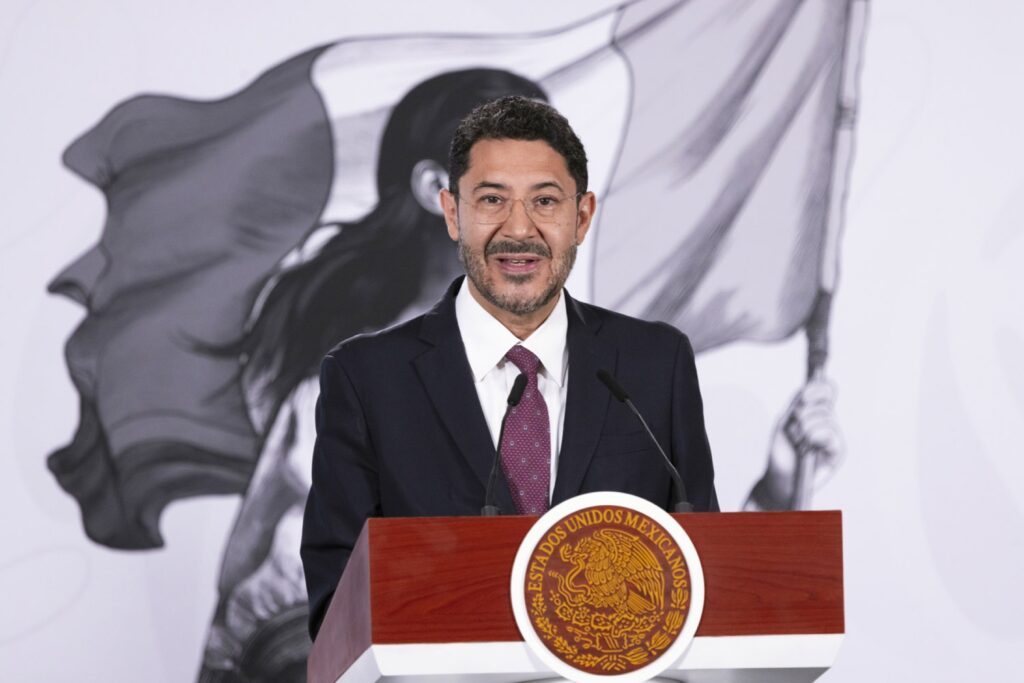
Public Insurer is the Way to Meet CNTE Demands; 2007 ISSSTE Law Can’t Disappear ‘Overnight,’ Batres Says
June 8, 2026
Mexican officials offered a gradual path on teachers’ pension demands: full repeal would cost 7 trillion pesos (20% of GDP), so Pensionissste will grow progressively, with August consultations feeding next session’s bill.
-

Sheinbaum Drives the First Mexican Electric Vehicle: Olinia 1 to Sell for 150,000 Pesos
June 8, 2026June 8, 2026
Sheinbaum took the wheel at the debut of the Olinia 1, a plug-in with 125 km range that goes on sale next summer as Mexico’s bet on building its own electric vehicle.
-

People’s Mañanera June 8
June 8, 2026June 8, 2026
President Sheinbaum’s daily press conference, with comments on
The post Public Insurer is the Way to Meet CNTE Demands; 2007 ISSSTE Law Can’t Disappear ‘Overnight,’ Batres Says appeared first on Mexico Solidarity Media.
From Mexico Solidarity Media via This RSS Feed.