

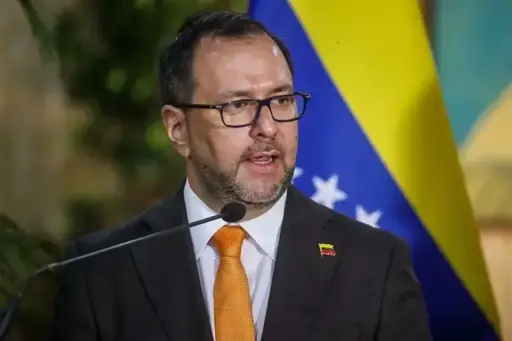
The Venezuelan Government said this Sunday that it has “well-founded doubts” about the process being carried out by the International Court of Justice (ICJ) regarding the territorial dispute with Guyana over Esequibo, after Georgetown assured that the court would rule in favor of the validity of the 1899 arbitral award.
Acting President Rodriguez Reaffirms Venezuelan Sovereignty Over Essequibo Before The Hague: Venezuela Expresses Serious Doubts About ICJ Process After Guyana Statements
“It is striking that the Guyanese authorities magically dare to take for granted the content of a future decision by the International Court of Justice,” the Venezuelan Foreign Ministry said in a statement published on Telegram.
In his opinion, this stance demonstrates Guyana’s “clear disregard” for international law and confirms Venezuela’s “well-founded doubts” about the course of the ongoing process at the ICJ.
Venezuela rejected these statements by the Government of Guyana and reiterated that it has never given his consent to submit the territorial dispute over Esequibo to the jurisdiction of the court.
“Said controversy can and should only be resolved under the Geneva Agreement, that is, through a practical, satisfactory and mutually acceptable arrangement,” it added. Likewise, he insisted that it will not recognize the ICJ’s decision, “whatever it may be.”
#Comunicado La República Bolivariana de Venezuela rechaza firmemente las declaraciones proferidas por el Primer Ministro de la República Cooperativa de Guyana, en relación con la eventual decisión de la Corte Internacional de Justicia sobre la demanda unilateral írritamente… pic.twitter.com/RKtoVYHjk3
— Yvan Gil (@yvangil) June 7, 2026
Guyana’s Prime Minister, Mark Phillips, assured on Saturday that the ICJ, after concluding eight years of proceedings, would rule in favor of the validity of the 1899 arbitral award, in the face of the border dispute with Venezuela over the Esequibo region, a territory of almost 160,000 square kilometers.
Likewise, the Guyanese Prime Minister remarked that the court’s judgment will be legally binding for both Guyana and Venezuela under the United Nations Charter and the Statute of the International Court of Justice.
Delcy Rodríguez, Venezuela’s acting president, defended in May before the International Court of Justice (ICJ) her country’s sovereignty over Essequibo Guyana, emphasizing the 1966 Geneva Agreement as the only valid mechanism to resolve the territorial dispute.
She affirmed that Venezuela will not renounce its rights and that her appearance before the ICJ represents the voice of a people who love justice and international legality, not an act of rebellion.
Venezuela to ICJ: Guyana Seeks to Legitimize Colonial Fraud with 1899 Award
Rodríguez highlighted that the Venezuelan people, through a consultative referendum, ordered the defense of the territory of Essequibo Guyana, which is sought to be achieved through peaceful means and assistance before the International Court of Justice (ICJ) to preserve international legality and show Venezuela’s truth.
She denounced a judicialization strategy by Guyana, driven by the interests of transnational energy companies, seeking unilateral control of the area after the discovery of natural resources.
The Venezuelan vice president presented documentary evidence dating back to 1777, confirming Venezuela’s sovereignty over Essequibo Guyana, emphasizing that it is not just an economic interest, but part of its inalienable historical moral, despite the British blockade that prevents access to key documents for Venezuela.
(teleSUR)
From Orinoco Tribune via This RSS Feed.