

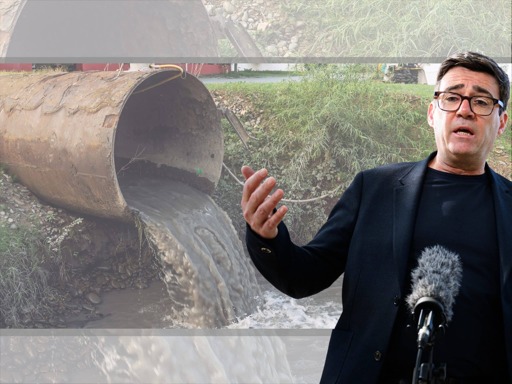

It’s been widely reported that Andy Burnham wants to ‘renationalise’ vital public industries and utilities. This sounds good, because people hate privatisation, and they want the UK to once more own its own assets. The problem, of course, is that Burnham isn’t planning to renationalise anything, as he keeps admitting:
Andy Burnham says we could have a “localised public control option” for Thames Water
What does that mean? Who is in charge? Where do the profits go?
We need nothing less than permanent PUBLIC OWNERSHIP of Thames Water with households, workers and anti sewage groups on the board pic.twitter.com/0s1OT1mMzz
— Cat Hobbs (@CatHobbs) May 23, 2026
Half measures
We observed early on that political commentators and outlets like the Guardian were reporting on Burnham’s plans to ‘renationalise’ utilities. Take the following clip, for example:
Andy Burnham: “I don’t blame anyone who left our party. I don’t blame anyone who voted for other parties”.
“We need to renationalise water, energy and housing.” pic.twitter.com/lS5TXENvXG
— Tory Fibs (@ToryFibs) May 16, 2026
Despite it being presented as a quote, Burnham did not talk about ‘renationalising’ anything in the above; instead he talked about putting utilities under “stronger public control”. Now, Burnham is setting the record straight, with the Times reporting:
He has also spoken of stronger public control over utility companies. “I use that phrase advisedly. People then shorthand it as nationalisation; it’s not the same thing,” he said, pointing to Greater Manchester’s bus services, which are run by private operators.
It’s good that Burnham is using terms “advisedly”, we suppose, but we’d advise he investigates what the public actually wants. As YouGov polling has shown:

Dead-eyed Labour centrists will ask: ‘as long as these services are efficient, what does it matter?‘
It matters because these services will not remain efficient if private operators remain in the mix. If we allow them to retain a stake, they will use their foothold to push for more and more power until eventually they own the lot. We’re seeing this happening in the NHS right now. And we cannot let the fox in the henhouse simply because Andy Burnham is ‘mad for it’.
You do, though
Burnham also told the Times:
Thames Water, for instance, you don’t just say ‘nationalise water’. You could have a localised public control option there.
Sorry, Andy, but we are just saying ‘nationalise water‘, and so is the majority of the public.
We ‘ve reported on scandal, after scandal, after scandal relating to these private water companies; why would we want these proven crooks to retain any degree of control over our most vital resource?
As Hannah Sharland reported for the Canary on 19 May:
the government has so far actively refused to bring Thames Water into special administration. It has repeatedly fallen back on water industry spin to justify pursuing a ‘market-led’ – privatised – solution. Now, ministers and Ofwat are poised to sign a deal that would allow it to dodge fines for the next four years.
If working with private water companies worked, we wouldn’t have to spare them from paying fines; they would simply be able to profit from the service without incurring them.
Burnham — more of the same
Of course, it’s easy to understand why crooked Labour politicians would want private money in the mix. These people are in the same social circles as the fat cats who profit from privatisation, and ‘everyman’ Burnham is literally a graduate of Cambridge University.
We will say this for Burnham, though; he is at least making it clear what he is and isn’t offering. Hopefully people listen to him now so they’re not surprised in 12 months when Labour’s polling is back in the sewer along with Britain’s poorly treated water.
Featured image via Getty Images (Leon Neal)
By Willem Moore
From Canary via This RSS Feed.