

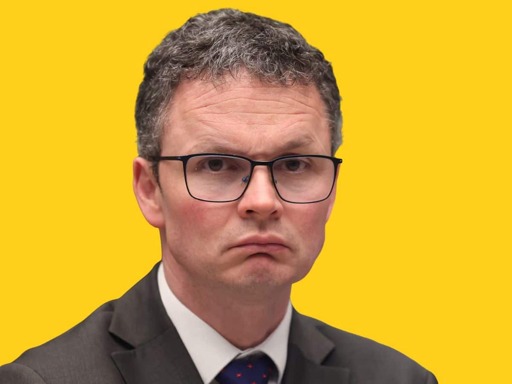

As part of dodgy attempts to affect media coverage he was unhappy with, Fine Gael minister for communications Patrick O’Donovan held a call with Ireland’s media regulator “outside normal communication channels“. He then failed to disclose that the conversation took place.
The Ditch reports that on Saturday April 11 O’Donovan spoke to Coimisiún na Meán’s (The Media Commission or CnaM) Rónán Ó Domhnaill to:
…express concern regarding media coverage of the fuel protests and to ask whether there was a mechanism for the minister within the legislation to ask for an examination of the broadcast coverage of the protests.
The protests in early April were led by hauliers and farmers opposed to the rising cost of fuel. The recent spike in prices has been caused by the US-‘Israeli’-led illegal war on Iran, and the latter’s perfectly reasonable response of closing the Strait of Hormuz, a vital oil corridor. Ireland’s government carries a share of the blame in this, due to its role in weapons shipments for the aggressors, and its failure to criticise the mass murder taking place.
Ireland — Minister likely broke EU law on press interference
Rather than accept this failure, O’Donovan — likely breaching EU rules on ministers pressuring media – sought to shift the narrative in press coverage. The Ditch note that O’Donovan complained about:
…“a lack of balance” in an RTÉ radio broadcast that included three opposition spokespeople and one government representative and “Prime Time interviewing protestor James Geoghegan in a gentle way”.
An internal note from CnaM reported that O’Donovan said:
…the media only giving the side of the protestors in their news reports, and not the victims of the blockades.
O’Donovan also bemoaned:
…a journalist broadcasting from a protest from inside an unauthorised portacabin belonging to protestors.
The latter seems an entirely reasonable thing for a journalist to do as a means of conveying the reality of a protest environment. The public clearly thought RTÉ’s coverage was adequate, with the broadcaster only receiving nine complaints following the protests’ main period.
O’Donovan went on to say on Monday April 13 that he was intending to speak to Coimisiún na Meán about his dissatisfaction on fuel protest reporting. He failed to declare that he’d already been jockeying behind the scenes via that informal phone call to find a way of pressuring media organisations.
Those public comments had already generated furore, with National Union of Journalists assistant general secretary Séamus Dooley describing them as “sinister and deeply disturbing.” Dooley said:
The Media Minister is not a bystander but is in a position to influence the allocation of funds, the approval of commercial radio licenses and overall policy on broadcasting.
It is not his role to dictate to the independent regulator or to apply pressure on media organisations. RTÉ is a public service broadcaster not a State broadcaster and is independently regulated in the interests of democracy. You cannot have a ‘slightly independent’ public service broadcaster.
O’Donovan’s ‘Trumpian’ attacks on the media
Dooley continued:
There’s no place for Trumpian ad hominem attacks on journalists and the Minister’s comments have caused genuine concern.
Upon hearing of O’Donovan’s phone call, Dooley told The Ditch that the minister “crossed a line by phoning the commissioner”. He also said:
…individually and collectively commissioners should not be subject to political pressure of any type.
O’Donovan dodgy campaign wasn’t without success, however, as The Ditch report that he managed to extract “two concessions from the regulator“. The minutes from the department of culture, communications and sport, stemming from a subsequent Tuesday April 14 meeting with CnaM, reveal that the commission will:
…”examine the issue of broadcasters producing an anonymised schedule of complaints on an annual basis” and “will provide a briefing to the minister on their work on protecting democracy”
The minutes also failed to mention the minister’s Saturday phone call with commissioner Ó Domhnaill.
EU regulations stipulate that:
Member States shall respect the effective editorial freedom and independence of media service providers in the exercise of their professional activities. Member States, including their national regulatory authorities and bodies, shall not interfere in or try to influence the editorial policies and editorial decisions of media service providers.
Given ministers are high-profile figures whose words frequently receive wide circulation, any public statement commenting on press coverage would amount to a move to “interfere in” or “influence” media. Phoning up commissioners on a Saturday outside formal channels is a further step beyond that, and neglecting to report said phone call merely compounds the misconduct.
If the minister wants nice things said about him, maybe he should focus on ensuring his government change policy away from warmongering and impoverishing its own citizens, rather than complaining when the press reports on the consequences of those disastrous decisions.
Featured image via the Canary
From Canary via This RSS Feed.